Public service reminder: it happens 26 minutes and 43 seconds into the movie. In Home Alone 2: Lost in New York (1992) – a festive favourite for many families – Kevin McCallister (Macaulay Culkin) is in the Plaza Hotel in New York and bumps into its then-owner: Donald Trump.
He asks the future president, not yet orange-crested, where he might find the lobby. “Down the hall and to the left,” replies Trump. He doesn’t praise Kevin on the “incredible job” he is doing, accuse him of being “garbage” or have him arrested by ICE. That all lies in the future.
In fact, this is only the best-known of Trump’s many movie cameos. Before he became the leader of the free world, he made brief appearances in The Little Rascals (1994), The Associate (1996), Celebrity (1998), Zoolander (2001), and Two Weeks Notice (2002). Sometimes – in the case of Scent of a Woman (1992), for instance, and Wall Street: Money Never Sleeps (2010) – what he presumably called his “beautiful scenes” didn’t make the final cut.
It is in this context that the president’s deep fascination with the battle for Warner Bros Discovery between Netflix and Paramount Skydance should be understood. For Trump is obsessed by Hollywood and the movies. True, a single showbusiness deal is hardly the Ukraine conflict, peace in the Middle East, or the US affordability crisis. The difference is that Trump really cares about this stuff.
So much so, indeed, that he seriously considered going to USC’s film school and tried, as recently as 2012, to found Trump World Studios in Florida. “I was attracted to the glamour of the movies,” he says in The Art of the Deal (1987), “and I admired guys like Sam Goldwyn, Darryl Zanuck and most of all Louis B Mayer.” His personal Mount Rushmore bears the faces of these moguls, rather than Washington, Jefferson, Lincoln and Theodore Roosevelt.
The fixation with tinsel town has not been diminished by the presidency. In a speech in Colorado Springs in February 2020, he let rip at the Oscars: “By the way, how bad were the Academy Awards this year? Did you see it? And the winner is a movie from South Korea [Parasite]. What the hell was that all about? We got enough problems with South Korea with trade – on top of it they give them the best movie of the year! Was it good? I don’t know yet… Can we get Gone with the Wind back, please? Sunset Boulevard. So many great movies”.
Even before his second inauguration, he appointed three “special ambassadors” to Hollywood: Sylvester Stallone, Jon Voight and Mel Gibson. In May, he posted on Truth Social that the foreign movie industry represented “a National Security threat”, promised to impose “a 100% Tariff” on overseas films (yet to be implemented) and declared: “WE WANT MOVIES MADE IN AMERICA, AGAIN!”
Meanwhile, Trump personally lobbied his friend and supporter Larry Ellison, whose son David is the CEO of Paramount Skydance, to ensure that Rush Hour 4 secured a studio deal (its director Brett Ratner has been accused of sexual misconduct but recently made a documentary about Melania Trump for Amazon, set to be released on January 30).
On December 7, at the Kennedy Center Awards in Washington – remember, Trump now chairs the center – he said that he would be taking a personal interest in the fate of the $83bn Netflix bid to buy the Warner Bros studio and HBO Max. “I’ll be involved in that decision, too,” he said.
This presidential intrusion, needless to say, is totally inappropriate. If, as many in the entertainment industry object, the sale would give Netflix too great a market share, it could indeed be scrutinised by the antitrust division of the Department of Justice. But since Pam Bondi, the attorney-general, is a devoted acolyte of Trump, it will, in practice, be the president who holds the veto.
It is also worth noting that David Ellison was in Trump’s box at the awards ceremony. On the following day, Paramount Skydance launched a hostile $108bn bid for the whole of Warner Bros Discovery – including all its television networks. The $30-a-share cash offer is backed by Gulf money and by Affinity Partners, the private equity firm led by Trump’s son-in-law, Jared Kushner.
Whichever bid prevails – and more may follow – this auction will be one of the most consequential in the history of Hollywood. Though Amazon has owned MGM since 2021, success for Netflix would be a transformative moment in the entertainment industry, giving a tech platform control of perhaps the most prestigious legacy studio – responsible for Casablanca (1942), A Streetcar Named Desire (1951), 2001: A Space Odyssey (1968), All the President’s Men (1976), Goodfellas (1990) and The Dark Knight (2008) – as well as the HBO brand, which has contributed more than any other to the golden age of prestige television (The Sopranos, The Wire, Curb Your Enthusiasm, Succession, Game of Thrones, The White Lotus).
Its streaming service HBO Max also has 130 million subscribers to add to Netflix’s 300 million – a potential aggregate 30% market share which, as Trump noted, “could be a problem”. The streaming service’s co-CEOs, Ted Sarandos and Greg Peters, have argued that such metrics do not reflect the growing dominance in the war for eyeballs of YouTube which already commands 13% of all viewing hours in the US.
Not surprisingly, Sarandos has worked hard to cultivate a good relationship with Trump, who has reciprocated his flattery. “I think, in the history of Hollywood, there’s really been, almost, you could say, nothing like what he’s done,” the president said at the Kennedy gala. “You’d go back to Louis B Mayer, maybe, Metro-Goldwyn-Mayer, MGM. Ted has done an incredible job”.
It is certainly true that the rise of Netflix from a mail-delivery DVD rental service to an entertainment giant is an extraordinary tale of industry disruption. But film-makers are considerably less enthusiastic than Trump about the direction of travel, principally because Sarandos is no friend of theatrical release for movies. Hollywood directors and cinema chains want to preserve a so-called “window” of at least 45 days between a film’s launch in movie houses and its appearance on streaming platforms.
Sarandos has said that the “window” has to “evolve” – code, to many, for “wither and die”. On this basis, the sale of Warner Bros to Netflix could spell the end of the age of cinema that began with nickelodeons in 1905 and prefigure, except for those prepared to pay very high ticket prices, the decline and fall of the movie-going experience.
It is hard to believe that Trump cares very much about ordinary cinema audiences. But he certainly does care about the news and who owns it. What may sway the auction Paramount’s way is the fact that the Ellisons want to buy the full portfolio of Warner Bros cable channels – including the network that MAGA regards as the “enemy within”, CNN.
“I think CNN should be sold,” said Trump on December 10, “because I think the people that are running CNN right now are either corrupt or incompetent.”
If successful, Paramount would almost certainly fold the channel into the CBS News empire already being made more Trump-friendly under the editorship of Bari Weiss. This, in turn, should alert us to a core feature of our hypermodern age: that news is increasingly a mere subdivision of the entertainment industry.
Suggested Reading
Mar-a-Lago Face: the new Trump uniform
In addition to the existing studio control of CNN and CBS, ABC News is owned by Disney, while NBC and MSNBC are part of NBCUniversal. Ironically, Fox News is now the outlier, since its detachment from 21st Century Fox’s film and TV studios in 2019, remaining part of the Murdoch family’s conventional media portfolio.
In the UK, we still think it is a pretty big deal that the Daily Mail’s parent company may soon control the Telegraph titles. Contrast, then, the awesome command over the US media exercised by the seven members of the Motion Picture Association: Disney, Paramount, Sony, Universal, Warner Bros, Netflix and Amazon.
Not for nothing are these mega-corporations compared to the “five families” in The Godfather. Between them, they control much of the information supply to the most powerful democracy in the world. They are also exposed across multiple commercial sectors, which makes them vulnerable to governmental pressure.
It is no accident that ABC News paid $15m to Trump’s presidential library fund to settle a defamation suit over remarks made by George Stephanopoulos; or that CBS News stumped up $16m over an allegedly misleading edit of a 60 Minutes interview with Kamala Harris. Small wonder that the president is suing the BBC for $10bn over ill-judged splicing of footage in an episode of Panorama: he has grown used to broadcasters bending the knee (though his chances of squeezing money from the Beeb are minimal).
It is now commonplace – in a way it was not 10 years ago – to acknowledge that politics is downstream from culture. In Trump’s case, the two are inseparable: not only because of his role as host of NBC’s The Apprentice for 14 seasons but because he is so visibly at home in the arena of American popular entertainment and sports: comedy roasts, the UFC, the WWE, Nascar, and the longform bro shows of “Podcastistan”.
The unconventional appeal of his “weave” style of oratory has long been recognised by stand-up comics such as Jim Jefferies, Shane Gillis and Dave Chappelle. For Trump, showbusiness is not a side-hustle away from politics. It is politics. State power and showbusiness might are inextricably entangled.
Suggested Reading
Trump’s new war on Europe
Again, it is Paramount that has been most attuned to this cultural shift, as the home to Taylor Sheridan’s mighty slate of “red state”, MAGA-adjacent shows: Landman, now in its second season; Tulsa King (a late-career vehicle for Stallone); Special Ops: Lioness; Mayor of Kingstown; and – above all – Yellowstone and its multiple spin-offs, more of which will be released in 2026.
In the original Yellowstone, now concluded after five seasons, Kevin Costner plays the patriarch of the Dutton ranching dynasty, appalled by the coastal elites and property developers preying upon the American heartland. “This is America,” he roars at a busload of Chinese tourists. “We don’t share land here.”
The huge success of Sheridan’s shows continues to baffle the New York Times, but is emblematic of the broader front upon which MAGA is fighting its culture war. As long ago as 1992, the conservative film critic Michael Medved, now 77, raged in his book Hollywood vs America against the spiritual emptiness and contempt for traditional values of mainstream movies.
“Tens of millions of Americans now see the entertainment industry as an all-powerful enemy,” Medved wrote, “an alien force that assaults our most cherished values and corrupts our children. The dream factory has become the poison factory.”
Though Trump would put it more demotically, he is similarly hostile to what he sees as Hollywood’s wokery and irredeemable liberalism. “What they’re doing with the kind of movies they’re putting out,” he said in August 2019, “it’s actually very dangerous for our country”. In April, when asked about China’s decision to reduce the number of US films released in its cinemas, he made a joke of it: “I think I’ve heard of worse things.”
Intuitively, the president grasps the brute reality that the battle for control of American popular culture will have a much greater impact upon the future trajectory of the nation’s politics than the latest book by Ezra Klein or Jill Lepore. Which is why he is so personally invested in the fate of Warner Bros and the battle between Netflix and Paramount. It will be a cornerstone of his legacy. What Americans watch, experience and listen to matters much more to him than the narrow business of public policy.
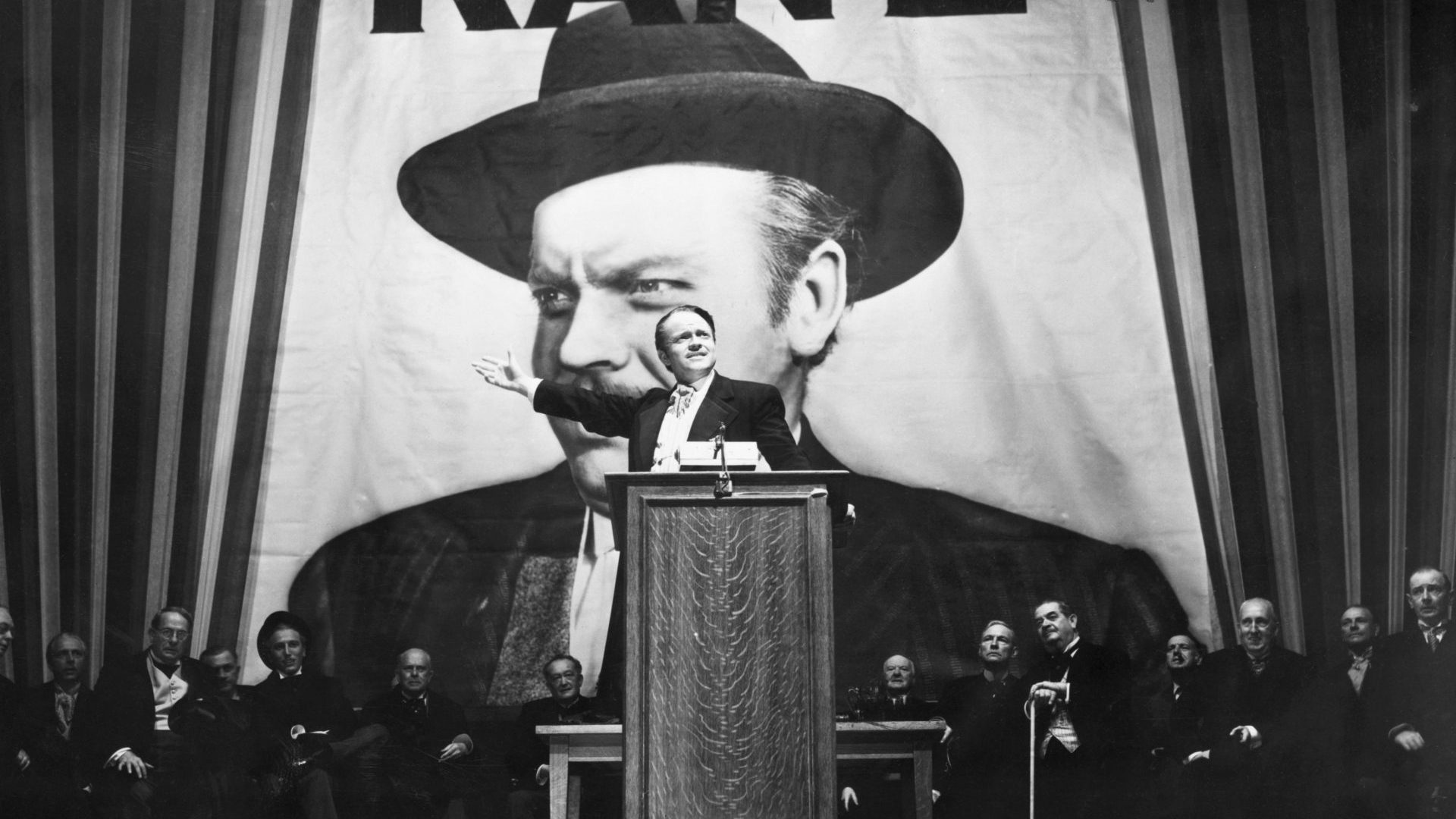
Unlike Medved, he has no problem with violent movies: Bloodsport (1988), starring Jean-Claude Van Damme is one of his in-flight favourites, often accompanied by a huge bucket of popcorn. But the film he loves most is Orson Welles’s Citizen Kane (1941).
Mar-a-Lago, naturally, is his very own counterpart to Charles Foster Kane’s Xanadu. Much like Trump in The Apprentice, the fictional tycoon ends up saying to his best friend Leland (Joseph Cotten): “You’re fired!” As for politics: Kane fails in his bid to be governor of New York. But Trump forgives the character.
“It was a great rise in Citizen Kane,” he has said. “And there was a modest fall.” A modest fall? Has he not reflected upon the dying Kane murmuring “Rosebud”? Has he grasped what Welles was saying about the wages of narcissism and avarice?
Of course not. It is so characteristic of the president that he should miss the point of one of the greatest movies ever made: that he sees Welles’s cautionary tale as a playbook for future moguls. He misunderstands the grace, humanity and subtle potential of the very art form he claims to love most. But there you go: that’s entertainment!
Happy Christmas.