
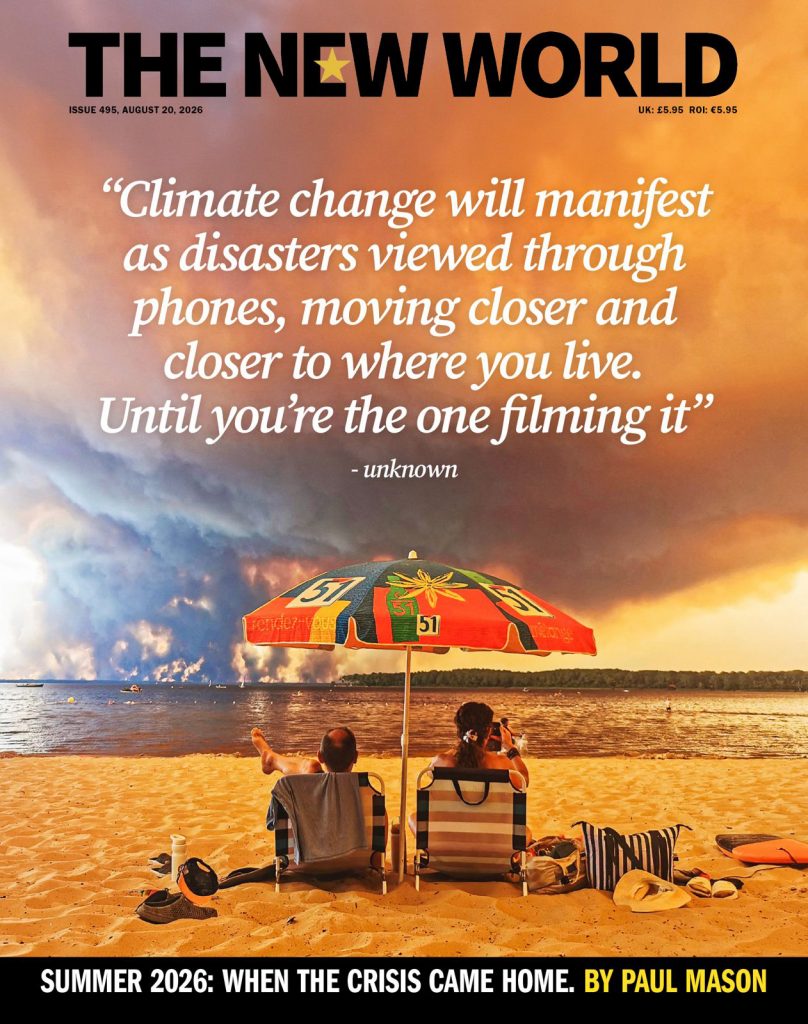
Re: “The climate crisis is coming to your kitchen” by Paul Mason, TNW #495
Paul Mason neatly summarises the necessary change for which consensus is building. To paraphrase: “[To move towards] a post-neoliberal society, [we need] to ask: how can I help?”
We have everything we need to move to a sustainable future, with rich, satisfying and long lives. But not by continuing to live as we do now.
The chance of a better future is made more possible by the multi-faceted changes in our use of technology, by better democratic processes, and by the improvements in land use that will get us there.
Paul Dabinett
I often think of a future where we reclaim farmland for housing. And turn smaller farmland plots into high-rise farms producing fruit, veg and (fake) meat as efficiently as possible.
Simon Tomes
Does Paul Mason realise that, by flying from London to Edinburgh, he is part of the problem?
Perhaps he could consider the train from city centre to city centre; at four hours 10 minutes a quicker, more convenient and sustainable form of travel.
Richard May
Cottenham, Cambridge
Re: “14 reasons to love our terrifyingly intense British summer” by Jonn Elledge, TNW #494
We could end the national argument about air conditioning by one simple regulation: all air-con units should be required to be solar powered, and the sale of those with a three-pin plug should be banned, along with the ridiculous disposable barbecues.
And our summer suggests a few other simple rules that Andy Burnham could bring in:
All new roofs to have solar panels (a warehouse without a single panel should be considered a crime); all energy suppliers to be required to install “smart” meters, and to pay an in-out tariff for the power generated and supplied to the grid; all new-build homes to be fitted with sash windows – a brilliant Victorian idea that guarantees air circulation; impose heavy fines on water companies for having a hosepipe ban, or for a loss of supply (that’ll make the value of the shares drop like a stone, then the government can buy them back).
I’ll bet other readers can suggest more quick and simple changes that might be made.
Peter Tyzack
Severn Beach, Gloucestershire
Re: “The Democrats’ secret plan to elect JD Vance” by Matthew d’Ancona, TNW #495
If, as Matthew D’Ancona has said, JD Vance has found his “path back to religion”, then it is a “religion” that any decent human being should not touch with a barge pole. It is the “religion” of snatching defenceless people off the street, of murdering protesters and bombing civilians, to name but a few of its most egregious traits.
To characterise Vance as some deep reflective thinker lends an unmerited gravitas to someone whose credo is his own self-service, which is why he fits in so neatly with Trump & Co.
Andrea D’Ambra
Re: Alastair Campbell’s Diary, TNW #495
Alastair’s friend Justin Welby is right to tell him, “You may not do God, but God does you”. There’s a time and a place for us all; mine was 2000, after several decades of proud atheism… still surprises me daily.
Andrew Rogers
Re: “Where’s the suicidal empathy now?” by Sunder Katwala, TNW #495
I was born in the UK and am black. I had wanted to become an academic. My experience of studying at Oxford as an undergrad soon put paid to that. The number of white, male academics found guilty of plagiarism who still have tenure beggars belief and extends well beyond Oxbridge. There’s one rule for the “old boys” and another, far harsher one, for everybody else.
Miya Knights
I was at Gonville and Caius College in Cambridge from 1953 to 56, and one of my best friends was a guy called Gideon ben Tovim, who as you may guess wasn’t a Christian.
He had a scholarship, which obliged him to say a long Latin grace before dinner for a week in each term. On the Monday he broke the record for saying it in the shortest time, on the Tuesday he broke the record for saying it in the longest time. When he said it in a strong Yiddish accent on the Wednesday, the college authorities finally excused him from saying grace.
Though nothing like as serious as the Jason Arday case, this memory demonstrates that bias against racial minorities in Cambridge is not new.
Tim Fell
Suggested Reading

Sorry Andy – Manchester and ‘the north’ aren’t the same thing
Re: “Does Andy Burnham really understand the other north?” by James Ball, TNW #495
Andy Burnham is a well-intentioned person, able to empathise with the conditions that have harmed people in certain areas, from Cornwall to many parts of the north.
Given that much of the damage has been Thatcherite in the making, undoing it and repairing these communities is going to be long and arduous.
None of the populists can help these places as they are self-interested, largely devoid of the skills required to address long-term decline, and clearly illustrate when given the opportunity to govern that they lack the diligence necessary.
Keith Brisley
Re: “The challenges of swimming pool centrism” by Marie Le Conte, TNW #495
Marie, you shouldn’t spurn wild swimming. There is no other freedom quite like it.
I swim with my family in a tributary of the Trent, near Ashbourne in Derbyshire. Below the weir is a millpond. In common with all its kind, at one end it is shallow for children, and gets deep enough for adult swimming near the weir.
But the greatest gift is the water! It’s like swimming in silk. Swimming-pool water is filled with chemicals. The sea is always knocking you over, and tastes horrible. A gently flowing river is the best.
Nick Wigg
Ripley, Derbyshire
BELOW THE LINE
Re: “Now that’s what I call the best music books ever!” by Paul Hanley, TNW #495:
Paul Hanley rightly says many music books are dull; one reason is that so many of the “great” artists have the same story; the postwar, lower-middle-class upbringing.
So some great books are of those who do not meet the above background. For that reason, I’d throw in Eternal Troubadour by Justin Martell, about the life of Tiny Tim, as well as Gilles Verlant’s exhaustive Gainsbourg.
Perry Hewitt
Paul Hanley should have included his brother Steve’s The Big Midweek. Clearly written, open, honest and humorous.
Mike Noon
Re: “The strange death of sex in the movies” by John Bleasdale, TNW #495:
I have just finished viewing My Beautiful Career on Netflix. There is a remarkable scene where what thrilled me was the cut to Frank’s facial expression – thrilled, excited and proud as Sybylla explodes in orgasm.
You rarely see a man’s face during a sex scene – usually just his bum.
Angela Weight