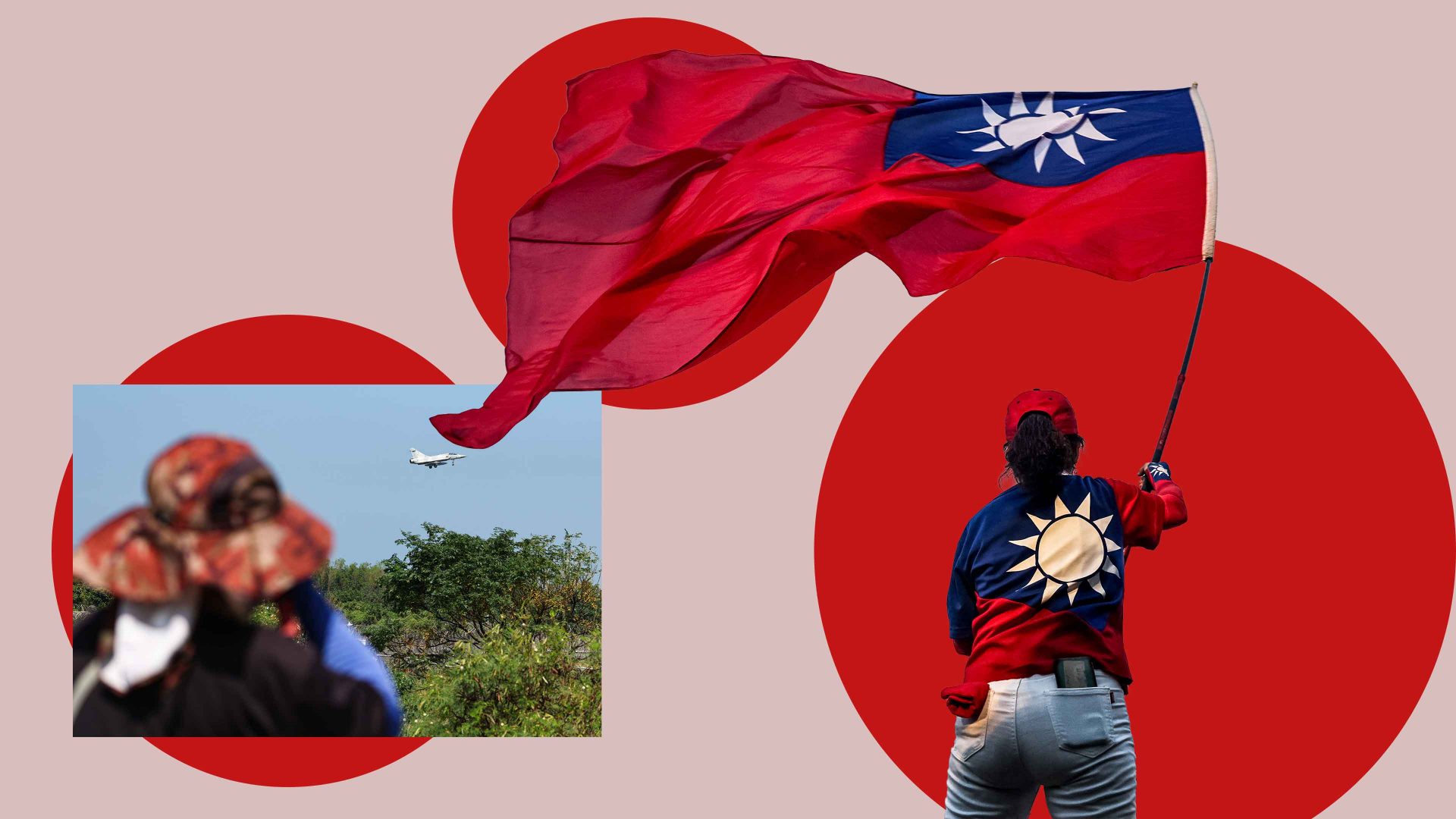
1. The island we call Taiwan lies around 100 miles from the south-east coast of China. It is home to 24 million people, a third of them in and around the capital, Taipei. It produces the majority of the world’s most advanced semiconductors and computer chips, an industrial footprint some countries would quite literally kill for; and by far its largest trading partner is the giant that lies across the South China Sea. That is about as far as consensus reality goes.
2. One source of contention is the name. Although we generally refer to the island as Taiwan, it was historically known as Formosa – from the Portuguese llha Formosa; “beautiful island” – and is officially, for reasons we’ll get to, the Republic of China. It’s sometimes referred to by the synecdoche Taipei or often, by diplomats and international bodies, as Chinese Taipei. But “Taiwan, China” and “Taipei, China” are off limits – because they’re seen as linguistic support for a Chinese territorial claim over an island that does not want to be Chinese.
Suggested Reading

Nerd’s Eye View: 16 things you need to know about sharks
3. Beijing’s claims that Taiwan has been Chinese since “ancient times”, in fact, look pretty questionable. For a long time the island was mainly home to indigenous Austronesian tribes, and although there was some Han Chinese settlement during the Middle Ages, it only became part of the Chinese empire after a stint as a 17th-century Dutch trading colony.
4. Some analysts say the inhabitants saw the Qing – the last imperial Chinese dynasty – as a foreign colonial regime, and did not conceive of themselves as Chinese at all. Taiwan only officially became a province of China in 1887. Eight years later, it was passed to a different empire entirely, after China lost the first Sino-Japanese war.
5. Taiwan remained in Japanese hands for much of the long Chinese civil war, which raged for more than two decades from 1927, and only reverted to China as part of the post-second world war settlement in 1945. This proved useful for General Chiang Kai-shek’s nationalist forces, because it gave them somewhere to flee to when they lost to the communists.
6. After the war, the nationalist regime running Taiwan was confusingly known as the Republic of China (RoC), to distinguish itself from the People’s Republic of China in Beijing. Both refused to have diplomatic relations with countries that recognised the other.
7. By the 1970s, though, it had become clear that – while both sides’ claims to exercise full sovereignty over both island and mainland were silly – Beijing carried a lot more weight than Taipei. In 1971, a vote in the UN General Assembly “recognised the People’s Republic of China as the only legitimate representative of China to the United Nations”, and expelled representatives of the RoC. In 1978, the US – one of the minority of countries that had voted against – also switched diplomatic recognition from Taipei to Beijing, as part of its efforts to normalise relations with the PRC.
8. Beijing has tried to conflate this “one China policy” with its own “one China” principle – the assertion that Taiwan is an integral part of China – and has blocked its participation in international organisations. This is why the UK, like most countries, does not recognise Taiwan as a sovereign state. Instead, it conducts its diplomatic relations with the island through the British Office Taipei, not an embassy.
9.Since the 1990s, Taiwan has transitioned into a stable, liberal democracy with a vibrant civil society. Polls show a shrinking number of the island’s inhabitants now identify as Chinese: although the majority of them are Han Chinese in origin, most are descended from settlers who arrived centuries ago.
10.Beijing’s policy remains “reunification”. Its military is of an order of magnitude larger than Taiwan’s – and some analysts believe it is working to a deadline. Don’t have nightmares.