
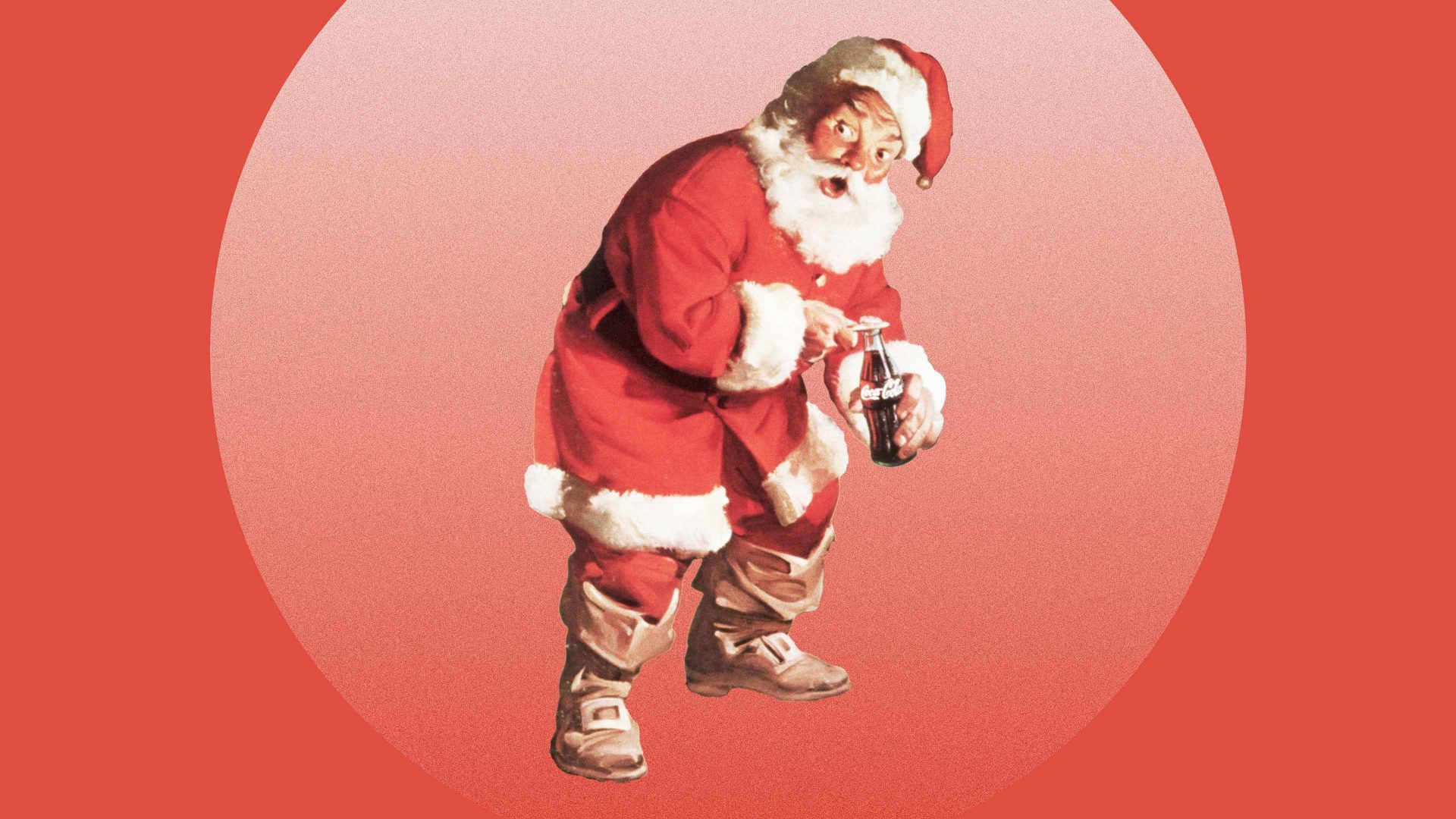
1. St Nicholas was purportedly the bishop of Myra, in what is now Turkey but was, in the fourth century, a Greek-speaking bit of the Roman empire. One day, so the story goes, he learned of three sisters who couldn’t afford dowries, and – to spare them from a life of prostitution, and their father from some mild embarrassment, which is just as bad – started secretly leaving them gold. This, following a fair bit of cleaning up, became a story about a nice old man who brings toys for children.
2. “Santa Claus” is a variant of the Dutch name for St Nick, Sinterklaas. The original Sinterklaas isn’t actually much like Santa – he arrives by boat from Spain in mid-November, accompanied by Zwarte Piet (“Black Pete”), a helper dressed in what is euphemistically described as “Moorish attire” and (there’s no easy way of saying this) blackface, before distributing presents on December 5. His name, though, was brought to the Americas by Dutch settlers in New Amsterdam and anglicised after the British showed up and turned it into New York.
3. St Nick’s work was popularised in North America by the 1823 poem A Visit from St Nicholas, probably written by Clement Clarke Moore but possibly not (I’m not going there). Its portrayal of a jolly, fur-clad fat man, travelling on a flying sleigh pulled by reindeer, became – via Hollywood, Coca-Cola adverts etc – the most popular image of the Christmas gift-giver throughout the world.
4. Not just in America, either. Today, Rovaniemi airport in Finland styles itself as the “official airport of Santa Claus”, even though, as we’ll see, the Finns have entirely different ideas of Christmas tradition.
5. Santa Claus was not, originally, the same as Father Christmas. The traditional personification of Christmas in England was bearded and robed, but started out as a symbol of adult feasting and merry-making and came dressed in a crown of holly. As the 19th century wore on and Christmas became more focused on children, though, he became increasingly identified with Santa, until today they’re synonymous.
6. It’s a reminder that Britain is closer to Europe than America that French children get their prezzies from Père Noël or, sometimes, Papa Noël. They leave their shoes by the fireplace stuffed with carrots and other treats for his donkey, Gui (“Mistletoe”); when they wake up, if they’ve been good, said carrots have been replaced by presents. Gifts must thus be small enough to fit into a shoe, which obviously places a limit on the chances that Père Noël will bring you La PlayStation.
7. Chilean children get their presents from Viejito Pascuero. He’s really just Santa again, but worth noting because, while the name is generally translated as “Father Christmas”, it literally means “Old Man Easter”.
8. Not every tradition relies on a Santa variant. Martin Luther, the German theologian who kicked off the Reformation in 1517, promoted the idea that gifts were brought by baby Jesus himself, in a transparent attempt to ensure that no one forgot what Christmas was really meant to be about. The generous holy tyke is known as Christkind in German, but Gesù Bambino in Italian, Ježíšek (”Little Jesus”) in Czech, Niño Dios (”God child”) in Latin America and so on.
9. In Iceland, meanwhile, presents are brought by the Jólasveinar, or “Yule Lads”: the 13 prank-loving sons of a pair of child-eating giants who visit one by one over the 13 nights before Christmas and leave presents in shoes left on windowsills. If the child has been naughty, they leave a potato instead, which one can only assume must symbolise the vegetables the child can expect to be cooked with.
10. The Russian equivalent of Santa Claus, Ded Moroz (Grandfather Frost), has his roots in pagan Slavic mythology. He dresses in a long fur coat, carries a magic staff, and unlike most equivalent figures is accompanied by a woman, his granddaughter the Snow Maiden. They bring presents on the New Year’s holiday, which replaced Christmas during the anti-religious Soviet era.
11. The nisse is a diminutive, white-bearded household spirit, who wears a red cap and looks a lot like a garden gnome. Since the mid-19th century, as Santa Claus became more popular worldwide, such gnomes increasingly brought presents to the people of Scandinavia, displacing…
12 …Julbocken/Joulupukki, the “Yule Goat”, whose beat is Sweden and Finland, and which seems to have its origins in the pagan tradition that thunder god Thor’s chariot was drawn across the sky by a pair of goats. Once upon a time, the goat was scary and demanded you give it presents; then it was nice and gave them out; now it’s basically just Santa, but mystifyingly named after a goat.
13. Possibly the weirdest Christmas tradition of all is the Catalan Tió de Nadal, or “Christmas log”: a grinning bit of wood that children are expected to care for and feed in the run-up to Christmas, before beating it on Christmas day until it, er, poos presents. Only small ones, though – sweets and the like – as big ones will be brought by the three wise men on January 6. So don’t go blaming your poor log care for the fact you never got that Scalextric you asked for.
Suggested Reading


Nerd’s Eye View: 12 things you need to know about Copenhagen
Demre
Modern Turkish name of Myra, the Lycian town where St Nicholas was bishop
1823
First publication of the poem A Visit from St. Nicholas, also known as ’Twas the Night Before Christmas
1863
Harper’s Weekly prints a cartoon by Thomas Nast showing Santa distributing presents to soldiers fighting in the union army
1930
Fred Mizen paints Santa in Coca-Cola corporate colours to promote a popular brand of soda. They stick