
1. Tantalisingly little is known about the origins of human speech. Nonetheless, humanity’s unique capacity to use the mouth and respiratory system to make a range of noises complex and sophisticated enough to give us, say, Monty Python’s dead parrot sketch, or the Gettysburg address, seems to have evolved at least 100,000 years ago.
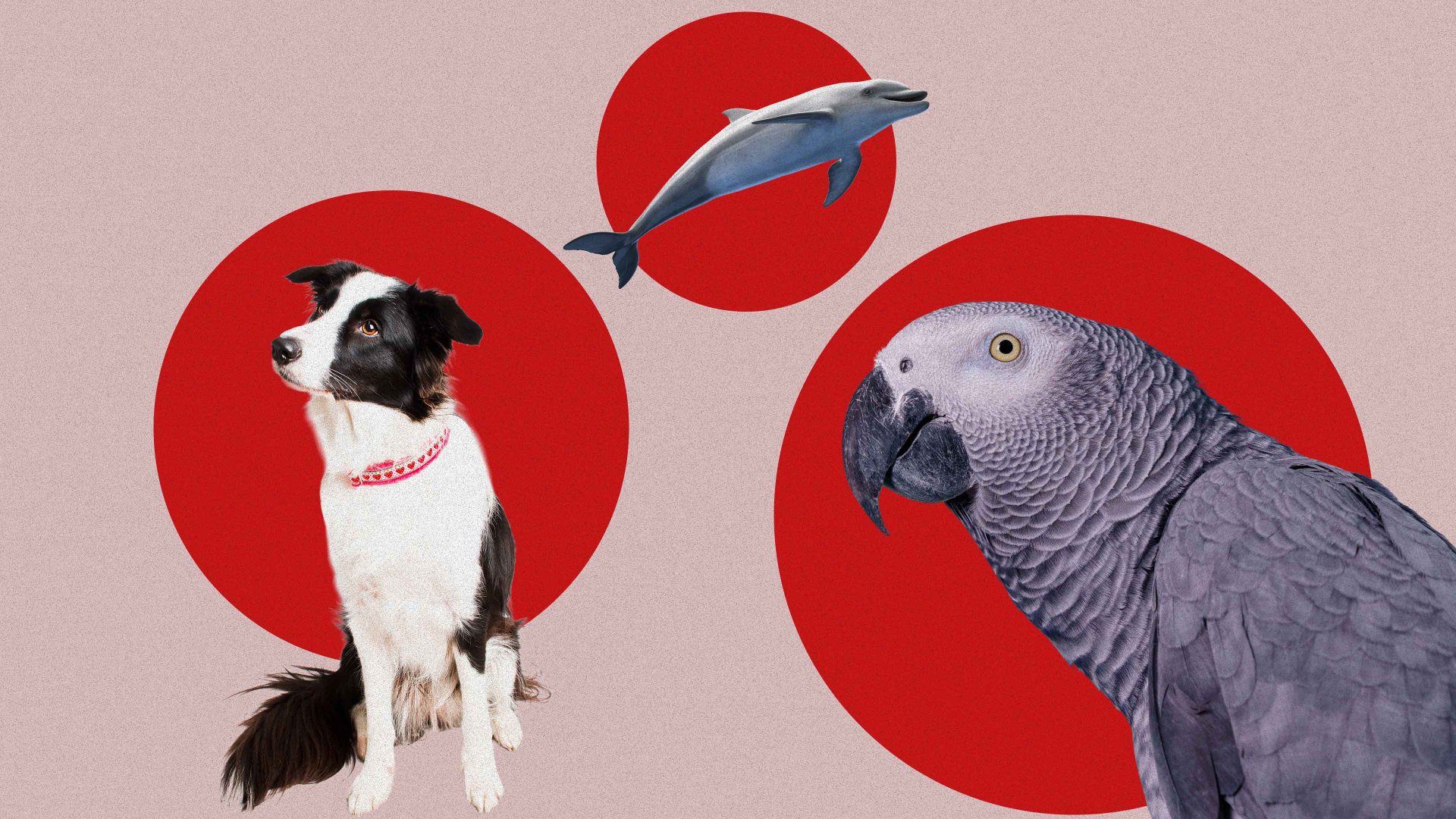
2. Anyone who has ever lived or worked with an animal could tell you that they can also communicate rather a lot. Dogs, which have been evolving alongside us for more than 20,000 years, are perhaps the best placed to understand human language: a 2022 study found that the average canine pet could understand an average of 89 words.
3. A South Carolina-based border collie named Chaser (2004-2019) has gone down in history as the smartest dog in the world, after demonstrating an understanding of over 1,000 words. And just this month researchers from the – I promise this is real – Clever Dog Lab at the University of Veterinary Medicine Vienna found that some particularly intellectual pups could pick up words simply by listening in on conversations.
4. Recent years have seen attempts to teach dogs to “speak”: the confusingly named Bunny, a sheepadoodle, has amassed two million Instagram followers during her participation in the University of California, San Diego’s TheyCanTalk study. Videos show her using a system of buttons to express complex “sentences” like “stranger paw ouch” (she’d trodden on a thorn).
5. Other creatures do not need buttons because of their natural talent for mimicry. Since 1995, a budgie, named Puck, has held the Guinness World Record for largest avian vocabulary, with 1,728 words. Some experts believe this to be more than shadow home secretary Chris Philp.
6. Other animal-human communication experiments have involved either sign language (with primates) or whistling (with dolphins, who have never quite got the hang of the hand gestures). One of the most famous was Washoe the chimp, who learned 350 words of American Sign Language. In one famous interaction, after a keeper explained a lengthy absence by telling her she’d had a miscarriage (“I lost my baby”), Washoe replied by tracing the path of a tear down her face – the sign for “cry”.
7. Then there was Koko the gorilla who in 1983 asked for a kitten for Christmas; on being presented with a toy, she made clear she meant a real pet kitten. Another subject of a language experiment, Nim Chimpsky (geddit?) also loved cats, although on at least one occasion documented in the 2011 film Project Nim, this was rather more literal than one would ideally hope.
8. Some linguists have dismissed the results of such experiments. Science requires replicable results and experiments that involve working with individual animals for years, even decades, and are by their nature difficult to repeat.
9. Another issue is the “Clever Hans” effect, named after a horse who, in the early 1900s, was seemingly taught by his trainer to answer simple arithmetical questions by tapping his hooves. Alas, it turned out that, when Hans couldn’t see the person asking the questions, he no longer knew the answers. He had learned to pick up on human body language that the questioners didn’t even know they were expressing, which, to be fair, seems pretty clever in itself.
10. One animal whose facility with human speech seems to have been genuine was a parrot whose name was short for “avian language experiment”. Over 30 years, Alex the African grey learned colours, shapes, and concepts like “bigger” and “smaller”, “different” and “same”. Presented with an apple, a fruit he’d never seen before, he described it as a “banerry”, apparently a portmanteau of two more familiar fruits.
11. Alex died suddenly in 2007, at the tender age of 31. He is the only animal known to have posed an existential question, when he looked in the mirror, and asked his trainer what colour he was.
Suggested Reading


Nerd’s Eye View: 14 things you need to know about Venezuela
Six
Number up to which Alex the African grey could count
34
Number of whistles Phoenix the bottlenose dolphin is believed to have understood
89
Average number of words dogs can understand
1,022
Number of items Chaser the border collie could identify by name
20,000
Average human vocabulary of a native speaker. But don’t be smug, I doubt you could speak a single word of dog, parrot or dolphin