
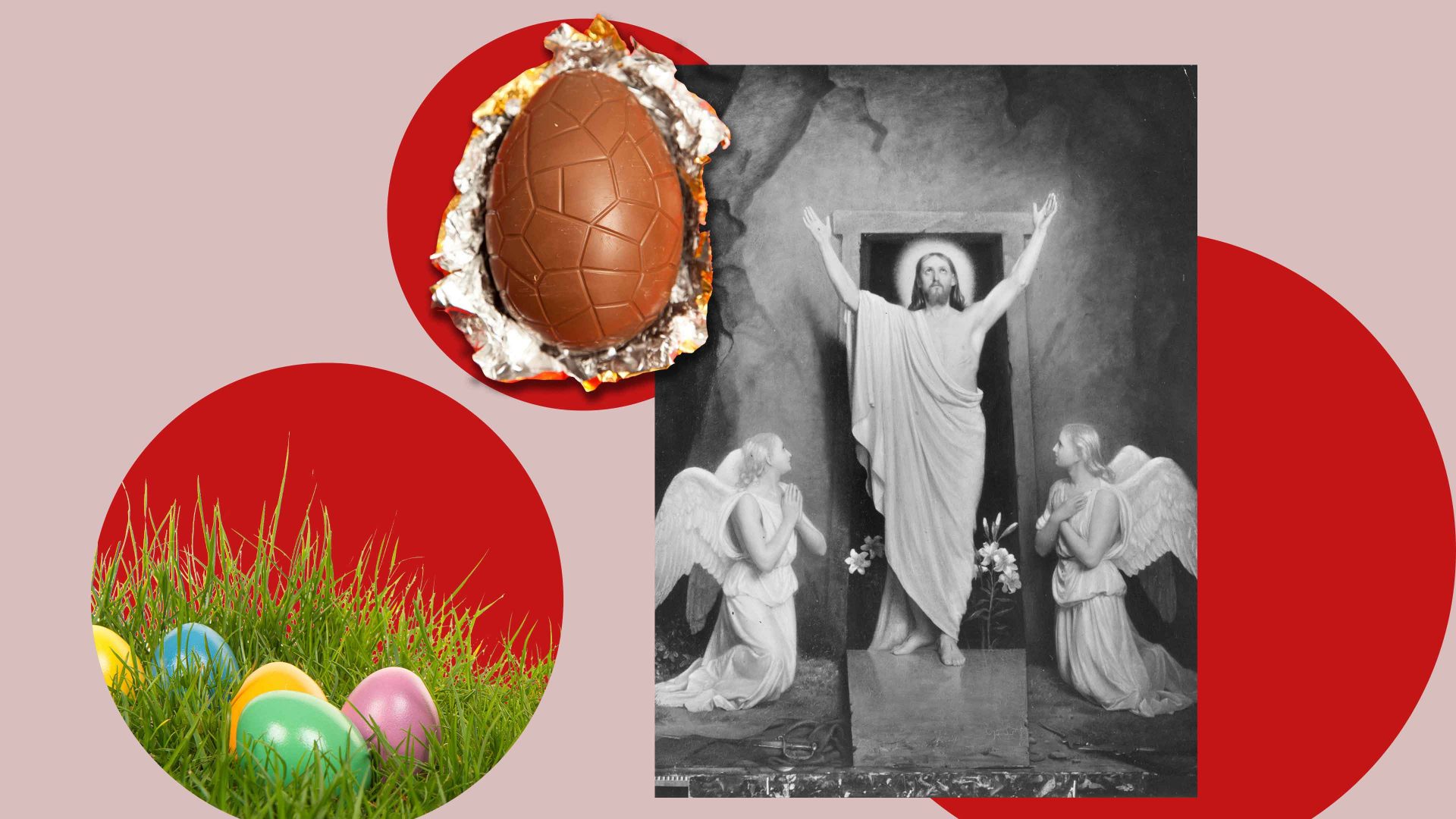
1. The earliest Christians believed the resurrection to have taken place on the third day after the Jewish festival of Passover, which gives it the date of Nisan 16. In the modern calendar, Nisan 16 moves around – the Hebrew year only has around 354 days, except in leap years, when the month of Adar repeats (“leap months”) – but regardless, that puts Easter in the spring.
2. The link to Passover is still visible in the name of the Christian festival in the many languages where it’s some variation on “pascha”.
3. … but it was actually officially broken 17 centuries ago. At the council of Nicaea in 325, the Church hierarchy decided that everyone should celebrate Easter at the same time, and that this time should have no connection whatsoever to the Jewish calendar. Instead, the date of the festival would be set by a thing called the computus paschalis: Easter Sunday was the Sunday following the full moon which falls on or after the equinox.
4. Think that sounds complicated? You don’t know the half of it. The spring equinox – when both night and day last exactly 12 hours – is generally March 20, but can be a day either side. The next full moon moves about a bit, too. Neither do so in a manner predictable to your average late antique monk.
5. The early Church got around both problems by, essentially, making a calendar up. By ecclesiastical convention, the spring equinox is March 21; the full moon is the 14th day of each lunar month. So: Easter Sunday is the Sunday following the theoretical full moon which the church assumes to take place on or after the theoretical equinox. Clear?
6. Clearly not – so in 1997, the World Council of Churches proposed to replace the computus with direct astronomical observation: that is, to use the actual equinox and full moon rather than the imaginary ones.
7. That wasn’t the first such proposal. In 1926, the League of Nations recommended that the world pick a specific date for Easter. Two years later, Stanley Baldwin’s government passed the Easter Act 1928, under which the Easter weekend would be that of the second Saturday in April: Easter Sunday would thus be between April 9 and 15.
8. That, though, has never been brought into force. The British government, apparently, does not get to unilaterally change the date of worldwide moveable feast.
9. The Council of Nicaea’s attempts to make sure everyone celebrates the same Easter, incidentally, have not been a success. The eastern Orthodox churches still use the Julian calendar, not the Gregorian one – Orthodox Christians, not huge fans of Pope Gregory XIII – which means that they’re only occasionally celebrating Easter at the same time as Christians in the west.
10. And in 7th-century Northumbria, differences over the date of Easter nearly led to civil war. England had been evangelised from two different directions, and King Oswiu followed the Irish tradition while his Kentish queen Eanflæd followed the Roman one. The result was that one half of the royal family were sometimes making merry while the others were still grumpily fasting. Tempers – especially that of Oswiu’s (but not, apparently, Eanflæd’s) son, Alhfrith, who was looking for an excuse – frayed.
11. In the event it took another big conference, the Synod of Whitby, to decide that Northumbria would follow the Roman line, with consequences for the next millennium or so of English history.
Suggested Reading


Nerd’s Eye View: 10 things you need to know about dead US presidents
March 22
Earliest possible date for Easter Sunday
April 25
Latest possible date for Easter Sunday
April 5
Actual date for Easter Sunday in 2026
April 3, AD33/ April 7, AD30
Most probable dates for the crucifixion
1,500 years
Approximate gap between this and any Christian country getting hold of any chocolate