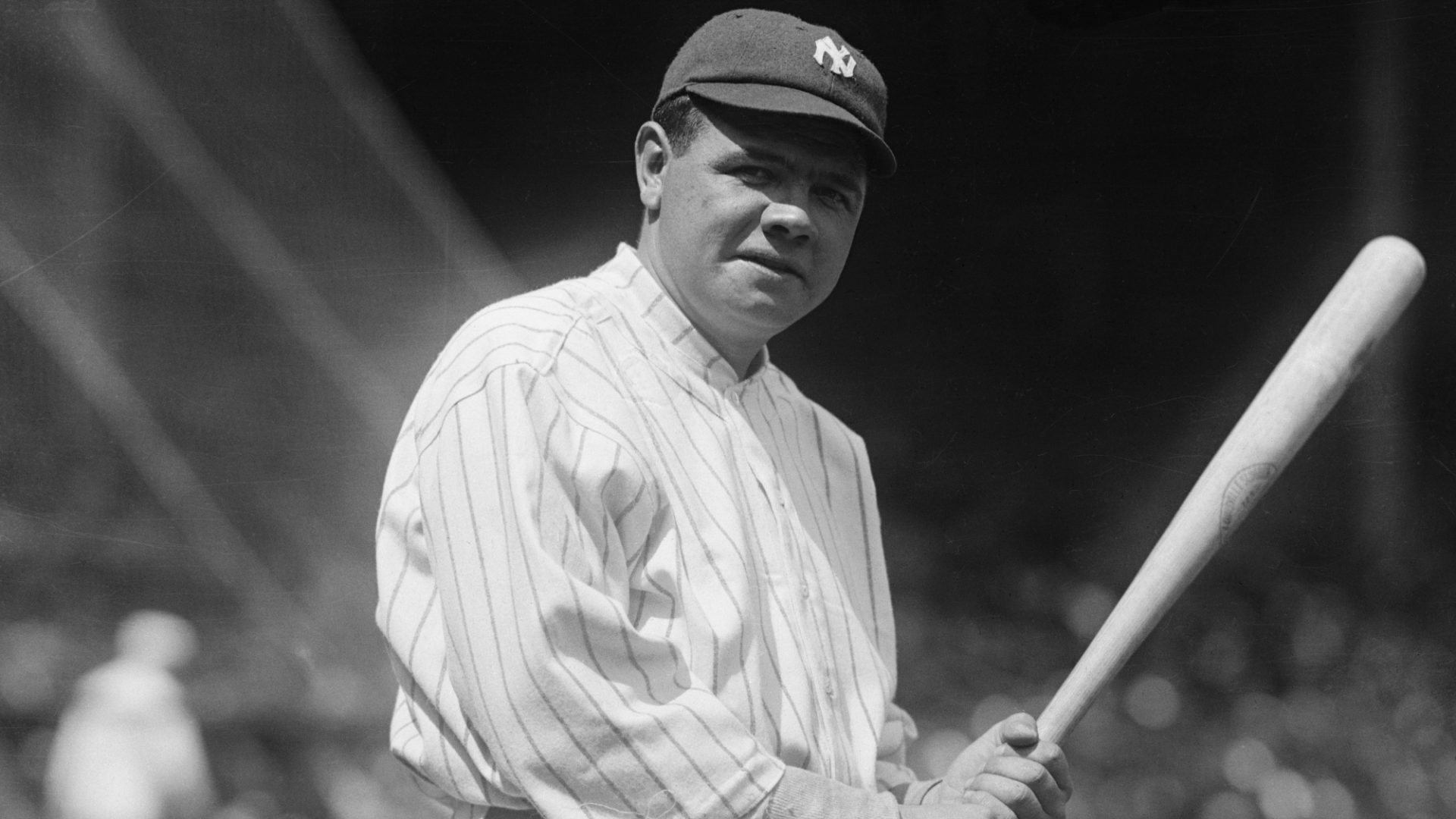
February 6, 1895 – August 16, 1948
Babe Ruth was furious. His New York Yankees had just lost a game in the 1922 World Series to the crosstown Giants, but a baseball defeat was not the cause of his ire.
Six foot two and powerfully built, the Bambino crashed through the Giants’ locker-room door and made for Johnny Rawlings, a hero when they beat the Yankees in 1921’s World Series but riding the bench this time around. Voices were raised, a shoving match ensued. Then Ruth, the game’s biggest celebrity, noticed a group of amazed sportswriters in the room, watching everything.
“Please don’t write anything about this. Please! I’m sorry I came in,” he begged them, before turning to Rawlings. “But lay off that stuff. I don’t mind being called a prick or a cocksucker, but none of that personal stuff.”
The room broke into relieved laughter, but what had enraged Ruth was deadly serious. He believed Rawlings had been screaming racial abuse whenever he came out to bat – a curious choice since Babe Ruth was white.
Or was he? Even when George Herman Ruth Jr was growing up in a German-speaking part of Baltimore, his wide nose and full lips made him the subject of racial taunts from his schoolmates. There were stories that he may have been the product of one of his mother’s affairs.
At the time, black heritage would have kept him out of what was then known as America’s pastime, with Major League Baseball refusing to sign black players, left to scrabble around in what were then called Negro Leagues. But Ruth’s parents were white and of German ancestry, and so in 1914, at the age of 19, he was able to join the Minor League Baltimore Orioles, owned by Jack Dunn.
Fresh from reform school, Ruth still ate his food like it was about to be taken from him, had never stayed in a hotel and did not know how to behave in public places – a wild streak he had shown since the age of seven still evident. The naive and uncouth kid was christened “Dunnie’s babe”, and the nickname followed him to the Boston Red Sox and then, for a record $100,000 (around $1.6m today), to the New York Yankees.
Suggested Reading
Inside the wild film flop that unlocked Robin Williams
Highly successful as a pitcher, Ruth’s ferocious power and desire to play every day rather than rest his pitching arm saw him converted to a slugging outfielder, capable of regularly hitting the ball out of the stadium. He racked up a total of 714 home runs, including a record 60 in an astonishing 1927 campaign, while taking up opportunities to advertise everything from cigarettes to breakfast cereal and baseball bats, “Babe Ruth” becoming an iconic national brand.
With each endorsement his reputation became wilder. He was a big drinker who stayed out late. His Yankees roommate Ping Bodie was asked what it was like to share a room with the Babe: “I don’t know. I never see him. I room with a suitcase.” But another potential roommate, the veteran Detroit Tigers star Ty Cobb, refused to share a cabin with him on a hunting trip, declaring “I’ve never bedded down with a nigger and I’m not going to start now.”
The way Ruth spent his free time reinforced views like these of his heritage. He had black friends, dated black women and spent time at the Cotton Club in Harlem, a jazz venue for almost exclusively black performers.
He always denied rumours he was black, and in all likelihood he didn’t know any more than those speculating, but as the Great Depression of the 1930s arrived, some questioned the amount of money Ruth was making, particularly those who had questions about his identity. When asked to justify how he could earn more than the president of the United States, his response was simple: “I’ve had a better season than Hoover.”
He was one of the few Major Leaguers who chose to play in racially segregated post-season exhibition matches, happily spending time with black fans, speaking positively about black players, including his friend Satchel Paige. His adopted daughter Julia Ruth Stevens claimed her dad was denied the chance to become a manager after his retirement because owners worried he would have picked black players on his team, breaking what was laughably referred to as a “gentlemen’s agreement” at the top of baseball.
Johnny Rawlings’s insults were compounded when the Yankees were whitewashed in the 1922 World Series. But a year later they would defeat the Giants, their first ever win and one of seven World Series victories for Ruth.
It would have brought him immense pleasure. As would the day in April 1947, just over a year before the now-retired Babe Ruth’s death, when Jackie Robinson of the Brooklyn Dodgers became the first African American to play in the Major League.