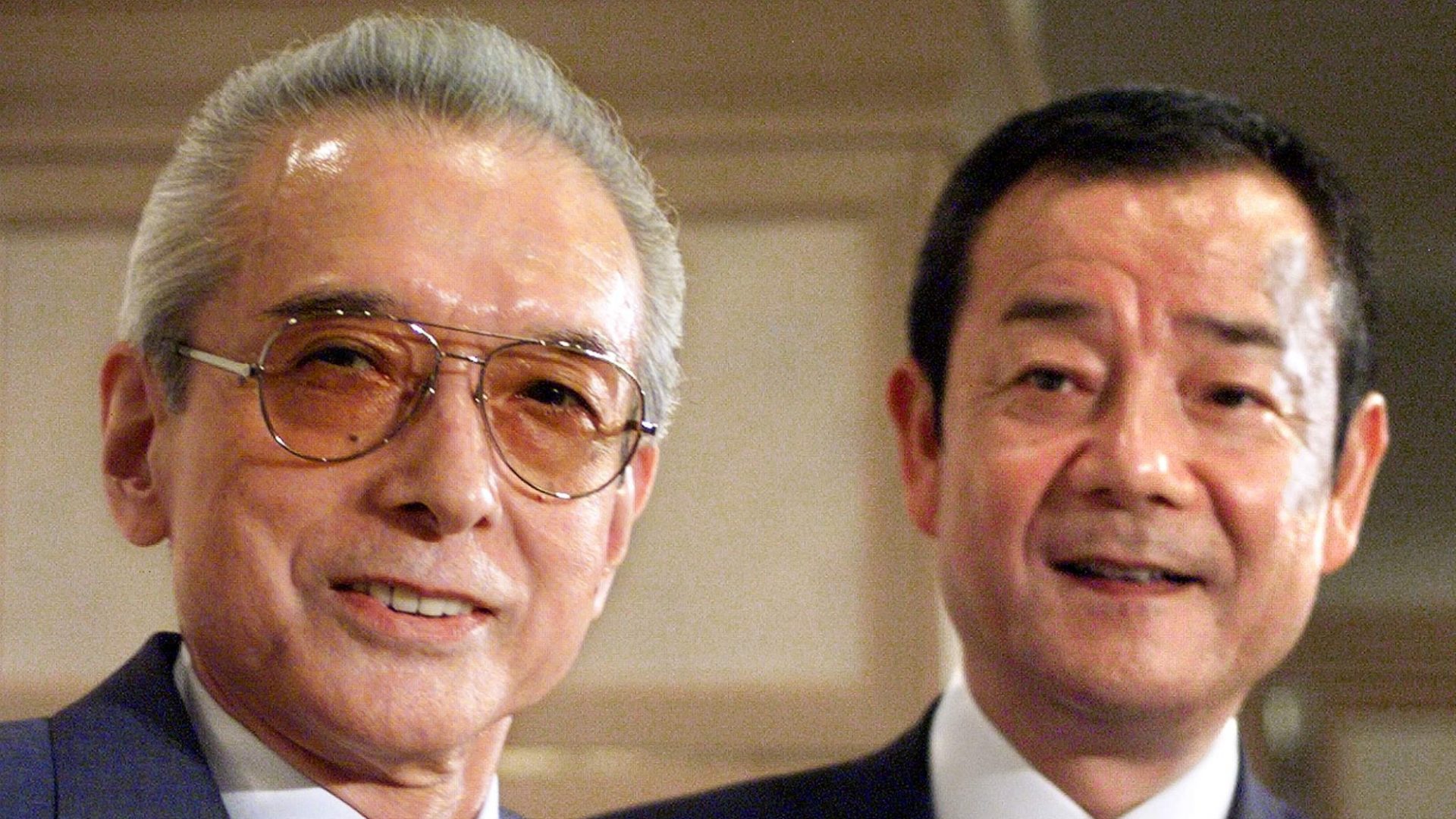
November 7, 1927 – September 19, 2013
The giggling in the Nintendo offices stopped suddenly when Hiroshi Yamauchi walked in to see one of his employees using a mechanical hand to grab objects from a colleague’s desk. He called the man responsible into his office. Knowing of his boss’s fearsome reputation, Gunpei Yokoi feared the worst.
Instead of firing him, Yamauchi was full of praise. He was in the process of diversifying the company, creating a new identity. Instead of being reprimanded, Yokoi was given the task of developing this toy he had made for a joke as a new product for Nintendo. By the end of the year the Ultra Hand sold 1.2 million units. It is Japan’s must-have Christmas toy of 1966.
It was this ability to spot talent that made Yamauchi his billions. Regularly listed as the richest person in Japan, he was one of the longest-running company presidents in history.
Nintendo Koppai began life in 1889 in Kyoto, producing beautifully illustrated playing cards. Yamauchi was born into the family business and took over in 1949 aged 21. One of his first achievements was to establish a licensing agreement with Walt Disney, selling 600,000 packs featuring characters from Disney cartoons. Although this proved that despite his young age he could pull off impressive deals, the numbers did not get close to matching Yamauchi’s ambitions. There had to be life beyond playing cards.
Nintendo’s laser guns and periscopes were relatively big hits for the company in the 1960s and 70s, but Atari’s release of Pong in 1972 gave a new blueprint for Yamauchi. As the early gamers of the world were learning to master the first incarnations of this exciting new medium by playing electronic games on their television sets, he was working out what this new technology could mean.
Suggested Reading

Noor Inayat Khan, the pacifist turned wartime secret agent
It was what he had been looking for his whole life, something to give him the global dominance he had been desperate for since first taking over his great-grandfather’s company.
Nintendo would no longer be about playing cards or toys. It would be in the business of video games.
Keen for his employees to absorb the core ingredients of what they needed to emulate, Yamauchi bought 10 Space Invaders machines for Nintendo’s offices. Yamauchi’s goal was clear: he wanted future generations to worship Nintendo and the games they made. With a firm understanding of the toy industry, Yamauchi knew appearance was vital and he wanted to avoid the clunky machinery of his competitors.
Success was not immediate. Nintendo’s first arcade game, Computer Othello, an adaptation of a popular board game, was Yamauchi’s attempt to stay loyal to the company’s card-playing history. But it was too complex for consumers, and lacked the vital wow factor. With his team, he was still striving to create the ultimate product, certain that the solution was not through extravagance but simplicity. The development continued, the understanding of technology improved, and one day a new character arrived.
In 1981, Nintendo released Donkey Kong, a game in which a hero tries to rescue a woman kidnapped by a gorilla. Using the basics mastered in the post-Pong world, the developers had created a simple, playable arcade game, and Yamauchi had allowed 29-year-old Shigeru Miyamoto, “the Shakespeare of games designers”, time and space to work on making something special. Despite uncertainty from the sales department, who were worried by how different it was to everything they had seen before, Yamauchi was confident.
Originally the rescuing hero was going to be Popeye, but when permission wasn’t granted, it presented an opportunity to create a new character. Throughout its development the game’s protagonist was known as “Jumpman”, due to the innovative way the character could move around the screen. It was only later he became known as Mario.
Miyamoto had been left alone to allow his creativity to flourish – but others found Yamauchi controlling and guarded as an employer. From his early days as CEO he had built a reputation for dismissing anyone who did not agree with him, and even briefly rebranded the company in 1933, renaming it for a short time as “Yamauchi Nintendo & Co”.
His talent was in identifying creative people like Miyamoto and putting his trust in them. Gunpei Yokoi, for example, inventor of the Ultra Hand, also went on to invent the Game & Watch. He also created the Game Boy.
The company went on to release seminal products, including the Super Nintendo, and the Nintendo 64, consoles, but it was the Game Boy that first truly encapsulated every element of Yamauchi’s vision. That was not only because it was hi-tech and cutting edge, but because it was simple, engaging and fun. Just like a deck of cards, in fact – which is where it had all started in the first place.