December 14, 1918 – August 20, 2014
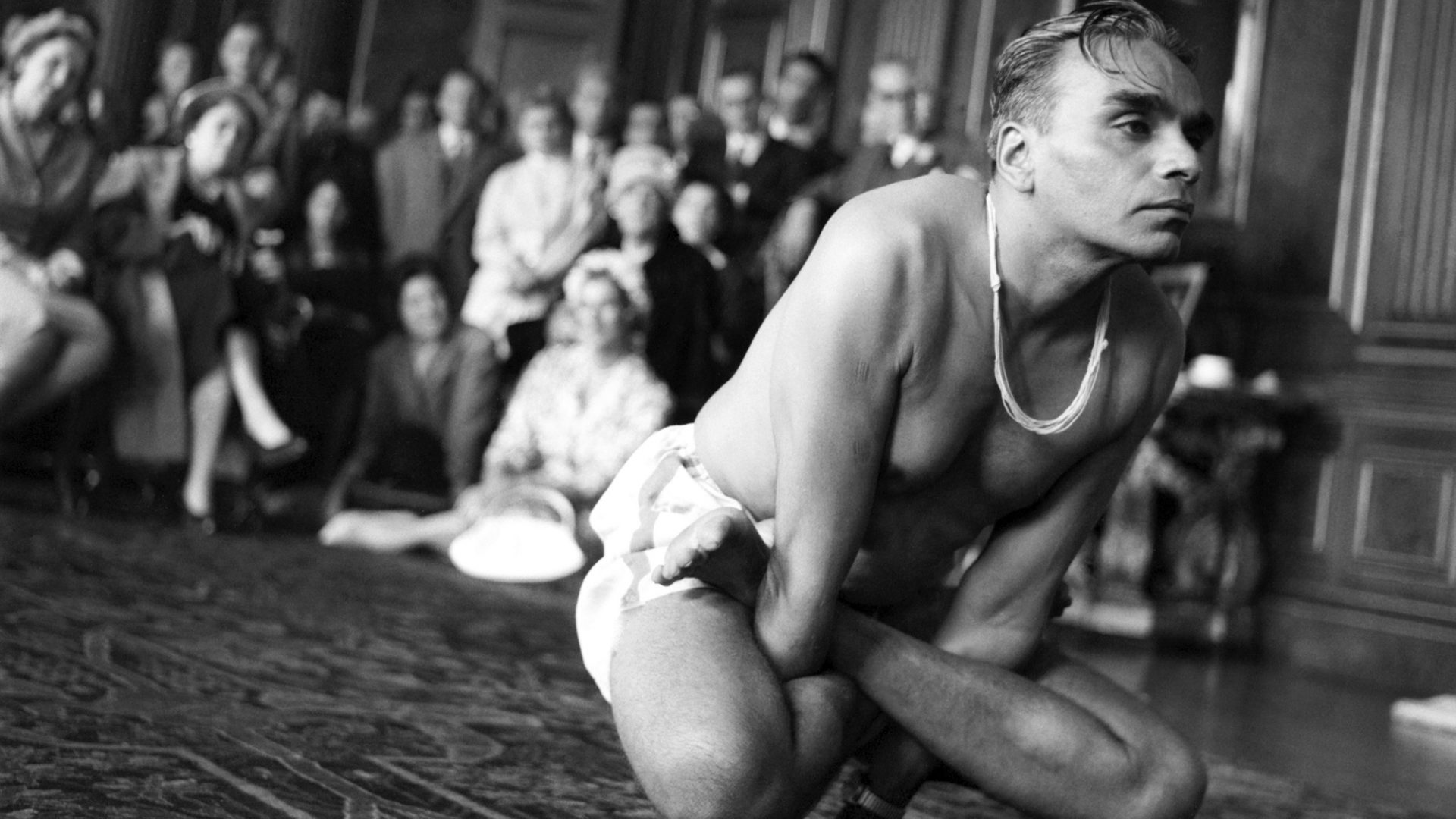
“Ultimate freedom means complete freedom in body, in mind and in the self,” BKS Iyengar, stripped to the waist, tells the camera, introducing the western world to yoga. Hands on hips, feet together, showing not an ounce of fat, he relays his one key belief, that yoga is for everyone.
“We have to understand the unknown,” he explains, gracefully and artistically, before bending backward from his knees, so he is able to easily rest the top of his head on the soles of his bare feet. His calm articulation is as impressive as the contortions of his body.
The film, initially recorded for educational purposes, is later released commercially as The Ultimate Freedom and for many is their introduction to yoga, with Iyengar’s softly spoken philosophies, his genuine desire for people to disconnect their brain from their body complemented by demonstrations of seemingly impossible poses. All this helped to make him an unlikely international celebrity, feted first by the violinist Yehudi Menuhin and later by figures as diverse as Aldous Huxley, Annette Bening and Sachin Tendulkar.
Yoga had not been a choice for the young BKS Iyengar, but a way to survive. Born in Karnataka (then Mysore), India, to a mother in the grip of influenza, he suffered from frequent bouts of malaria, typhoid and tuberculosis that left him weak, underweight and bedbound.
His poor health meant he suffered huge lows as he’d watch his healthy siblings run out to play. “A deep melancholy often overtook me, and at times I asked myself whether life was worth the trouble of living,” he said.
His mother’s response was to make him a promise: “You are going to overcome this and do something special with your life.” She sent him to spend time with his sister and her husband, knowing they would help him recover.
Despite his brother-in-law, Tirumalai Krishnamacharya, being widely regarded as one of the fathers of modern yoga, the young Iyengar struggled to keep up, his body too brittle to be able to do what was being asked of him. Rather than seeing this as a weakness, it gave him a moment of clarity.
To feel more aligned, more independent, more healthy, all he needed, he decided, was self-belief. By accepting what he was not able to do, he was able to take joy in what he could.
This felt like a new kind of yoga, one in which he could take his time. Day by day he found himself able to do things he never thought possible. If he was able to recover from such frailty, maybe he could help others do the same.
Desperate to share this yoga epiphany with others, at the age of 18 he travelled alone to Pune to learn, to teach and to share his story. Building on the teachings of his brother-in-law, this new distinct brand became known as Iyengar Yoga, a practice that emphasised “precision, alignment, and sustained attention in every posture.”
Most of all, Iyengar was determined that no one would feel alienated or uncomfortable, as he had done. “My own guru refused to answer any of my innocent enquiries into yoga. He did not instruct me as I do my students. He would simply demand a posture and leave it to me or his other students to figure out how it could be realised.”
This vulnerability shaped the way he and others would teach yoga for ever, whether your goal was to find inner freedom or to ease stiff knees and old injuries. Still teaching in his 90s, he was reinforcing his belief that yoga is for everyone, with adaptation vital, encouraging students to listen to their bodies, to use their own props if needed, to allow a fluid conversation between brain and body.
Suggested Reading
Why did Babe Ruth’s rivals think he was black?
But this gentle man was no soft touch. Iyengar Yoga is a demanding practice – after all, ultimate freedom does not come to you easily. One of his pupils suggested that anyone wanting “to do something for three minutes and then lie down and have a rest” would struggle with his methods. He had a reputation for ferocity in the pursuit of excellence, saying himself that his initials could on occasion stand for “beat, kick, shout”.
“Do not be frightened by seeing all the postures, that it is impossible for you to perform,” Iyengar said at the end of his film: “Believe me. When I started yoga with that wretched disease, my fingers could not even touch my knee. Today I am completely happy, because I am standing on my own altar.”
It was an altar built of simplicity, of a happy home life and of believing it is possible to find freedom within yourself.