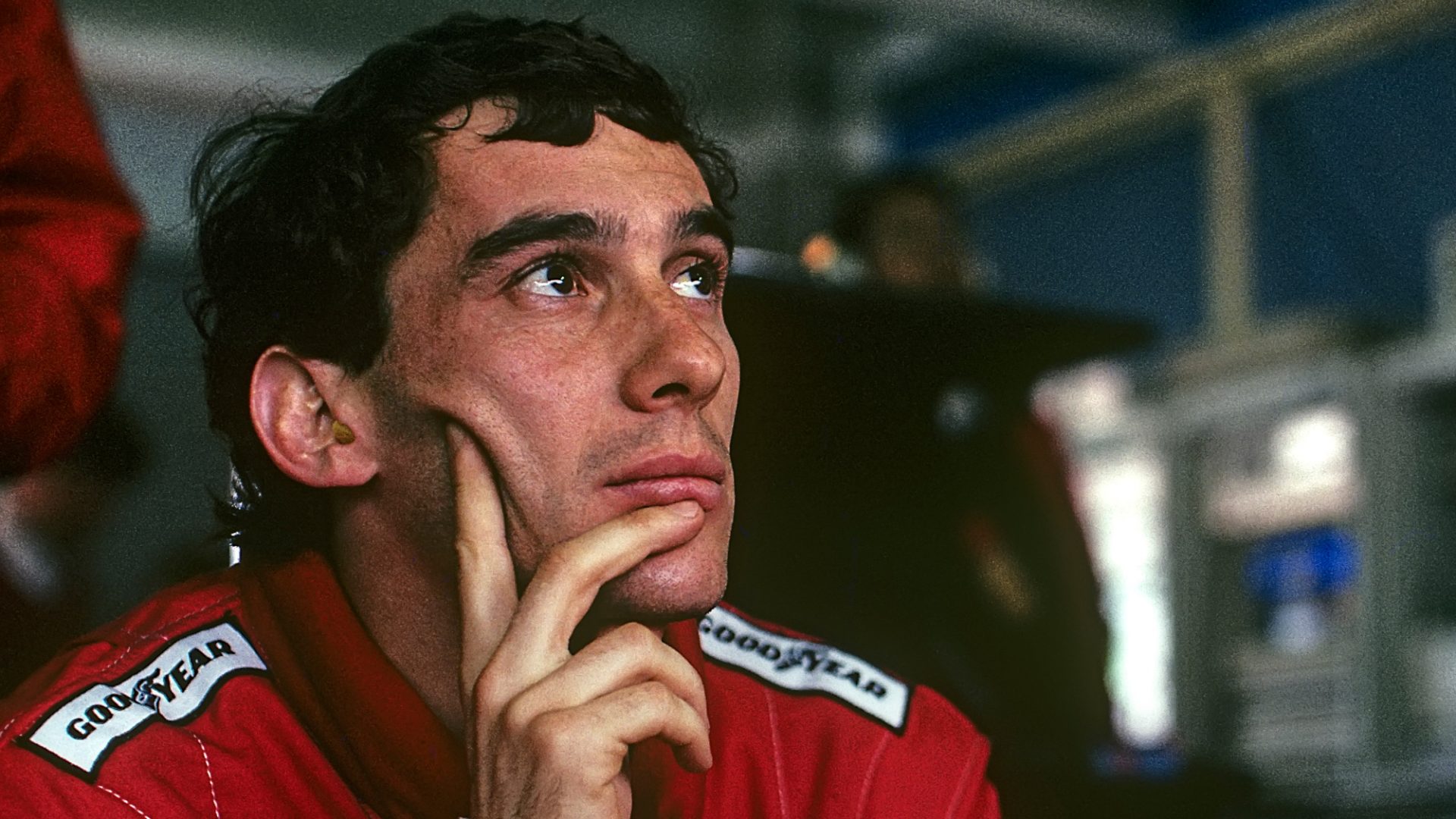
March 21, 1960 – May 1, 1994
“As you can see there’s been a dramatic change in the weather,” commentator Murray Walker says as Ayrton Senna lowers himself into his Toleman TG184. With visibility almost at zero and rain bouncing from the tarmac, it’s not clear to the drenched crowd attending the 1984 Monaco Grand Prix whether the race will even be able to start.
The cars line up on the grid and the lights turn to green. Senna, in his Brazil-yellow helmet, is starting in 13th place but immediately makes up ground on those in front of him, helped by a four-car crash at the first corner, rivers of water running across the track.
“I think we are watching the arrival of Ayrton Senna as a truly outstanding talent,” James Hunt, commentating alongside Walker, says in disbelief as Senna continues to cut through the competition: “He’s catching Alain Prost at something like three seconds a lap, and that is a truly staggering performance.”
On lap 31, Prost waves his arms at the officials in anger. Hunt notes: “He wants to stop the race and who can blame him?”
Senna has reduced the gap from 31 seconds to 18 when two officials step on to the racetrack, one with a red flag, the other waving a chequered flag, bringing the race to an abrupt end. Had there been one more lap, Senna would have taken an unassailable lead.
After the race, with the second-place trophy in his hands, he still looks confused, frustrated and wet. “That was the day we saw a future world champion,” said Niki Lauda.
The heavens opened again for Senna’s first ever Formula 1 win the following season, this time in Portugal, starting on pole in his black and gold Lotus. “I could not see anything in front of me,” he admitted after leading from start to finish, lapping every car other than the Ferrari that finished over a minute behind him in second place.
Senna was jubilant, punching the air with both fists. A solitary but respected driver who always presented himself as calm and controlled was now running around with his bottle of champagne, jumping for joy, hugging every Lotus engineer he could get hold of, all his dreams coming true.
He wiped tears from his eyes, knowing everything he had worked for back at home had paid off. “It’s not just for me, it’s for Team Lotus and all the Brazilians who cheer me on a lot,” said this endearing, unassuming man.
Born Ayrton Senna da Silva in 1960, his first experience of being behind the wheel was in the go-kart his dad, Milton, built for him using an old lawnmower engine. At 13, Senna started entering go-karting competitions and won the South American Karting Championship in 1977.
He moved to England in 1981, renting a two-bedroom bungalow just outside Norwich, racing for a team based at Snetterton. “It took him two or three races to understand a car is not the same as a kart,” said Dennis Rushen, whose Rushen Green Racing team Senna raced for in Formula Ford, “but once he got the hang of it there was no stopping him.”
Despite the clear promise he showed, he felt under pressure to abandon motorsport and take up a role in the family business. Then, at Brands Hatch, perhaps unsurprisingly in torrential rain, Ayrton Senna claimed his first ever victory in a single-seater car.
Winning the 1983 British Formula Three Championship went a long way to proving to himself and his family that the young Senna was the real deal, and in 1984 he signed for the British Toleman team. He would later join Lotus and then McLaren, where he had infamous battles with Prost and Mansell, before becoming teammates with Damon Hill at Williams in 1994.
Suggested Reading
The woman behind Mary Poppins hated the Disney classic – and this is why
Not wanting to make friends with other racers, who he regarded as fierce rivals, he spent time with his teams’ engineers, and relaxed by flying remote-controlled helicopters and aeroplanes. A McLaren engineer remembered Senna spending time with everyone on the team, and one year sending them all racing-themed Christmas cards, writing inside “Whatever you do in life, keep your right foot down.”
Motor racing changed for ever at the 1994 San Marino Grand Prix. During practice, fellow Brazilian Rubens Barrichello lost control of his car and was left unconscious. The first person he saw when he came round in hospital was the visiting Senna, there to check on his compatriot. On the same day Roland Ratzenberger, in only his third Grand Prix, crashed and lost his life.
The next day, May 1, leading the race on lap seven of the Imola circuit, the steering column of Senna’s Williams FW16 broke as he reached the Tamburello corner. He smashed into a barrier at 136mph and was gone. Brazil went into three days of national mourning.
Senna had won 41 of his 161 Grands Prix and three world championships. His continuing legacy is the Instituto Ayrton Senna, a philanthropic organisation run by his sister Viviane that has transformed the lives of millions of children living in poverty in Brazil, training teachers and creating programmes dedicated to changing the lives of those who need it most.
“Monaco 1984 was the race that made people notice me,” Senna said about the track on which he won six times between 1987 and 1993. It was also the race that started a career-long rivalry with Prost, one of the most intense battles in F1 history, with Senna calling him a “coward” during a televised press conference in 1992, to the delight of a giggling Nigel Mansell.
Prost though could not deny the brilliance of the Brazilian that day: “He was much faster than everybody in those conditions.” Had the race not been stopped, it would have been the only victory for the Toleman team, which disbanded the following year.
“He had this absolute belief,” the team’s engineer Pat Symonds said. “When the conditions were difficult, that’s when he became extraordinary.”