Leaving Marrakech at dawn on my way to the Sahara, the spectacular scenery unfolds. As we climb, the Atlas Mountains emerge on both sides of the road, alternating between rust, green and silver depending on the angle of the light. The 200km drive takes just over three hours.
I am heading for the town of Ouarzazate – or rather Ouarzawood, as it has been jokingly termed since the 1980s when it started to attract the big American movie houses. Several studios have been built here, many a blockbuster has been filmed, and many stars – from George Clooney to Brad Pitt to Angelina Jolie – have stayed here, all because of the quality of the scenery. And the light.
Now that same sunlight is providing the foundation for lasting economic growth and Morocco’s remarkable clean energy transition. It is also a potential salvation for Europe, as the green movement struggles to win the political battle for net zero.
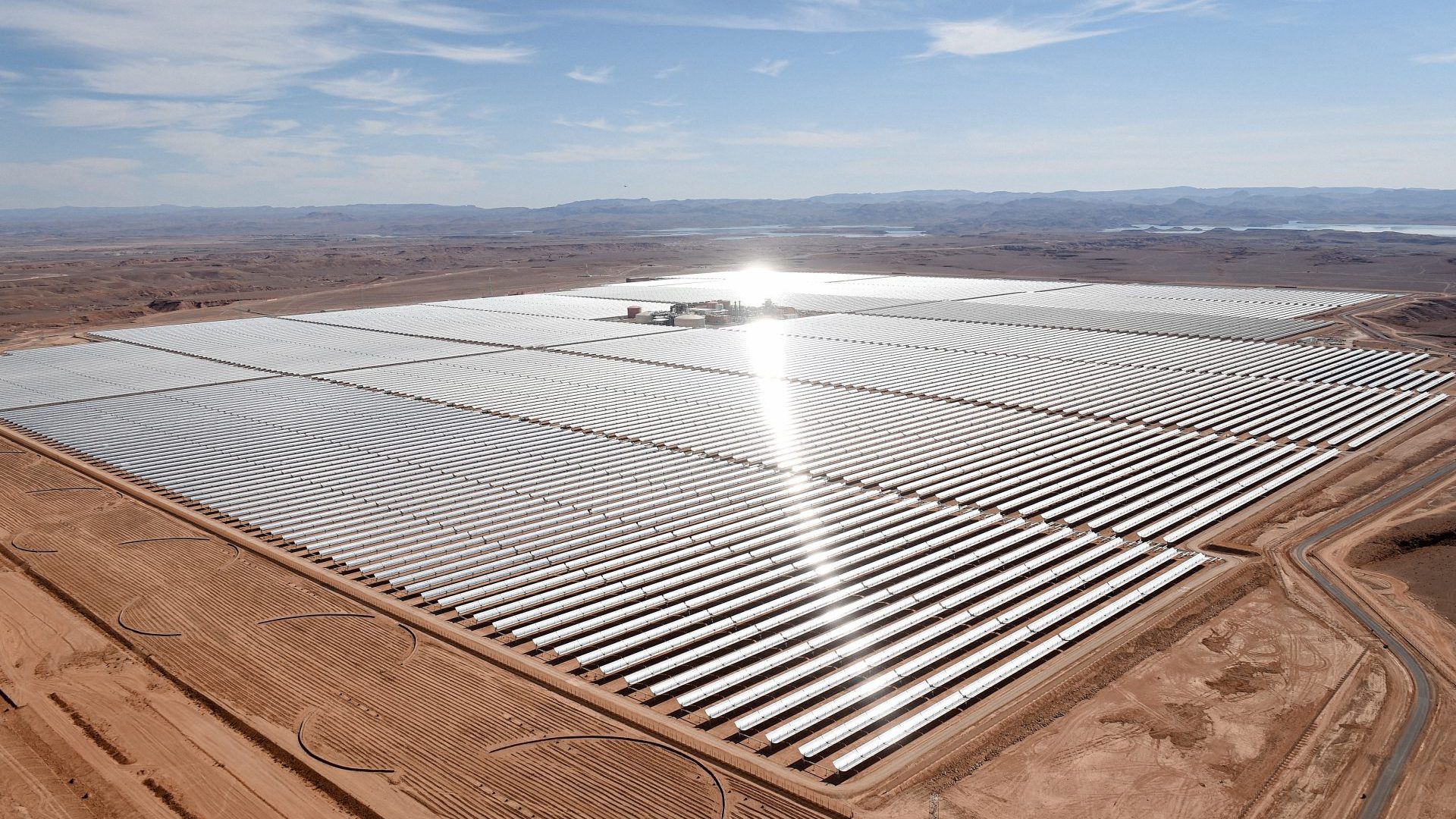
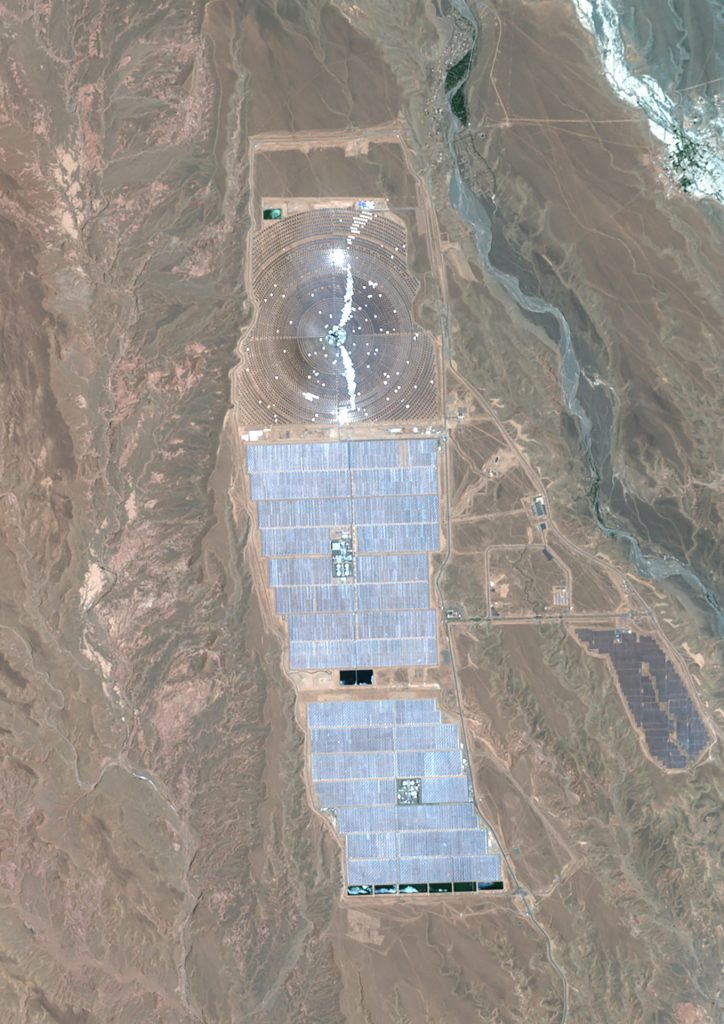
“This is where it all started,” declares the site manager, Mustapha Sellam, atop a viewing point where we look down on Noor Ouarzazate, the largest concentrated solar power (CSP) plant in the world.
This is the symbol of the Moroccan renewable energy dream, the start of an energy transformation that is unrivalled in its ambition. It is a manifestation of the country’s growing influence; it is a symbol of soft power and modernity. Every Moroccan citizen has heard of Ouarzazate: both the movie story and the energy story.
It began straight after the global financial crash in 2008. As we stare down at fields of solar panels as far as the eye can see, Sellam explains: “The cost of a barrel of oil suddenly soared to $150. We have never had any oil or gas or coal. By this point, 90% of our energy came from imports and our treasury was under considerable strain. We were particularly vulnerable to fluctuations in energy prices. We needed to look for new solutions, and quickly.”
Morocco, a country of 38 million people, is certainly not a democracy. Every major decision is either taken by, or referred to, the king, who brooks little dissent. Yet it’s not a sinister dictatorship either. Vigorous debates take place in the media, in parliament and among NGOs, not least on climate issues. You just need to choose your words carefully and not direct anything negative at the monarch.
Yet there is a bigger question, one that has often been disregarded in richer countries. How do emerging economies – Morocco is only the sixth-largest economy in Africa, but it is growing steadily – and countries that don’t necessarily adhere to “western” liberal democratic consensus deal with the similar challenges of delivering for their people? Do more dirigiste political systems make it easier or harder to plan for the long term, to change course when circumstances change or things go wrong, and to communicate candidly with citizens? The answers are not straightforward.
Shortly after it gained independence from France in 1956, Morocco started constructing dams in the north of the country. The decision was visionary for its time; it allowed its agriculture to survive periods of drought in the late 20th century without food shortages. But the hydroelectric plants provided only a tiny amount of the energy required. The country’s first wind farm, a small one, opened near Tangier in 2000.
Unlike its neighbours, Algeria and Libya – failed or failing states that produced copious amounts of oil and gas – Morocco was perilously dependent on others. Some 96% of its energy was imported fossil fuels – crude oil from Saudi Arabia, Iraq and Russia, coal from South Africa and Poland, electricity from Spain, as well as electricity and natural gas from neighbouring Algeria. That is the country with which Morocco has traditionally been compared, and that is the country with which relations alternate between bad and terrible. All the more reason to become self-sufficient in energy as quickly as possible.
As soon as you arrive at Noor and navigate the security checkpoints, you understand how this was an obvious choice for the first landmark project. This area on the edge of the desert gets just under 3,500 hours of sun a year, making it one of the most consistently sunny places on earth.
Work started on the first part of Noor – al-Nur means “light” in Arabic – in May 2013. At 2pm on February 4, 2016, live on television, the king pressed a button, making the parabolic mirrors turn and bringing the turbines and the complex to life.
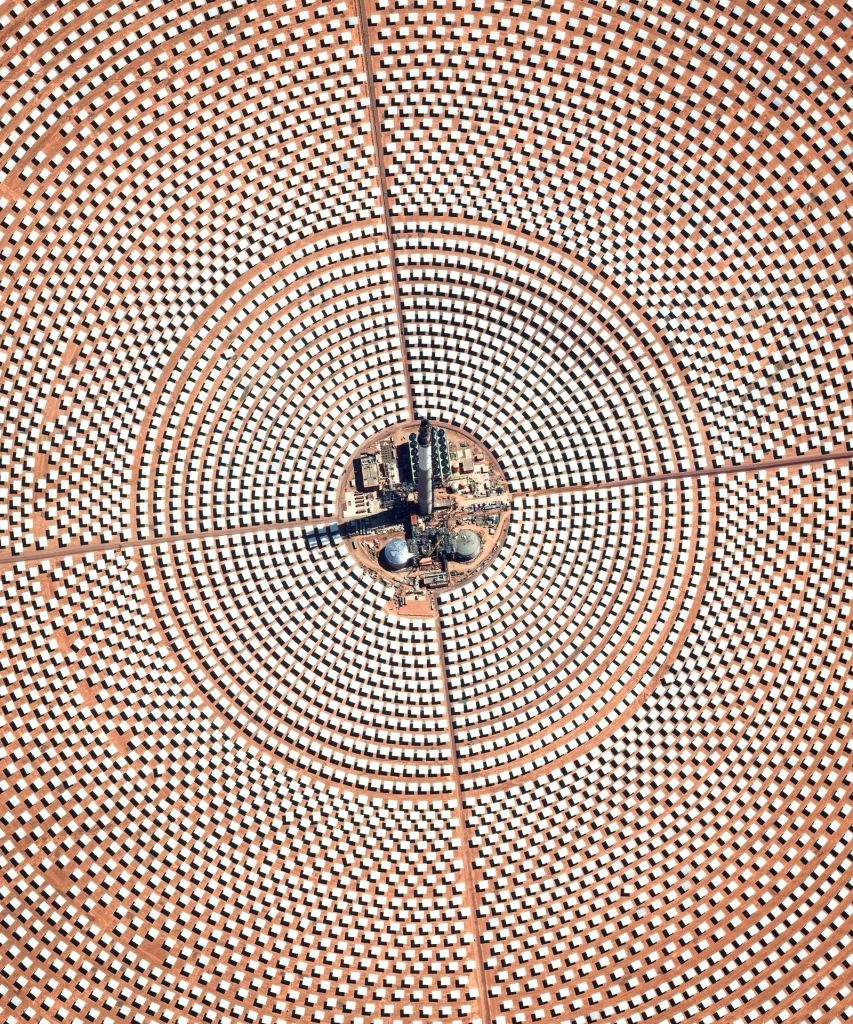
Sellam takes me to the visitors’ viewing platform. There I’m given a hard hat and hi-vis jacket and whisked up in a lift. As I squint even behind strong sunglasses, the scale of the site is hard to take in: 3,000 hectares of arid stony desert, the size of 3,500 football fields, containing over half a million parabolic mirrors. Even on a clear day it is hard to see where the rows of solar panels end. And there is a lot more land they could build on, if they wanted to.
What strikes me most, apart from the searing light, is the silence. I can hear nothing except for a dull rhythmic humming sound as the wind blows through the gaps in the gargantuan structures. We get into his 4×4 to tour the area. For the next hour or so, I see few people, at least not outdoors.
Workers are involved mainly in maintenance, which includes washing the solar panels at night with huge machines, and security. In the control room high above Noor 1, which we reach by clambering up four flights of stairs, two young men are monitoring computer screens set into the wall, each with real-time data detailing water pressure, temperature and flows. They greet me cordially and offer me tea, without taking their eyes off the dials.
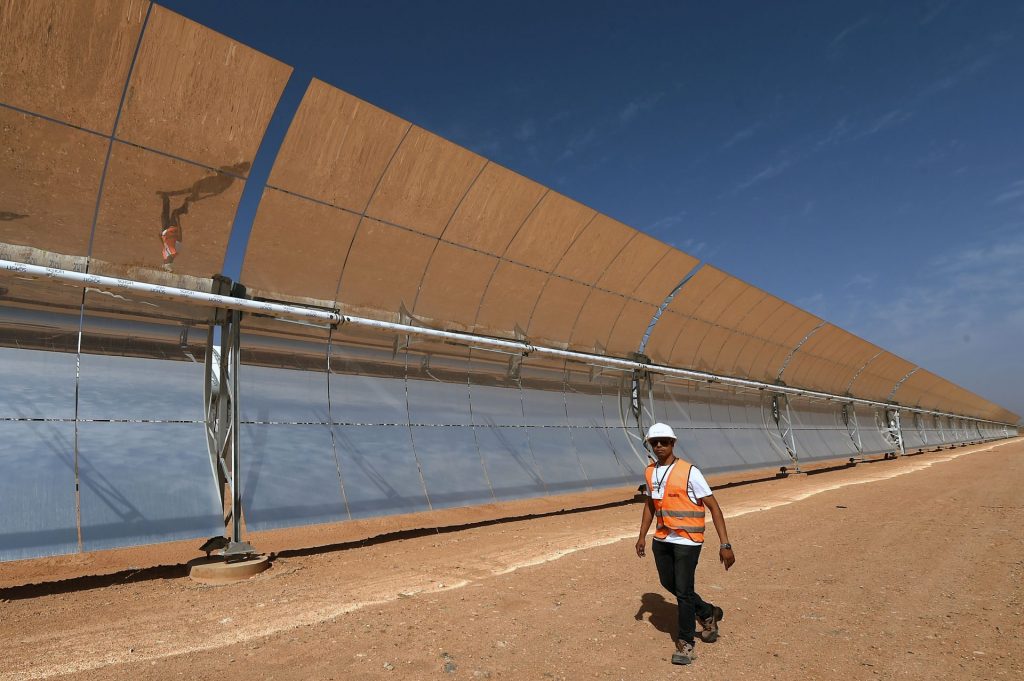
At Noor 1, the original plant, which is right in front of us, some 800 rows of parabolic mirrors track the sun, swivelling every few minutes to adjust their angle as the earth rotates. They are equipped with steel solar collectors that hold the mirrors and receivers in place, capturing radiation throughout the daily solar cycle. Electricity is generated when the concentrated light is converted to heat, which in turn drives a steam turbine.
Two large tanks not far from the turbine building hold 45,000 tonnes of liquid salt. This mixture, also containing sodium and potassium nitrate, stores the energy produced during the day that is not used and delivers it in the evening to produce more energy. That molten salt system allows the electricity to be generated for an additional three hours after sunset, which is when energy is most needed.
Noor 2 is based on dry cooling. This allows a greater storage time, of up to seven hours. The third and largest plant, Noor 3, contains a giant tower – once the tallest structure in Africa – to treat and store water. It uses mirrors to reflect light to the top of the tower. The smallest and most recent plant, Noor 4, is based on photovoltaic technology, which is now the global standard.
Altogether, these four fields produce an average of 582 megawatts of electricity, serving around 2 million citizens. Or to put it another way, enough to power a medium-sized city.
Sellam, who has been working at Noor since the start a decade ago, says all of this means “we are currently avoiding emitting 690,000 tonnes of CO2 per year”. That’s the equivalent of 120,000 cars being driven for 10,000 miles, or powering 1.1 million Moroccan homes.
“We’re very proud of what we’ve done here,” he adds. He is too polite to point out – but others do on my trip – that other states across the Maghreb, the Middle East and sub-Saharan Africa enjoy similar solar resources but have yet to exploit them. A similar story can be told of a failure to tap into wind potential in wealthier northern countries.
The Moroccan government has been eyeing up energy exports to Europe, but the plans have so far failed to materialise. At the Cop28 climate conference in Dubai in 2023, Morocco signed an energy agreement with Portugal, Spain, France and Germany, the first African country to have a power-cable link to Europe. In theory, it will allow the export of surplus renewable electricity produced in one country to be transferred to another.
The most eye-catching project should have been with the UK. Xlinks, an energy start-up, teamed up with the Moroccan state to build the world’s longest undersea power cable, taking electricity to Britain. The idea was for four high-voltage HVDC cables, powered by solar and wind energy combined with battery storage technology, to snake along the 3,800km seabed, passing by the Atlantic coasts of Spain, Portugal and France and landing in the Devon village of Alverdiscott. Both sides were bullish when the outline agreement was signed. The cable would provide enough electricity to power 7 million British homes for 20 or more hours a day.
It was risky – and the UK has a terrible track record in realising infrastructure projects remotely on time or on budget – but it was ambitious. At its deepest, the pipeline would have been 700 metres below sea level. The best-case estimates were that around 13% of the energy would be lost through seepage as it travelled along the cable. Then came the cost: estimated at £25bn. Finally, a new concern arose around terrorism, state-sponsored or otherwise, with the prospect of Russia or a country allied to it damaging or destroying the cable – just as happened to the huge Nord Stream 2 pipeline.
As ever in Britain, long-term planning ran up against the immutable object that is Nimbyism. Locals and second-home retirees complained that their rural vista and tranquillity would be ruined by lorries and loud construction. Which is true, and was planned to last five years. Farmers were angry at the prospect of having to give up a fifth of their land. In a bid to pre-empt this, in August 2023, the previous Conservative government named it a Nationally Significant Infrastructure Project, which would allow it to bypass planning procedures.
Its Labour successor was initially forthright – then it lost its nerve. Facing disastrous poll ratings and an acute fiscal squeeze, and with the project cost of HS2, just one small stretch of high-speed rail, ballooning to £80bn, Xlinks proved too much. In June 2025, the Department for Energy Security and Net Zero pulled the project, issuing an apologetic press release, noting that it was “not in the UK national interest at this time”.
The burghers of one Devon village helped to scupper a project that could have met 8% of the UK’s overall electricity needs. The Xlinks setback was frustrating for Morocco, but in the long term it is likely to be only a small dent in its ambitions.
Does it matter that quite a few of the governments making a beeline for solar and wind power are not paragons of virtue? China is operating on an altogether different scale on renewable energy. Uzbekistan is an example more like Morocco, but with a human rights record much worse. It is nevertheless presenting itself as a forward-looking emerging market for global investors. In January 2025, its president, Shavkat Mirziyoyev, announced plans to boost its proportion of renewable energy to 54% by 2030, as part of a wider move in Central Asia towards a greener economy. The money will come from the UAE, Saudi Arabia, Qatar, Turkey and China.
I’ll admit this makes me uncomfortable. But if we are going to tackle some of the world’s most intractable problems, we will need to have the humility and open- mindedness to deal with countries such as these that have different political systems and priorities to us.
And most of all, western liberal democracies need to practise rather than preach. Europe is moving in the right direction, though not at the speed it should be. In 2024 a milestone was reached when solar panels generated 11% of the EU’s electricity, exceeding coal-burning power for the first time. Some areas are seeing progress; others are going backwards or slowing down. I could have opted for other countries as an example, such as Australia, which installs more solar panels on rooftops than anywhere else.
Chile is also a trendsetter in solar, thanks to resources in the Atacama Desert. Africa has vast potential to be a big producer of green energy. So far it has been a laggard, with just 1% of the world’s installed solar and wind capacity, but there are signs that it too is on the cusp of change. This makes Morocco’s role even more important, setting an example on the ground and helping to harness the continent’s influence at international forums.
The global struggle to deal with climate change needs countries like Morocco to be at the forefront. The compromises are acute; the imperfections are clear. That is precisely why I chose to tell its story. As power relationships change across the world, it is good that new players are emerging. And if they are helping to set the agenda, while growing their economies, then that is to the benefit of all.
An edited extract from Braver New World, by John Kampfner, published by Atlantic Books (£22)