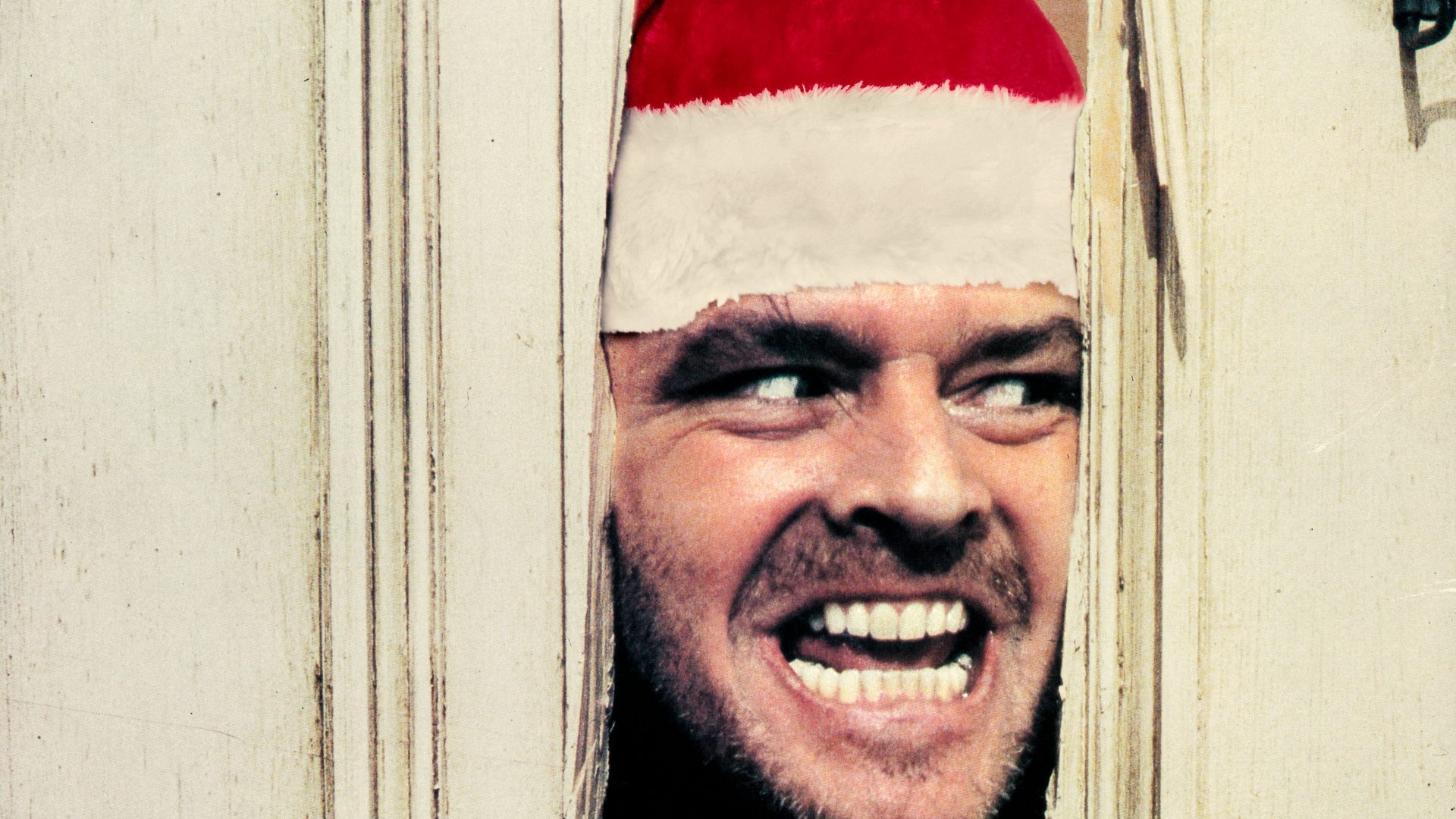
When Juju’s petals have been discovered and George Bailey saved from suicide; when Hugh Grant has finally declared his love for that girl from EastEnders and the horror of Love Actually can end; when Hans Gruber has finally been flung from the Nakatomi Plaza and Michael Caine has begun to sing with Muppets, then I’ll be settling down with a cup of hot chocolate, dressed in my comfiest woollen pullover to watch a light yellow Volkswagen Beetle head up into the mountains to the sound of Wendy Carlos playing the medieval Dies Irae on electronic synthesisers in the most Christmassy of all movies: Stanley Kubrick’s The Shining.
I know that you might not think it’s Christmassy. In fact, The Shining hardly refers to Christmas at all, but that’s exactly what you’d expect from Stanley Kubrick. It’s not like he’s just going to come out and say “Look, I faked the moon landing”, so why do we expect a Kubrick Christmas movie to be any different?
The very fact that Christmas is absent in a film that takes place at Christmas time feels like a glaring omission. It is what us eggheads call a structuring absence. And for those who want to find Christmas Presents (the seasonal version of Easter Eggs), they run all the way around the maze of The Shining like red thread from a bloodsoaked jumper.
Here are the facts I’ve gathered from Reddit rabbitholes:
• There’s a Christmas tree on the island in the very first aerial shot.
• The Shining takes place over the holiday season from the Hotel closing at the end of October – Halloween – to mid-December, maybe even Christmas Eve, which fell on a Wednesday, the day of the last title card, in 1980: the year of the film’s release.
• Chef Hollaran says that they have 12 turkeys in the larder. There are 12 days in Christmas. Room 237: 2+3+7=12.
• There’s snow, which automatically makes a film Christmassy. See my coming articles on Where Eagles Dare and John Carpenter’s The Thing.
• Grady spills advocaat on Jack Torrance, a drink very similar to Yuletide tipple egg nog.
• Wendy talks about the Donner party. Santa’s reindeer are called Dasher, Dancer, Prancer, Vixen, Comet, Cupid, Rudolph, Blitzen, and Donner.
• Green and red are traditional Christmas colours which appear throughout the film. Red: the blood from the elevators. Green: the bathroom in Room 237.
• Jack has stubble, like he’s growing a beard, and wears a red coat, like Santa… who also has a beard. Tim Allen will revisit this theme in 1994’s The Santa Clause.
Suggested Reading

When did George Clooney lose it?
Many of you will be thinking: this is all incredibly convincing, but so what? So what if The Shining is a Christmas picture? What does that add to our enjoyment of it, or our understanding of the holiday?
It is important for two reasons. First, because it explains the horror of the film. Christmas is a period when we are forced to be with our families whether we want to be or not. In the case of Jack and Wendy and Danny Torrance, the word is very much not.
As a recovering alcoholic, Jack feels pressured that he can’t face the week without a drink and Wendy, valiantly attempting to hold the disintegrating family together, is torn between supporting an increasingly cold husband and protecting her increasingly odd son. Going to the mountains might have seemed like a good idea at the time – no in-laws; plenty of time to work on the new novel. The big shop has been done – Chef Hallorann has seen to that – and potential Christmas gifts – the baseball bat, Danny’s trike, the ball – abound.
But there is an important truth that you won’t find in a John Lewis advert, which is that for some people, Christmas is actually a nightmare. To be thrown together with abusive partners in a heightened emotional atmosphere of forced jollity can be a combustible combination. In The Shining it is a literal as well as metaphorical trap; a maze which Danny must escape.
The other more overt Christmas movie in Kubrick’s oeuvre is of course Eyes Wide Shut. It has more Christmas trees, decorations and baubles than Will Ferrell puts up in Elf. Nicole Kidman wraps presents and Tom Cruise goes to what is essentially a high-class work party with Sydney Pollack, who unfortunately has an ODed sex worker in the bathroom. So maybe not that high-class after all. There’s also a costume party and the film finishes in a toy shop.
Kubrick uses a holiday that is usually viewed as the apotheosis of the nuclear family to test that concept to destruction. Cruise is a movie star who doesn’t really fit into the family. His sex-mare is that of a man who wants to have sex but doesn’t want to take his clothes off.
It’s a film that cleverly plays off the essential sexlessness of this supposed sex symbol. When told to strip at a party he crashes, he looks terrified. The definition of uselessness, he’s the guy who can’t get laid at an orgy.
On radio, I once recommended Eyes Wide Shut to Mariella Frostrup as my Christmas film and was rewarded with a throaty laugh (swiftly ticking off an item on the bucket list). But a double bill of The Shining and Eyes Wide Shut would be better still. The horror is based on male resentment and jealousy: the heroines are the wives who will only put up with the shit for so long.
The essential immaturity of the men can be seen in the way both women are named after resourceful girls from children’s literature: The Shining’s Wendy, patron saint of the Lost Boys in Peter Pan, will save her son and herself and leave Jack to [SPOILER] freeze to death mid-sulk in the maze.
Eyes Wide Shut’s Alice, who is far more experienced with looking glasses and Wonderlands than her naif husband, succeeds in saving them by forcefully stating the true meaning of Christmas – which after all is a pagan fertility celebration – in the last line of the film.
John Bleasdale is a writer, film journalist and novelist based in Italy