
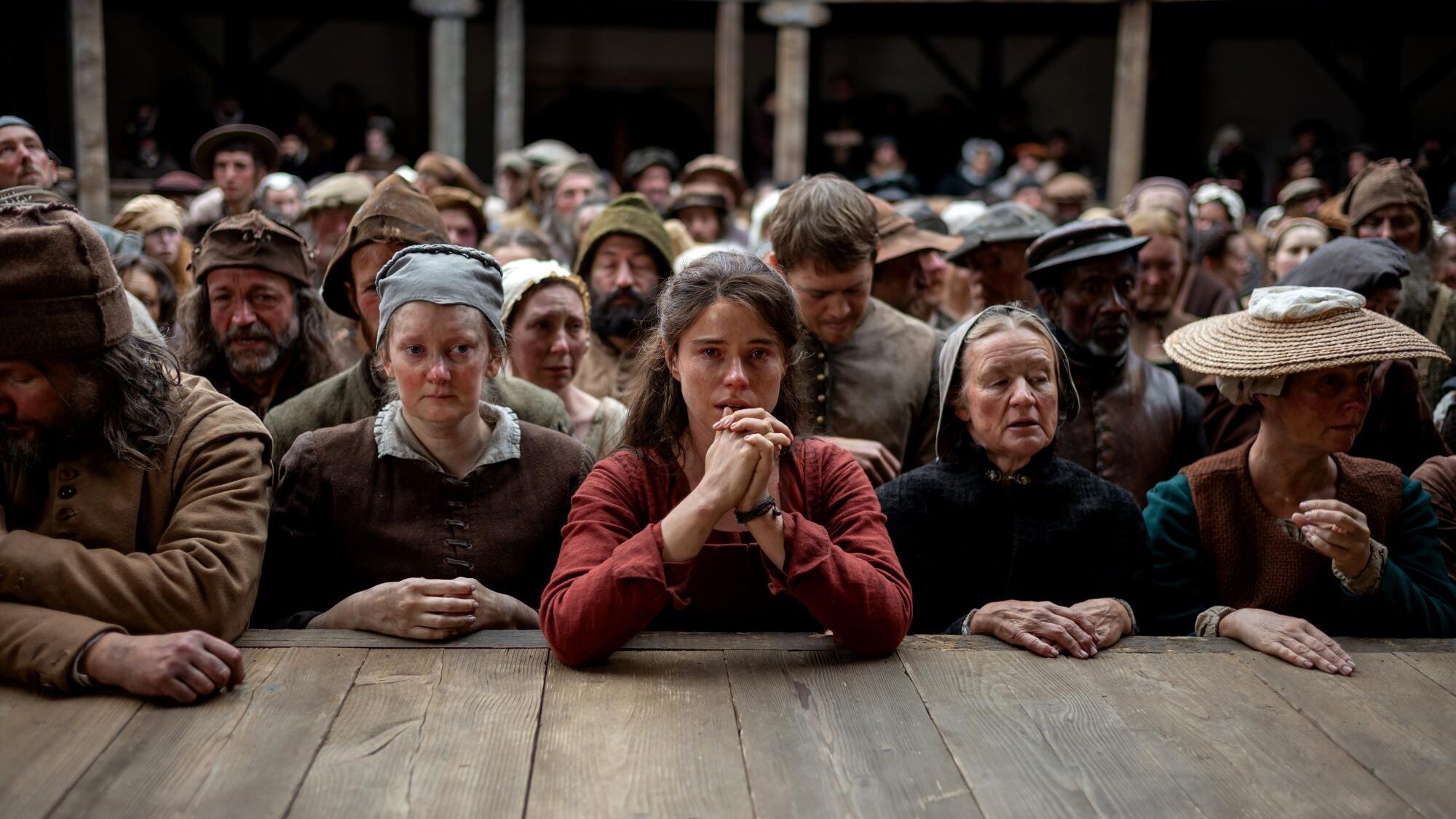
“You come at the King, you best not miss”, as Sir Little says in William Shakespeare’s King John (act 3, scene ii)*. The meaning is obvious. You try to hit the head of power, it has to be definitive – no flesh wounds, no maiming. Lethal force or nothing at all.
I thought about this when watching Hamnet, the new Chloé Zhao film based on the novel by Maggie O’Farrell. Depicting Shakespeare, writing about Shakespeare, playing Shakespeare… there’s always a trace of violence. Of getting your own back, of one-upping or overthrowing. After all, Shakespeare is the king of English literature, of drama, of theatre and its direct descendant, cinema.
In 1973, the American literary critic Harold Bloom proffered the concept of the anxiety of influence, by which an author must kill their influences in order to find their own voice. It’s a Freudian-heavy, male-centric idea – kill your father and have sex with the muse, your mother. But that aside, a lot of writers and artists have sharpened their poinards with the aim of having a go at the biggest daddy of them all.
Shakespeare is the most influential English writer of all time, deeply embedded in the very veins of language: his works introduced approximately 1,700 words and phrases into the English language. More importantly, he set the precedent that you could change English.
If you’ve ever verbed a noun or were adverbed adjectively, that fluidity, that malleable, ductile quality to the language has its precedent in the Bard of Avon. Anyone proposing prescriptive rules to English grammar must face the fact that the best user of the language didn’t give a fig (which was 17th century for haemorrhoid, BTW) about rules and broke them with deliberate abandon, and if you think that last phrase a paradox, Shakespeare loved those too.
Portraits of Shakespeare start with a biographical blank. We know that William gave his second-best bed to his wife on his death (actually not a slight, as that would have been the bed they slept in, saving the best one for guests).
We know he was an occasional actor, kingly parts according to tradition. He made more money as a businessman than as a playwright, but he wrote a bunch of plays that were successful at the time. We know he was born and died on the same day, April 23. But he left no letters, no diaries, no treatises.
The portraits are uncertain and disputed. Probably a slaphead, but who knows? We don’t know if he was Protestant or Catholic, or even if he believed in God. We don’t know if he was straight or gay or bi. We do know that he was married and had three kids, one of whom, Hamnet, died young and is the subject of Zhao’s film.
That we don’t know much about Shakespeare has meant that he is a character ripe for exploration, if not exploitation. There is a curiosity to know what he was really like.
Suggested Reading

The weird and dangerous history of Hollywood snow
He’s the sort of person you’d like to meet in a time-travel narrative. Indeed, he’s turned up in Dr Who a couple of times. The Immortal Bard by Isaac Asimov, The Muse by Anthony Burgess, Henry Kuttner’s The Comedy of Eras and Nelson S Bond’s Much Ado About Pending are all short stories which usually stir up the authorship controversy by interfering in how Shakespeare wrote his plays, or simply writing them for him.
Roland Emmerich’s pile of effluent twaddle Anonymous, which embraces the conspiracy theory that Shakespeare didn’t write Shakespeare, is beneath consideration. What most fictional versions of Shakespeare conduct is an iconoclastic intervention. They try to cut him down to size. They come for the king.
Joseph Fiennes’ portrait of him in Shakespeare in Love shows him as a forlorn, jobbing writer, working against dishonest theatre owners, egocentric actors, at the bottom end of a class system that won’t allow him to follow his heart. He’s handsome with a receding hairline and is overshadowed by Christopher Marlowe (Rupert Everett), whose death he feels guilty about in a literal anxiety of influence. The writer, Tom Stoppard, had already written his own take on Shakespeare with Rosencrantz and Guildenstern Are Dead, a play that proves even the most incidental characters in a Shakespeare play can be the leads.
One of the running jokes of Shakespeare in Love is hearing lines of dialogue from his most famous plays being spoken in different contexts and Will picking up his quill to jot them down. The comedy is in seeing the ordinary as the source of the historic and sublime. This is the comic version of Chloé Zhao’s film.
It starts with the fact that Hamnet and Hamlet were different spellings of the same name and offers us a view of the relationship between Agnes (Jessie Buckley) and Shakespeare (Paul Mescal) from youth to pregnancy to marriage and family. The focus is on Agnes Hathaway – that’s how she is referred to, rather than Anne, in her father’s will.
Hamnet, adapted from O’Farrell’s 2020 book, is part of a trend of fiction which focuses on the untold story of the female character in a more familiar male-centred tale. This began with Bertha Mason in Jean Rhys’s Wide Sargasso Sea, the daring 1996 feminist prequel to Jane Eyre, and has been followed in recent years by a flurry of others, including Julia by Sandra Newman (based on George Orwell’s Nineteen Eighty-Four). Madeline Miller and Pat Barker have both rewritten Homer from a female perspective.
Agnes is an earthy pagan presence, radical, witchy, connected to nature, but also higher in the class system than the Shakespeares, who owe her family money. Shakespeare is under the thumb of his father, mopey (it’s Mescal and mope is his default setting), scratching away at night with no real sense of what he wants to do.
It is Agnes who supports the family and sends Shakespeare to London to fulfil himself. Will bobs back to Stratford now and again, but he’s a fleeting if loving presence and is crucially not there when fundamental events occur, which Agnes must face alone. All of this will finally come out in the denouement of creation.
The idea that something is autobiographical is ultimately a Hollywood trope. It takes the massive complexity of creation, which mixes in with cultural background and collaboration – we see Shakespeare berating some actors, but get no sense that he was part of a thriving collaborative milieu – and reduces it to one dominant thing.
What all these films and novels and short stories fail to grasp is that the blankness of Shakespeare isn’t a bug, it’s a feature. What Keats called Shakespeare’s “negative capability” is his ability to take himself out of the equation.
A murdering arse like Macbeth gets one of the finest speeches Shakespeare wrote, while the wronged old King Lear falls into incoherence. In Hamnet, by contrast, we’re always aware of where our sympathies must lie, who is to be championed, who is to be disliked. Our emotional responses will coincide entirely with the intended direction of the film.
It is an argument with added emotion. And not a bad argument, and certainly deeply felt emotion. But it isn’t Shakespeare. Not even close.
*Actually, The Wire (Season 1, episode 8).
John Bleasdale’s novel Connery, a fictionalised account of the life of Sean Connery, is published in February