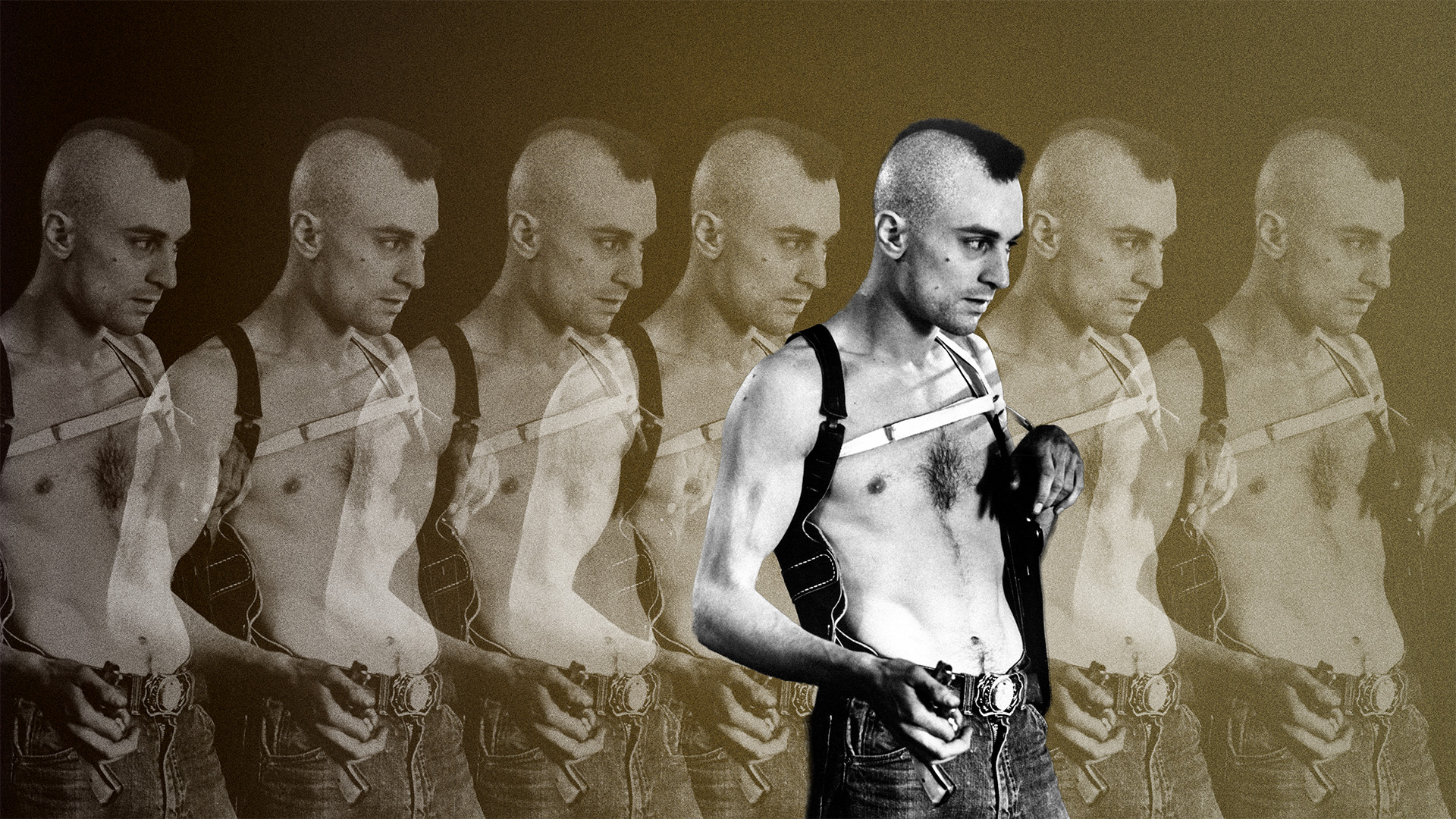
“Are you talking to me?” A man stands in front of a mirror, rehearsing a confrontation. He is an actor – Robert De Niro – playing a man – Travis Bickle – who is performing a part like a bad actor in the revenge movies that were all the rage in the seventies.
Bickle’s masculinity is in its mirror phase. He’s trying to fine-tune it, find a role which will project power into the world, power he doesn’t naturally have. He wants to be an Alpha. He trains himself with masochistic routines.
He writes in his diary: “June 29th. I gotta get in shape now. Too much sitting has ruined my body. Too much abuse has gone on for too long. From now on it’ll be 50 push-ups each morning, 50 pull-ups. There will be no more pills, there will be no more bad food, no more destroyers of my body. From now on it’ll be total organisation. Every muscle must be tight.”
If Travis Bickle was alive today he wouldn’t have a podcast, but he’d listen to them 24/7 and I don’t even have to tell you which ones.
Fifty years ago, Martin Scorsese’s Taxi Driver hit screens and today it is more relevant than ever. Written by transcendental nihilist Paul Schrader and starring the young Robert De Niro, the film was zeitgeist then and is zeitgeist now. It was New York, post-Vietnam urban alienation, with a grimy glamour or glamorous grime, sleazed up by Psycho-composer Bernard Hermann’s last score. It possesses an all-things-to-all-men politics.
You can cheer Travis’ monologues of misogyny and racism or deplore it: “All the animals come out at night: whores, skunk pussies, buggers, queens, fairies, dopers, junkies… sick, venal.” The depth of Dostoyevsky – “I’m God’s lonely man” – at the service of the urges of Michael Winner’s Death Wish, delivering a portrait in male loneliness and alienation with both detachment and intimacy.
The detachment is there from the start. We see the main character from angles that aren’t quite right. The film might edit him as he walks down the street, as he zones in and out. We hear his voiceover delivered in an affectless voice, reading his journal like a child reading out his homework – hesitant at times, finding a decisiveness only in rage, but a blank rage, not impassioned.
We don’t know much about him. He has no friends, no family. He claims to be a vet of the Vietnam war in his job interview and wears a military jacket, but the jacket could have been picked up in any thrift store and since when has anyone told the truth in a job interview? In Cinema Speculation, Quentin Tarantino argues that Bickle’s inability to deal with black people rules out a tour of duty in Vietnam.
Vietnam was a problem for the menly-men of New Hollywood. Machismo was to be had in the army and their dads’ wars in Europe and the Pacific served as precedents, but no one really wanted to go and get killed in south-east Asia.
John Milius, who wrote the first two first two Dirty Harry films and co-wrote Apocalypse Now, spent all his time shooting guns off and talking about being a warrior poet, but when it came to Vietnam, he was rejected because he had asthma. Scorsese also had asthma and was happy to stay home watching and making films.
Schrader also got a medical deferral but has used the image of the Vietnam veteran as a way of embodying retributive violence in Taxi Driver and in Rolling Thunder, a proto-First Blood prefiguring Sylvester Stallone’s fantasy figure John Rambo. Sly also never went to Vietnam, getting a medical deferral and spending the war as a PE teacher in Switzerland, which is, if you think about it, the opposite of going to Vietnam.
John Wayne – quite rightly – got no end of aggro for being a patriotic blowhard while at the same time skipping out on world war two. He also made a laughably bad film about Vietnam, but he had this over the New Hollywood lads: he did actually visit the country.
Like Milius, Schrader became something of a gun nut and let it be known that while writing Taxi Driver, he slept with a loaded pistol under his pillow; to which the only response is: “oooh hard.” In Mr Runner-Up, a 2016 episode of the spoof series Documentary Now!, a version of Schrader is shown who can only write screenplays by tapping on the typewriter keys with two loaded handguns.
Bickle works as a New York taxi driver, taking shift after shift, an insomniac pill-popper. He goes to porn theaters when off work. If he’s scared of black folks, his relationship with women is terrified.
He falls – at a distance – for Betsy, played by Cybil Shepherd. She is described in the screenplay as cover-girl-beautiful, who is always assessing men for their potential: “Simple pose and status do not impress her; she seeks out the extraordinary qualities in men. She is, in other words, a star-fucker of the highest order.”
Leave aside the misogyny (actually, don’t leave it aside, underline it – I shall return to it later), it makes the least credible part of the film even less credible. How does Betsy find anything remotely attractive about our taxi driver? Is it just that he looks like Robert De Niro? How doesn’t she pick up on how weird and dumb this man is? When she agrees to a date, he takes her to see a porno, obvs.
The other significant female in his life is the 12-year-old sex worker Iris, played by Jodie Foster. Once he’s been definitively rejected by his Aryan ideal of womanhood, Betsy, he starts to obsess about Iris, the child he wants to rescue from her pimp, Sport (Harvey Keitel). In the script, Iris is 14 and has a nude scene revealing her breasts like “two young doves hiding from a winter wind.” You can hear the pistols rattling as Schrader tapped that line out. Jesus indeed wept.
Suggested Reading


The Berlin Film Festival’s cowardly retreat over Gaza
When Travis talks to Iris, he’s more or less on the same level. As his childish handwriting indicates, Travis is not particularly developed. Even when he goes to the porno theatres, he watches from between his fingers and eats candy like a kid.
None of this is to say that Taxi Driver is a bad film. It isn’t. In fact, it’s a masterpiece. It’s just that what it is showing us has changed in the half-century that has passed.
What its writer and director intended is no longer what we experience watching it. Then it was the backwash of the ‘60s and the hippies – Iris is a hippy prostitute and Betsy is a product of women’s lib as seen through a chauvinistic lens.
Bickle himself was seen as an anti-hero: a poster-boy for alienation and a proto-punk icon. He’s inarticulate, except for his exercise books. When given an opportunity by a politician to voice his prime concern, all he can come up with is the gripe that New York is smelly.
Nowadays, we’d call Bickle an incel. This neologism was first coined by a woman called Alana in the ‘90s to describe an online community for the lonely and involuntarily celibate, or incel, which soon morphed to incel. The idea was to support this neglected community and help them.
But through the years, the term was co-opted by an increasingly aggressive group of men who indulged in misogyny and blamed feminism for their plight and despised women, who are on the lookout for “Chads,” the high-status males attractive to “starfuckers” like Betsy. When an incel becomes convinced of the permanence of their inceldom, they are described as black-pilled.
In 2014, Elliot Rodger killed six people and injured 14 more before taking his own life in Isla Vista, California. He recorded a video message immediately before embarking on the spree, identifying as an incel and left behind a 137-page manifesto.
Suggested Reading
Melania’s Leni Riefenstahl: The queasy resurrection of Brett Ratner
Travis Bickle has similar energy. His voiceovers wouldn’t look out of place on a Reddit board. Once Betsy has rejected him, he’s effectively black-pilled. His relationship with Iris isn’t sexual but pre-sexual. He wants to take her back to her childhood. His championing of Iris is like the QAnon conspiracist willing to believe all sorts of guff about pizza parlours.
There are other parallels. The other taxi drivers are casually racist, homophobic and sexist, but Bickle is a full-on white supremacist who hankers for extermination: “Someday, a real rain will come and wash all this scum off the streets.”
Sport has called him “cowboy” because of his boots, but why does he cut his hair into a mohawk? Scorsese has referred to a group of GIs who would adopt the haircut if given a particularly dangerous mission as inspiration, but it could also be seen as his going native, American Shaman style. It is the pre-mass murder. This is someone who no longer wants to affiliate himself with anything or anyone. He’s ready to go on the rampage.
The nihilism of Taxi Driver makes the film more urgent now than it has been since its release. Rewatching it, we see Travis Bickle asking, “Are you talking to me?” We might not want to talk to him, but the film is definitely talking to us.
John Bleasdale’s novel Connery, about the life of Sean Connery, is out now, published by Plumeria
 Most popular
Face it: Trump’s going mad

Matt Goodwin, Zack Polanski and Lucifer: the fight for Gorton and Denton

The coercive control of Marco Rubio’s Munich doctrine
Am I still a friend of Peter Mandelson? It's complicated