
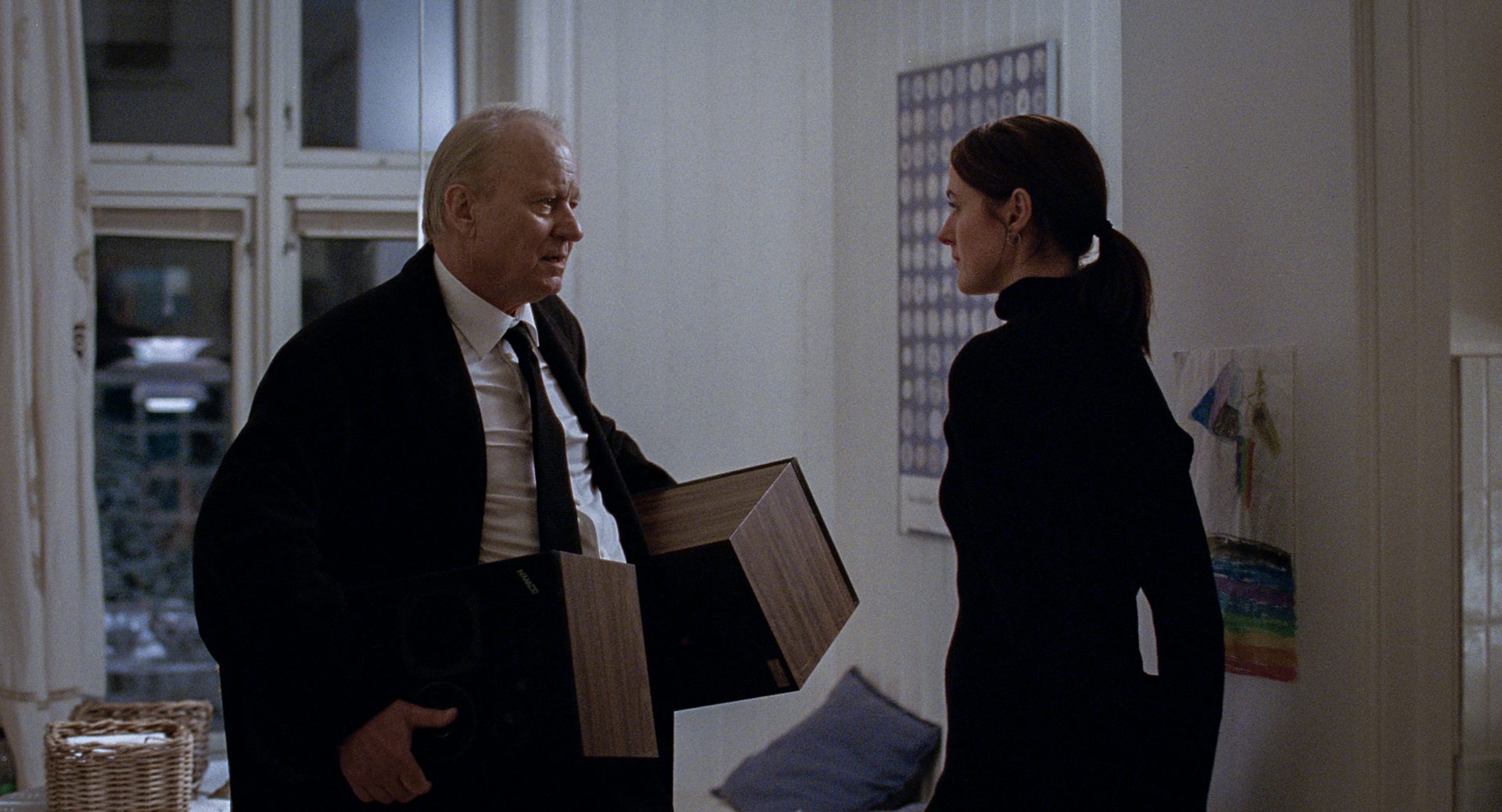
“Is that AI?” Renate Reinsve is telling me off. “I’m very against AI,” she says.
She’s peering at my transcription software, which is reproducing our conversation on my tablet screen as we speak. “It’s like that scene in Harry Potter, where the quill writes what’s being said.”
“I feel like I’m the bad man now,” I say.
“No, I’m non-judgmental,” Reinsve says. “And this is a very non-judgmental movie.”
We’re on the top floor of a hotel in central Oslo, talking about Joachim Trier’s Sentimental Value, the Norwegian hit film which won the Grand Prix at Cannes, stormed the festival circuit and is now officially a hot Oscar contender in several different categories, including (for my money) best actress.
The film tells the story of a dysfunctional middle-class family. Stellan Sarsgaard is the film-director dad, Gustav, largely absent from his two daughters’ lives. Their mother is a psychiatrist who has suffered from depression.
Nora (Reinsve) becomes a famous actress, her sister Agnes, played by Inga Ibsdotter Lilleaas, is a historian. When Gustav returns to the family home for a funeral, it leads to an uneasy meeting and a proposal that Nora star in his new film, which recreates his own trauma of dealing with his mother’s suicide.
Suggested Reading


Are the movies finally getting mental illness right?
At its heart, the film explores how being an artist can compromise a family. As the Polish poet Czesław Miłosz once wrote: “When a writer is born into a family, the family is finished.”
But Reinsve sees it a little more openly: “It’s different for all families. Ingrid Bergman, she was also away a lot, but her family feels that she was really present, because when she was there, she was really present, and they always felt loved.
“Gustav struggles to communicate anything apart from his work, and that’s why his family is affected, because that’s the only place he can be sensitive or understand anything. And I feel Nora is exactly the same. She doesn’t know how to express or process what she’s been going through, except on stage. So they’re quite similar in that way. But so it’s not about the absence itself, so much as the way he was when he was there too.”
Do you feel that way in your own life? “It’s kind of invisible that suddenly you don’t notice that you’ve not been with your friends for a couple of months, right? Because you’ve been away, and I really aspire to try to keep those relationships.
“And because everything is changing so much, it becomes even more important with those things that ground you, but you also want to fulfill your ambition. In my heart, I know that what really matters is the friendships and family, and so I really try to make an effort.”
Although Reinsve had appeared in Joachim Trier’s Oslo, August 31st in 2011, it was a decade later that she broke out, reuniting with the director in a role he’d specifically written for her Julie in The Worst Person in the World. The role won her awards in Cannes, a BAFTA and international acclaim.
She went on to star opposite Jake Gyllenhaal in the miniseries Presumed Innocent, but it is once more with Trier that she is given a central role of complexity and nuance that we see her skills for comedy and drama. She deserves comparison with the greats: Diane Keaton and Gina Rowlands both spring to me, especially the latter in an introductory scene that recalls the actress in John Cassavetes’ Opening Night.
“I have very little anxiety,” Reinsve says. “I did a test this summer, and I scored super low. I love playing panic. So I had a lot of fun. And I really love comedy. So it was like my time to do a bit of comedy for once, then a lot of heavy emotions.
“Whenever you have to do acting, you have to actually open up in front of a whole room of a crew and a director, and you have to make it truthful, to actually open up places in myself. And when Nora gets to the threshold of opening up, all of this stuff comes out, and she’s not ready to deal with it, so her panic is to try to get her away from actually opening up.
“When she goes on stage, all that power that comes out is her anger, her sadness, her fears. It is everything she’s carrying that she hasn’t processed. So it makes her a very powerful actor, but she really doesn’t know, want or know how to go there when it happens.”
Lilleaas, who acted with Reinsve years earlier at a children’s theater, says that doing so again reignited a certain chemistry. “With her, it’s just alive the whole time, and I can say something, and I can see that it affects her what I say, and that affects me back, you know? So it becomes very real and natural. It’s just like being alive and experiencing the moment together without thinking so much about the fact it’s a movie.”
From children’s theatre in the woods in Norway to Hollywood is a crazy journey. “It’s so crazy,” Reinsve says. “I didn’t even dream of it, because it’s impossible when you come from a really, really small place.
“I’ve done theatre for 25 years before I did The Worst Person in the World, and that was my first lead in a movie ever. So, it wasn’t even on my radar, but it’s, yeah, it’s so funny to think about being on stage in the forest in Norway, with just kids, and then going all the way to the biggest award for actors in the world. It’s impossible to even comprehend.”
Sentimental Value is in cinemas on December 26
 Most popular

Matt Goodwin’s road to derision

GB News Scandal: How Ofcom let GB News corrupt British media

GB News sets its lawyers on to The New World
Matt Goodwin’s new book: The missing chapter