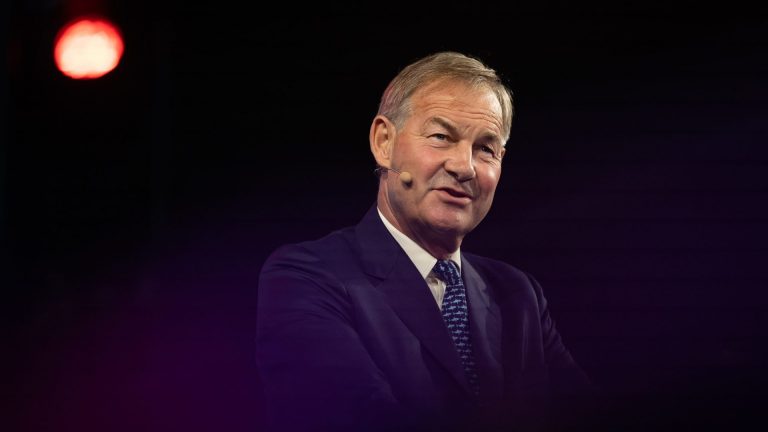
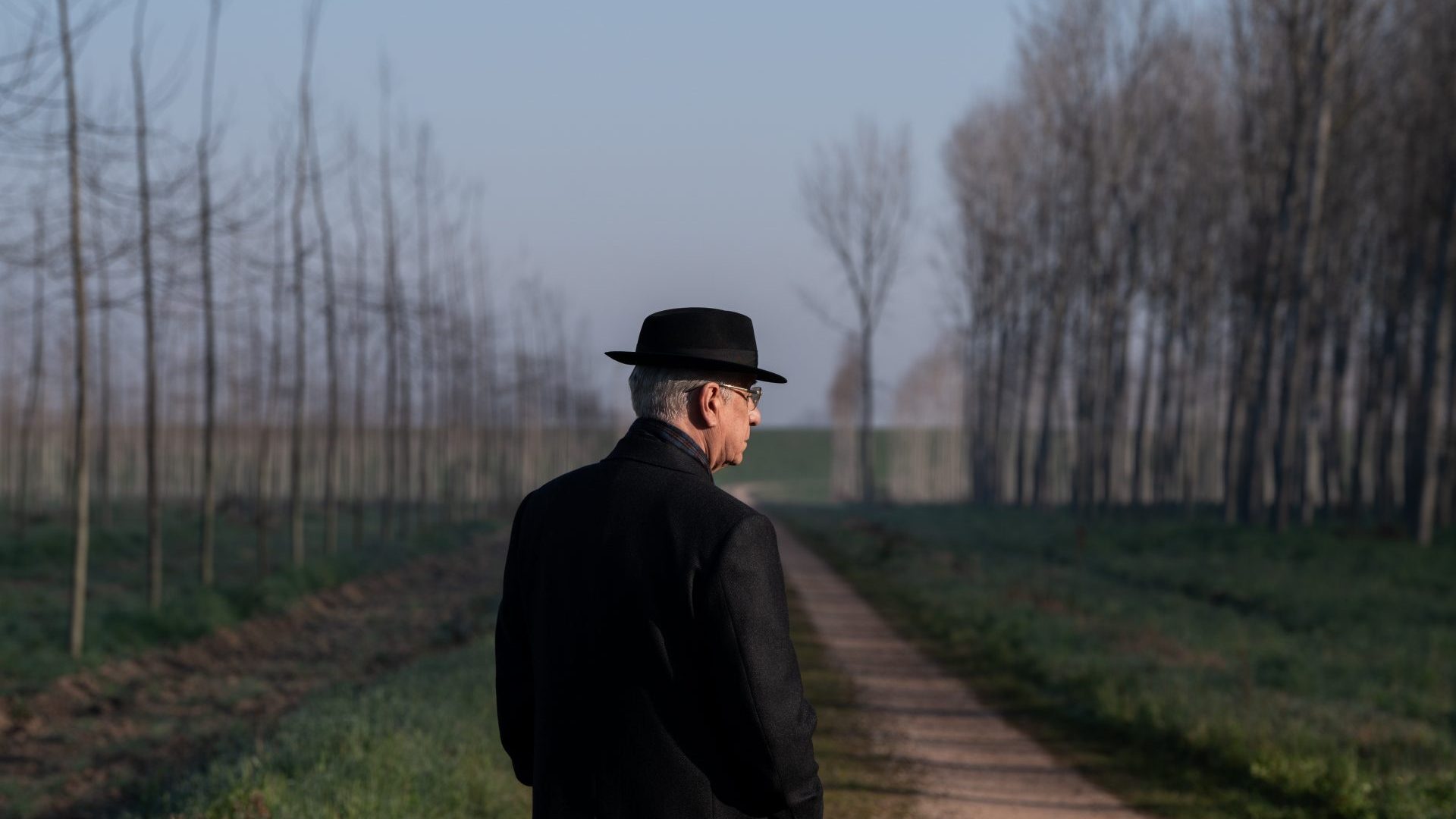
There’s a lot about Paolo Sorrentino’s new film La Grazia that feels familiar. It stars Tony Servillo, his frequent collaborator and one of Italy’s finest actors, and deals with the complicated involutions of Italian politics as he has done previously in his remarkable breakthrough hit Il Divo and his epic car-crashy Loro.
However, there’s a new thoughtfulness to the film, a maturation. And there are fewer tits.
Servillo plays Mariano de Santis, an Italian president in the last weeks of his final term as head of state. De Santis has a largely institutional and ceremonial role. He welcomes ambassadors, checks in with the Pope, fends off talks about his successor and deals with two important cases where he deliberates over whether or not to give a pardon, the grazia of the title.
“The film draws inspiration from moral dilemmas, and that is the central issue around which the film revolves,” Sorrentino tells me when we speak over Zoom, an unlit cigar in his hand. “I wanted to focus on how the president of a country, who holds a position of great responsibility, needs to tackle ethical themes, ethical issues.
“And among the most thorny and the most challenging ones is the end of life, and euthanasia. And if you draw that over a man who is of a certain age and is concerned about how his own life is going to end, I thought it would become a solid dramatic element.”
Sorrentino based Il Divo on the career of Giulio Andreotti. Prime minister for three spells – the first in the early 1970s and the last in the early 1990s, he, for many, exemplified the Machiavellian manoeuvres of Italy’s First Republic and its attendant allegations of corruption and collusion with organised crime and the CIA.
Then, in his 2018 political epic Loro, Servillo played Silvio Berlusconi, the proto-Trump populist who bent the country into his own image of broad populism and self-serving illegality. The film suffered from Sorrentino’s attempt to out-crass the insurmountable tastelessness of the man who brought Bunga-Bunga into the vocabulary.
Is La Grazia, which focuses on a very different kind of politician, then the third part of a political trilogy? “No, no. I never thought that in my life I would make a trilogy, so to speak,” Sorrentino says. “It’s a coincidence that I had politicians as protagonists three times, but there isn’t a deep desire to say something broader or more complex on this kind of figure. So it’s truly a coincidence.”
The current prime minister, Giorgia Meloni, is for many outside of Italy, like a foreign film without subtitles – intriguing and intellectual. She’s not as obviously oafish as Viktor Orbán or Javier Milei, Argentina’s Temu version of Wolverine, but once you toggle the subtitles on, it’s the same old fascist shit.
In comparison, de Santis is a refreshingly uncynical view of a man who is far from the kind of populist that pollutes our current environment. “If the world were led by people such as our president in La Grazia, a man who has an idea of politics that is based on wisdom, on using intelligence, doubt and common sense, the world would definitely be a much better place.
“That kind of politician was there in the past, but it’s as if it has gone out of fashion these days, and it’s as if people like him no longer work in politics, but they work in other areas, and therefore we’re finding ourselves with a world that’s in the hands of people who seem to use politics as opposed to seeing it as a wonderful tool that is in the service of the common good.”
The film has been hailed in some circles as a return to form after 2024’s muddled Parthenope, and it is filmed in a way that is a stylistic departure for Sorrentino. He has exchanged playful grandiosity for subtle reflection, seeming to follow his lead character’s style.
Suggested Reading

A night when the Oscars almost mattered
“I definitely agree,” says Sorrentino. “It’s a type of character and a type of story where at the core there are moral dilemmas, and therefore I didn’t need to have a style that would be cumbersome or that would be at the forefront. It’s to some extent a classical approach to filmmaking, and style could take a step back.”
The film is also about the intergenerational transfer of power. The president listens to the latest Italian rapper and tries to connect with his daughter, who has served as his personal assistant for the years he’s been in power.
“I believe it is fundamental and very hard at the same time,” Sorrentino says. “As people become older – and I can definitely say that about myself – they tend to find shelter in a vision of the past that’s imaginary and that’s idealised.
“They see it as much more splendid and joyful compared to the present, and yet they should make an effort to fully understand the present, arming themselves with an attitude based on being humble and patient and listening to the younger generation; trying to fully see their reasons, even when they seem a little odd, because they’re the result of that raw, unbridled energy, which is characteristic of youth. It’s the only way not to fall prey to a sort of underlying, creeping depression: the only key to free themselves of that is to fully understand young people.”
Sorrentino often uses his soundtrack to great effect. The best parts of The Great Beauty were moments when the score synchronised with the beautiful images of Rome. This Must Be the Place, one of his two English-language features, starred Sean Penn as a Robert Smith-like goth star.
“Music often represents the inner turmoil of the character,” he says. “The inner life. So rap represents this president’s effort to try to understand the present, as opposed to sheltering himself in the past. Rap is the music of today, and it’s closer to his daughter than to him, and yet he tries to fully understand and appreciate it.”
Tony Servillo has starred in seven Sorrentino films in 20 years, which is approaching Scorsese/De Niro level of symbiosis (ten films together in a half-century). Was this written with Servillo in mind, and how has their relationship changed over their two decades working together?
“Yes, I did have Tony in mind from the start, because I really enjoy working with him. And I must say that it is not a relationship that has evolved, so to speak, because it was a very, very happy relationship from the get-go.
“We’ve always got along very well. We’ve never fought. We like to laugh about the same things. There’s other ways in which we’re very different, but I know how to understand his differences, and he knows how to understand and respect mine.”
It is an answer that reflects the spirit of La Grazia, which is ultimately an old-fashioned tale about growing old gracefully. This grace, coming as it does from one of the rowdies of Italian cinema, makes it his most quietly subversive film.
La Grazia is in cinemas now. John Bleasdale’s novel Connery is out now, published by Plumeria
 Most popular

Screen scandal: How Ofcom lets GB News get away with it
GB News Scandal: Read our dossier of their flagrant Ofcom breaches

GB News Scandal: The presenters

Claudia Winkleman’s chat show is afraid of Claudia Winkleman