When Jim Jarmusch took the stage at last year’s Venice film festival to receive the Golden Lion for Father Mother Sister Brother, his speech was pure Jarmusch. “Oh, shit!” he said.
Afterwards, he told a press conference he’d been surprised by the award. “I wish I’d written a better speech!”
Jarmusch is a poet of losers and the lost, of bus-driving poets and taxi drivers. And Father Mother Sister Brother is the kind of lo-fi, slow-burner, mumblecore before mumblecore if you will, that seems a million miles away from glitz and prizes.
“I’d rather make a film about a guy walking his dog than the emperor of China,” the director once said. There’s cognitive dissonance seeing someone like that winning.
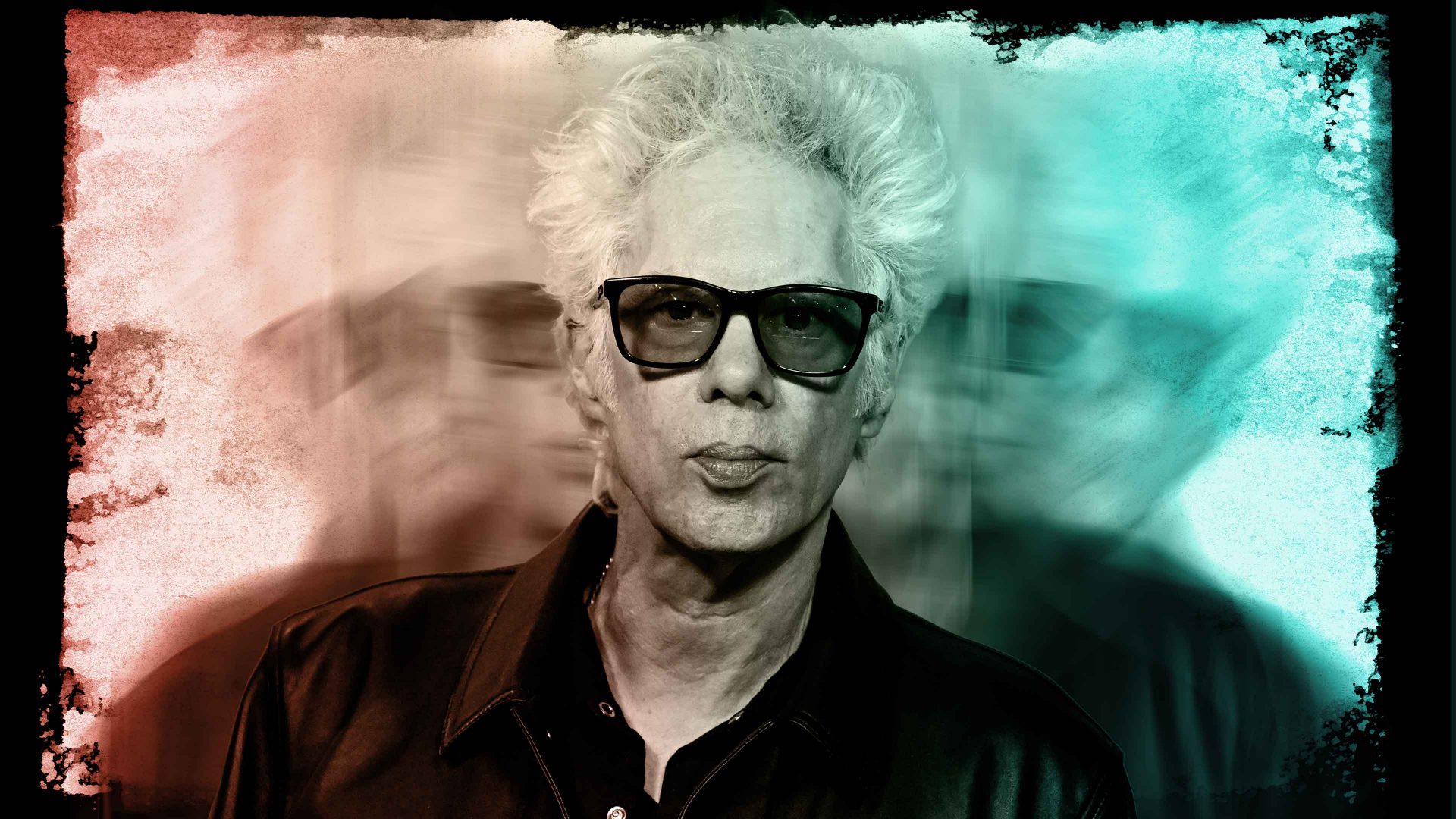
When we met, I was surprised by how – to quote Gandalf – he “hadn’t aged a day”. At 72, with his shock of white hair and black sunglasses, his skinny frame, Jarmusch looked like he had looked in the ‘80s when I first saw his films. Maybe his hair had already been 72, waiting for him to catch up.
Father Mother Sister Brother harks back to his earlier career. Like Mystery Train and Night on Earth, it is an anthology: this time telling the stories of three different families.
“They’re separate movements in one piece of music, and I worked very, very hard to make them accumulate,” he says. “Seeing them alone would be mortifying to me, because I worked very hard to build them.”
How did he go about this process? “I like to think of actors I want to create something with. So I started out with Tom Waits, then thinking Adam Driver as his son would be interesting. And then Mayim Bialik [from The Big Bang Theory]. She was a host on Jeopardy, and I love Jeopardy
“.Then while I’m writing that story, the other two are starting to form. And then, of course, Cate [Blanchett], Charlotte [Rampling] and Vicky [Krieps]. Vicky and Charlotte are the only two actors I have not worked with before, and Mayim also.”
It’s a stunning cast and the pleasure of the film is hanging out with the characters and their nuances. “I gather little seeds, and then I write very fast,” Jarmusch says. “The first one began, the garden was starting to grow, and then the other started. And then I wrote it quite fast. But I don’t really analyse where it comes from. It’s not autobiographical. It’s just observational.”
Born in Cuyahoga Falls, Ohio in the early 1950s, Jarmusch went to New York originally to become a poet, before a year in Paris as an exchange student changed his mind. The city appears in the final vignette as a pair of twins sort out their parents’ effects following their untimely death.
“Paris is very important to me, personally. It’s why I make films,” he says. “I went to study in Paris when I was 20, and I came from Columbia University in New York, and I came back not having fulfilled my studies because I spent all my time in the cinemathèque. I saw movies from India, Japan and China and old Hollywood movies.
“My mind was just so excited. It was electrified, and that’s where I became obsessed with this beautiful form where humans tell stories with a camera. It’s my second favourite city after New York. I’m currently trying to get a French artist visa, just so I can live there too.”
The first vignette is set in upstate New York, near where Jarmusch occasionally lives. “I like the landscape,” he says. The second part features Rampling as an English novelist in Ireland receiving her daughters for a tea party: “I wrote it first as London, but as soon as I finished the script and read it, I thought Ireland would be better. Ireland celebrates writers, and you don’t pay taxes if you’re a writer there: they’re storytellers.”
It’s been six years since his last film, the zomcom The Dead Don’t Die, and this is definitely a return to something more realistic. “It takes a lot of effort to look effortless,” he says. “It was very focused. Making this film is much more difficult than having 12 zombies come out of their graves.
“It’s harder to watch a gesture of Cate Blanchett with the right concentration. I learn every time. I’m still trying to learn. How do you do this thing?”
One form of inspiration comes in the form of Marguerite Duras, the French novelist and director whose scripts he reads before embarking on a new film: “I don’t like scripts, because scripts are not literature. They’re kind of frustrating. I never mention the camera in my script. I try to keep it very simple,” he says.
“And Duras is so elegantly simple. She’ll write something like ‘She responded with a negative gesture.’ She has this beautiful way of reducing prose into poetry. And so I always read Marguerite Duras before starting the script, and I get a voice. My scripts are no Marguerite Duras, but it’s a very important guide.”
Suggested Reading
Whatever happened to the great film comedy?
Another important teacher for Jarmusch was the director of Rebel Without a Cause and Bitter Victory. “I learned from Nicholas Ray when I was his assistant in the last years of his life, that it’s best to talk to each actor separately, because their character is separate,” he says. What this means in practice is that Jarmusch shuns rehearsals and also likes to use as few takes as possible.
“In Ireland at one point, Vicky, Cate and Charlotte wanted to read through together and have a rehearsal. And I said, ‘you’re welcome to but I will not be there’. I don’t like rehearsing, because acting, for me, is not acting out the thing that’s on the page, but reacting to one another. It’s why I like all the silences, too, and the moments when things aren’t said.”
Jarmusch shoots quickly. “Three or four takes and I’m good,” he says, though he’ll go further if he thinks he might catch a mistake, or something natural. It’s a deeply humanistic viewpoint that chimes with his humility.
When we sit down to talk before we begin he thanks me for the time I have spent watching his film. It’s not something I’ve come to expect from famous film directors. He also tells me about learning to make a decent cup of tea from Joe Strummer of the Clash, which leads to one of the best jokes in the film.
Jarmusch’s families are far from perfect – a father taking money from a son, a daughter boosting her current situation to her mother – and yet there’s something celebratory about the film. “I feel tender toward the characters because I don’t want to judge them,” he tells me. “I don’t like the good guy, bad guy thing. They are flawed people, and we see their flaws, but we don’t judge their flaws.
“I was concerned after I shot the first one and was cutting it. I don’t want the Tom Waits character to come off like an asshole because he is milking his son. He’s deceptive but he’s not an asshole.
“He takes advantage of his son, and the son, in a way, allows him to and the sister sees it all. She knows what’s happening. Did you think he was an asshole?”
No. (I could never think of Tom Waits as an asshole.)
“There were some bad guys in Dead Man, the bounty hunters, but that’s a different kind of story,” Jarmusch says of perhaps his most famous film, an existential western starring Johnny Depp in his prime. Jarmusch has always dipped his toe into genres, from the hitman movie Ghost Dog to the vampire film Only Lovers Left Alive, but he’s never made a conventional Hollywood film. His biggest hit was the laconic road movie Broken Flowers, starring Bill Murray at the peak of his second wind.
As a fiercely independent film-maker, commercial success beyond financing his next project doesn’t seem to have been a priority. “My religion is the religion of the imagination,” Jarmusch says. “Artists and scientists and people who create things that don’t exist, like architects, etc, so that the Hegelian dialectic is in all these things. Presenting a thesis, antithesis, synthesis is the procedure of creation. It’s procreation. The Holy Trinity. Those three things are magical to me. What was the question? Sorry, I’m sleep-deprived.”
But this is our jet-lagged genius, a somnambulant Socrates working his way towards the truth, while we’re grasping after the shadows on the cave wall: “Lawrence Ferlinghetti said ‘you don’t have to understand a poem to know what it means’,” he tells me.
“I’m a huge fan of surrealism, because it is not a negative thing. Dadaism, which was big for me as a teenager, was like punk rock and underground hip-hop. But surrealism is very optimistic, because it’s joining things, tangible things of the real world, with things that are from the subconscious. So the real world and not giving either one priority, because we don’t prioritise the subconscious, or what we think reality is.”
Jarmusch is a holistic film-maker who reads books and makes music. He’s a poet who understands the white space that poems need, and the pauses that inform conversation. “I’m very obsessed, partially through the use of psilocybin, with the theory of the single consciousness of the universe. So I read Jung, Schrödinger and Terence McKenna and this concept that each one of us has our own perceptions, but we are all one universe: the Consciousness in the Universe. Those trees out there, those plants, they are all one consciousness.
“As soon as you think: I have my own consciousness, then you’re employing the ego, which is negative. Ego can be valuable to accomplish things in the world, but it’s not the right way to be. I don’t want to get all new agey, but I’m very interested in that.”
Is that reflected in the title of the film Father Mother Sister Brother? I ask.
“It’s probably woven in there,” Jarmusch says. “There’s an old joke of the Buddhist priest who takes his son up to the mountaintop, and they look out over the landscape, and he says, ‘My son, someday, all of this will be you.’”
Father Mother Sister Brother is released in the UK on April 10
 Most popular
Exclusive: New Ofcom chair appointed – but will he fix Musk and GB News?

Screen scandal: How Ofcom lets GB News get away with it
Matt Goodwin’s new book: The missing chapter

I worked at BuzzFeed. Here’s the truth about why it’s on its last legs