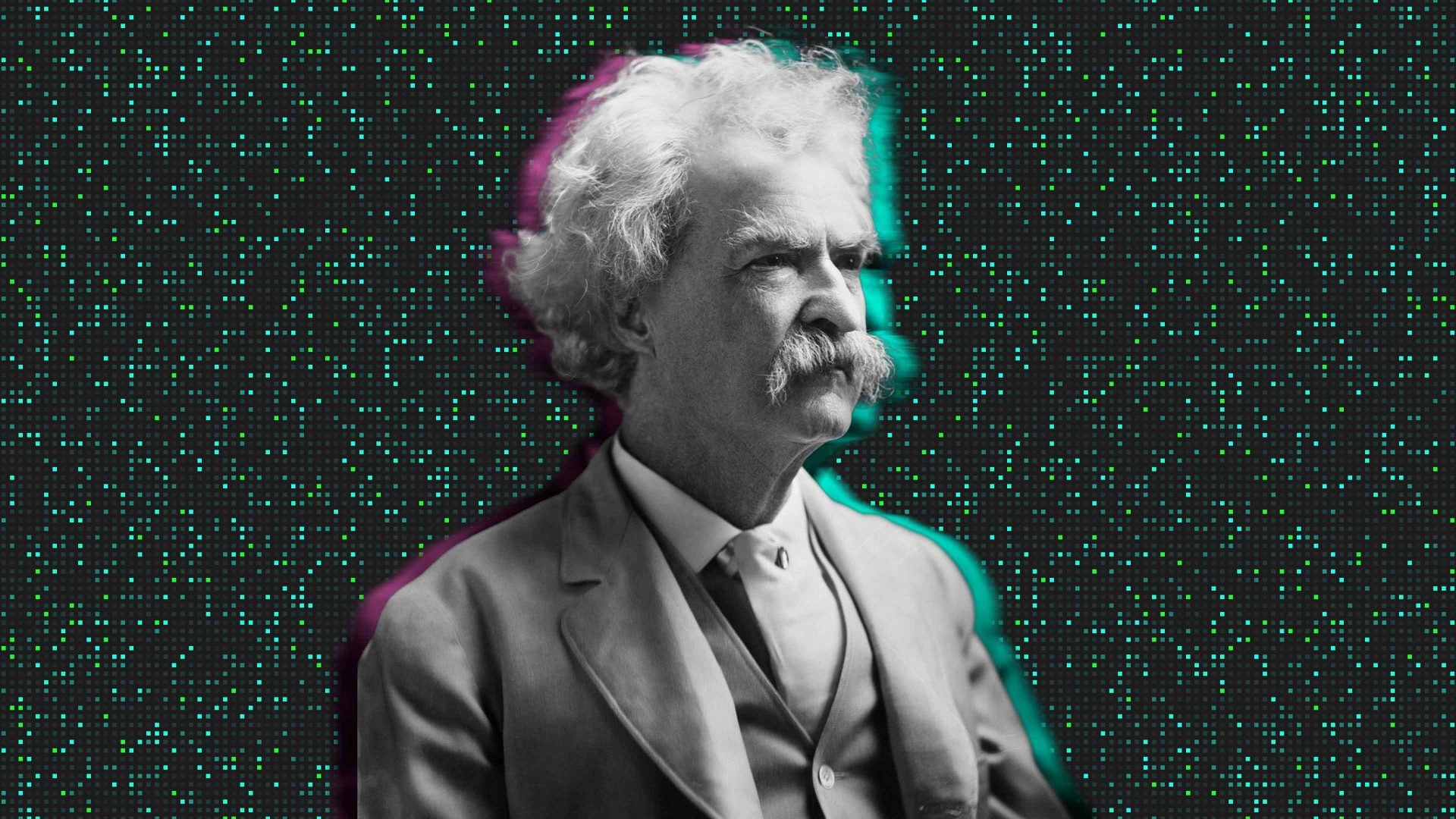
The Gilded Age author Mark Twain was enamoured of technology. He bought one of the original Remington typewriters, though he found it “full of caprices, full of defects – devilish ones.”
He had a first home phone installed in his Connecticut mansion. “Great is the telephone,” he declared. “We do live in an age compared to which all other ages are dull & eventless.” Twain fancied himself an inventor (of a sticky scrapbook, an inscrutable board game, and the precursor to the bra strap) and an investor. He was terrible at both.
Twain’s first of many vocations – riverboat pilot, miner, journalist, author, publisher – was as a printer’s devil or apprentice. He set type in his brother’s ratty Missouri newspaper, one lead letter at a time, then pulled the handle on a creaky, wooden press such as Ben Franklin used, up to 200 times an hour.
At 17, he left to wander America as a tramp printer, witnessing startling advances in the technology of publishing – most notably the steam-powered press, which churned out thousands of pages an hour. With it, the average circulation of daily newspapers leapt from just 4,000 to hundreds of thousands.
Suggested Reading


AI is designing viruses – what could possibly go wrong?
The dawn of mass media was nigh, but one person stood in the way of unhindered publishing progress. That was the compositor, who like Twain still set type the way it had been set since Gutenberg. As many as 100 compositors laboured in any city newspaper. The swiftest among them would have taken as long as two hours to set just the two paragraphs above. They could not keep pace with the lightning speed of news coming off the new telegraph or produce enough text to fill growing newspapers now printed on cheap paper made from wood pulp.
“It is discreditable to the inventive genius of this country that the one great mechanical want of our time is still unsupplied,” the New York World cried in 1869. “We want the means of supplying the demand for reading matter. The inventive talent of the country produced the steamboat, the cotton-gin, and the electric telegraph.” Why not yet a typesetting machine? Hundreds tried and failed.
Twain himself maintained that “a successful type-setting machine was an impossibility, for the reason that a machine cannot be made to think, and the thing that sets movable type must think or retire defeated.” Then he met James W Paige, “a most great and genuine poet, whose sublime creations are written in steel.”
He saw Paige’s improbable metal automaton in action, which “did most thoroughly amaze me. Here was a machine that was really setting type; and doing it with swiftness and accuracy, too.” He invested $2,000 on the spot. “I was always careful to risk only such amounts as I could easily afford to lose,” Twain said.
Such are the famous last words of the gambling man. Paige’s machine was as miraculous as it was disastrous, the inventor fiddling and futzing away Twain’s and his wife’s fortunes – roughly $200,000 then; more than £5m today.
Meanwhile, another inventor, German watchmaker Ottmar Mergenthaler, created the first successful typesetting machine, the Linotype. Unlike Paige’s, it did not replicate the delicate tasks of the compositor: picking letters, adding spaces to fill out lines, then redistributing type for reuse. The Linotype used matrices for each letter to instead mould entire lines of type, vastly speeding up the process of producing that daily miracle, the newspaper, and opening the floodgates to mass media with more, fatter, and cheaper publications.
Twain declared defeat and bankruptcy. Literary scholars have long debated how the failure of the Paige Compositor affected the novelist’s worldview and writing.
His later-life disillusionment and anger with technology seems evident in the denouement of A Connecticut Yankee in King Arthur’s Court. In it, Twain’s time-travelling hero introduces no end of misplaced modernity to Camelot – electricity, steam, telegraph, telephone, and newspapers – only to explode it all in a technological Armageddon presaging the horror of the first world war.
Hank’s young page, Clarence (“you ain’t more than a paragraph”), concludes: “We were in a trap, you see – a trap of our own making.” Is this Twain’s warning of the perils of technological progress?
Twain’s last and unfinished novel, No 44, The Mysterious Stranger, is even more telling. In it, he conjures ghostly “Duplicates” of human printers that take over a Gutenberg-era pressroom, themselves duplicating ceaseless pages of print as if by thinking machines.
Suggested Reading
We, the tweeters
We today can empathise with what Twain’s Gilded Age must have experienced under a sudden flood of text. With the advent of artificial intelligence, University of Virginia scholar Matthew Kirschenbaum warns of a Textpocalypse, when large language models generate words “in quantities so immense as to be all but unimaginable – a tsunami of text swept into a self-perpetuating cataract of content that makes it functionally impossible to reliably communicate.” Are large language models not the invisible embodiments of Twain’s Duplicates? Was this Twain’s warning of AI?
But fear not. There’s an app for that. An online company offers a program to “humanise any AI-generated text” and “enhance bland AI text into engaging and readable content that won’t get flagged by Google as low-quality AI-generated content.” The application’s brand: TwainGPT.
Jeff Jarvis’s Hot Type: The Magnificent Machine That Gave Birth to Mass Media and Drove Mark Twain Mad is published by Bloomsbury