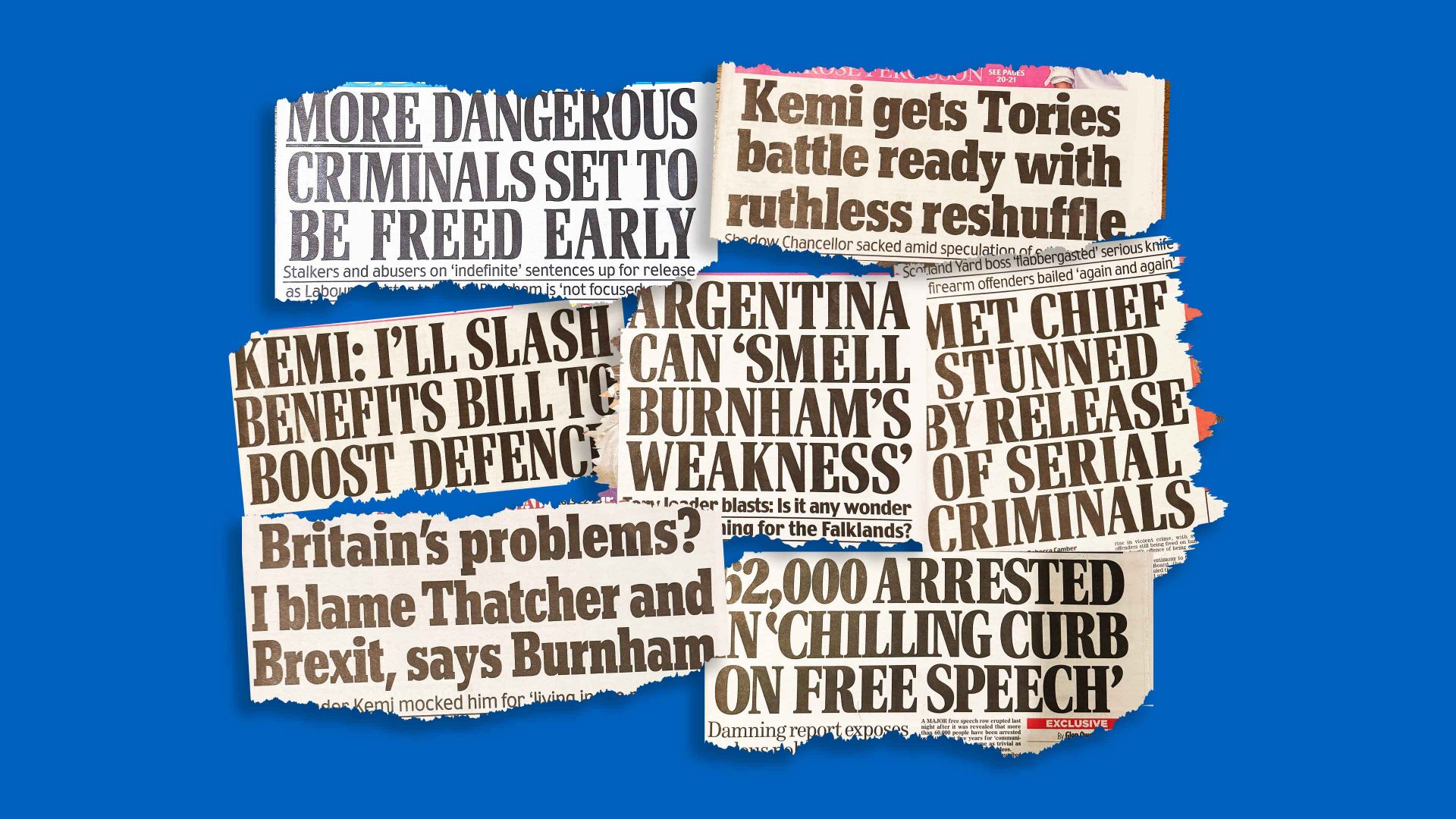
On July 7, the Daily Mail was in celebratory mood. After a years-long and bitterly acrimonious legal case, the High Court had rejected allegations by a group of claimants – among them Prince Harry, Elton John and Baroness Doreen Lawrence, mother of murder victim Stephen Lawrence – that it had engaged in the same kinds of practices that led to the closure of the News of the World in 2011. Cheers and champagne greeted the verdicts in and around the Daily Mail and General Trust group’s plush HQ in London’s Kensington.
The Mail had stood accused of phone hacking, use of private investigators, and unlawful payments for stories. Tens of millions of pounds in costs and damages were at stake, but more than that, so was its reputation as the paper of Britain’s respectable, conservative middle classes. Unlike many of the Fleet Street rivals that it has left in its wake, the right wing juggernaut had always denied all wrongdoing.
When the judgment came, the High Court dismissed every claim against the Mail. Paul Dacre, editor for more than 25 years, and still the Mail papers’ nominal editor-in-chief, made no effort to hide his delight at the ruling. “That is an OVERWHELMING vindication of our journalism,” he wrote. “The truth is this trumped-up action… should never have been brought to trial.”
For some Mail observers, though, the joy and bubbly felt like a temporary respite from dark clouds that had been beginning to gather. In February, its parent company released worrying figures showing an uncertain future for the brand that literally invented the idea of middle Britain – with sharply falling digital revenue now joining chronic declines in print and print advertising. Sources questioned whether high command was responding decisively enough to these depressing trends.
A dark cloud of another kind emerged on September 10, when far right activist and former Tommy Robinson bodyguard “Danny Tommo” rallied black balaclava-clad members of his Patriot Platform group outside the Mail offices, demanding that the paper buy his mother a new house, after a reporter had doorstepped her at home. “I expect this propagandist, enemy-of-the-people newspaper to do the right thing. If you do not, this will continue, and continue, until you do,” Tommo (real name Daniel Thomas) warned in a speech which journalists inside the building followed on social media.
The previous day, the Mail had run a profile, noting the “privately educated” Thomas – who had led a black-clad mob in Portsmouth the previous weekend – held a criminal conviction for kidnapping, and had visited his mother’s address because it was listed on Companies House as the base of a company owned by him. Thomas’s action against the paper soon fizzled out, but its impression continues to reverberate.
Like the court case, the Tommo farrago showed a newspaper battling to keep hold of its identity and its legacy. For years, the Mail and its Sunday counterpart have dominated what used to be called Fleet Street. The Mail’s political power has been unrivalled, seeing it become the effective arbiter and agenda-setter of the British right.
Meanwhile, it operated one of the world’s most popular newspaper websites – a hit that seemed to guarantee the Mail’s lasting place at the forefront of a new, digital era of journalism. Ironically for a newspaper so steeped in tradition, the success of MailOnline shaped global media for a decade – the stack ’em high, sell ’em cheap online model of chasing Google traffic in return for advertising cash based on clicks was perfected by the Mail.
These successes enabled it to massively outspend its rivals, boosting pagination while keeping cover prices low and hiring the writers it wanted on high wages that might double or treble what they were earning at their old employers. Richard Littlejohn was poached from the Sun in 2005 for a reported £1m a year. He is still there, continuing to report that Britain is going to hell in a handcart while living for much of the year in Florida.
The paper paid huge amounts for stories and serialisations too – reportedly £750,000 for Victoria Beckham’s autobiography in 2001. Its magnificent art deco HQ in the former Barkers of Kensington department store – complete with glass elevators and black marble busts of Mail luminaries – spoke volumes about the brand’s swaggering self-confidence and seemingly bottomless resources.
But now the Mail feels like a less assured place, one fighting to retain its very place in the world. The legal action threatened the paper’s reputation, and the legacy of its apex years, when Dacre was in the editor’s chair. His greatest journalistic triumph as editor was his campaign for justice for murdered Black teenager Stephen Lawrence – and yet here was Lawrence’s mother, suing the newspaper for allegedly violating her privacy and her trust.
Tommo and his thugs lining up outside the Mail’s offices, calling it an “enemy of the people”, showed something else: as Britain’s right fragments and radicalises, the newspaper that used to speak for it is struggling to find its voice – and part of its core constituency is no longer listening.
Print circulation has been in decline for decades. In late 2025, the Mail was selling less than 620,000 copies a day – a million copies down in a decade. Now online reach is plummeting, as the Google era of online publication draws to an end.
And the Mail, with its dwindling, ageing readership, feels increasingly out of touch with the modern British right. Is its time coming to an end?
The Daily Mail was founded in 1896 by two brothers, Alfred and Harold Harmsworth, as a cheap, mass-market alternative to the existing, stuffy newspapers of the establishment – leading to its dismissal by prime minister Lord Salisbury as a newspaper “produced by office boys, for office boys”. The newspaper was virtually an overnight success, and propelled the brothers firmly into the British establishment: Alfred became Lord Northcliffe – for whom the Mail’s headquarters are named – while Harold became Viscount Rothermere, and his descendants continue to own and control the DMGT group to this day.
The long association between the Rothermeres and the Mail is well known, but less well known is that the Harmsworth brothers were also the founders of the Daily Mirror, just seven years after the Mail, though they later sold off the Mirror.
You can easily argue that the Mail started as it meant to go on. In the early 20th century, it published a hoax letter purportedly showing British communists taking their orders from Moscow – just days before the 1924 general election, doing significant damage to Labour and helping to boot Ramsay MacDonald out of No 10. It also launched a vicious, racist campaign against immigration from China, which it dubbed the “yellow peril”.
Suggested Reading

Screen scandal: How Ofcom lets GB News get away with it
Most notoriously in this era, though, was Rothermere’s open admiration of fascism, and his friendships with Oswald Mosley and even Adolf Hitler. The Mail headline “Hurrah for the Blackshirts”, published in 1934 in celebration of Mosley’s British Union of Fascists, is the best-known such example, but perhaps not the most outrageous.
As late as August 1938, when the rumblings of the second world war were already well underway, and Germany was barely even trying to hide its persecution of the Jews, the Mail ran a story headlined “GERMAN JEWS POURING INTO THIS COUNTRY”, approvingly quoting a politician decrying this as an “outrage”, agreeing this was “a problem to which the Daily Mail has repeatedly pointed”.
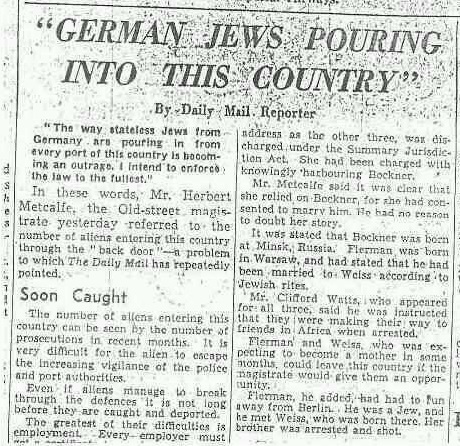
1938 Hostility to those fleeing persecution was an early hallmark of the paper
Hostility to those fleeing persecution, then, is hardly an innovation of the modern Daily Mail – but when the UK and Germany found themselves at war in 1939, Lord Rothermere’s political associations were too embarrassing to be borne.
Polite reasons were found for Rothermere to absent himself from the country (he died overseas a few months later), his son took over the newspaper, and it became an enthusiastic cheerleader for the war effort. Nazi sympathies? What Nazi sympathies?
The Mail didn’t entirely change course: it remained hostile to the idea of “enemy aliens” on British soil, calling for anyone of German extraction to be interned for the duration of the war – a move which meant that some of Hitler’s bitterest enemies, and those he had persecuted earliest, were sidelined and abused by the Brits in turn.
But for most of the 20th century, while the Mail was a successful newspaper and a strident voice on the British right, it was far from pre-eminent: the Express outsold it by a volume of two to one, or more. All of that was to change with the editorship of David English in the 1970s.
He is still considered one of the most outstanding British editors and circulation soared throughout his tenure, overtaking the Express in the 1980s and never looking back. Of the daily papers, only the Sun was bigger, and as a brash tabloid still showing topless page three models, it was a very different beast.
Still, no reign lasts for ever. Faced with the prospect of losing ambitious rising star Paul Dacre to the Times in 1992, the incumbent Lord Rothermere moved English upstairs to an honorific editor-in-chief role, and gave Paul Dacre the editor’s chair.
Dacre, 6ft 3 and ruddy-faced, even when not riled, soon ruled with an iron fist, and an inimitable style. The man in charge of a newspaper so family-friendly and proper that it often bordered on prim, famously swears like a navvy – editors on the newspaper’s back bench would judge the boss’s temper by the number of c-bombs he would drop in any given angry “bollocking”.
Some hacks were terrified by being “double-cunted” – meaning two uses of the c-word in one rant. Others grew more sanguine. Anything less than four “cunts” in one Dacre outburst meant things were actually pretty calm, one journalist told me.
Some staff, in a reference to the 1996 play, began to refer to Dacre’s c-word-laden tirades as “The Vagina Monologues”. Unembarrassed, the editor told Desert Island Discs in 2004: “Shouting creates energy; energy creates great headlines.”
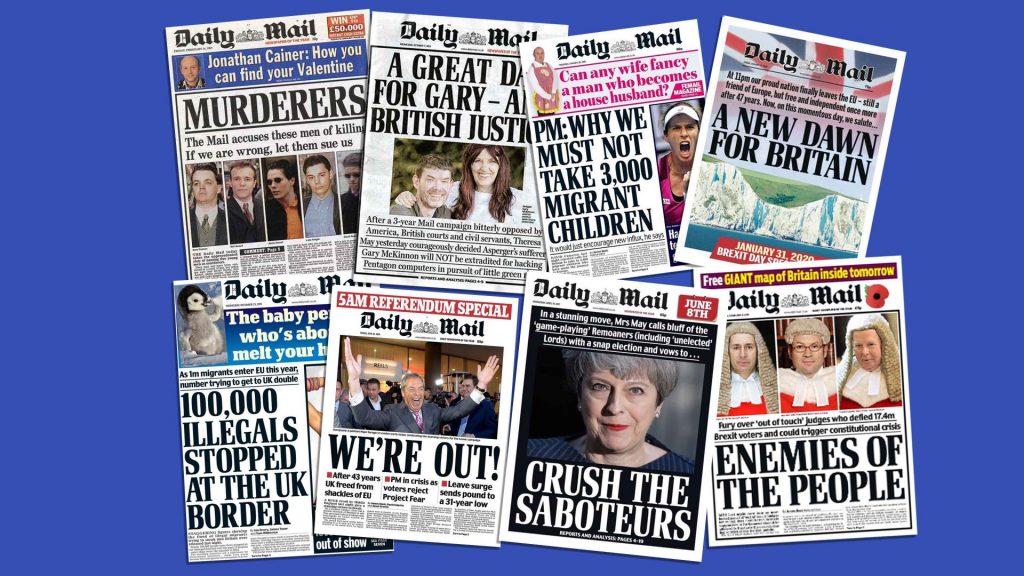
The newspaper produced by Dacre had a very particular vision of the country: it was plagued by yobs, by swarms of dangerous immigrants, and Dacre and the aggressive, thinkalike writers he hired for vast sums – Littlejohn, Sarah Vine, Allison Pearson, Quentin Letts, Stephen Glover – railed against political correctness decades before it was rebranded wokeism. But while the Mail might have been perpetually outraged and permanently angry, its standards were high: the newspaper was famously very well put-together, and its readership held together.
Even New Labour found it could not ignore the Mail, even if it knew it would never win its support. The “Daily Mail test” became a widely known bit of public-sector PR advice during the Dacre era: if you could not defend a decision after seeing it splashed on the front of the Mail in incensed terms, the mantra suggests, then don’t do it.
The Mail could turn this indignation into action, too: when in 2008 it launched a “Banish the Bags” campaign against single-use plastic bags, Marks & Spencer announced a 5p charge within 48 hours – and the government promised to follow this with legislation. The Mail campaign on behalf of the autistic hacker Gary McKinnon in 2012, who had broken into sensitive American defence networks, not only led to the government blocking his extradition to the US, but reforming how extradition worked more generally.
More significantly, the Mail was among the newspapers banging the drum for Brexit long before the referendum was ever called – and was among the loudest of those celebrating victory when the EU referendum was narrowly won by Leave in 2016. This campaigning took a darker turn following the Supreme Court’s ruling that triggering Article 50 required an Act of Parliament. The Mail’s “Enemies of the People” front page, accompanied by pictures of the judges involved, was widely condemned – but judges couldn’t fail to take notice of it.
There was one campaign, though, that the Mail referenced far more than any other. When faced with accusations that the newspaper often focused on black perpetrators of crime – or, especially after 9/11, the dangers posed to the country by Islamist radicals, or immigration from those countries, defenders of the Mail would often point to its coverage of the Stephen Lawrence case.
Lawrence had been murdered by a group of white teenagers in 1993, and his family’s attempts to find justice were stymied by a woefully inadequate police investigation riddled with basic errors.
Suggested Reading
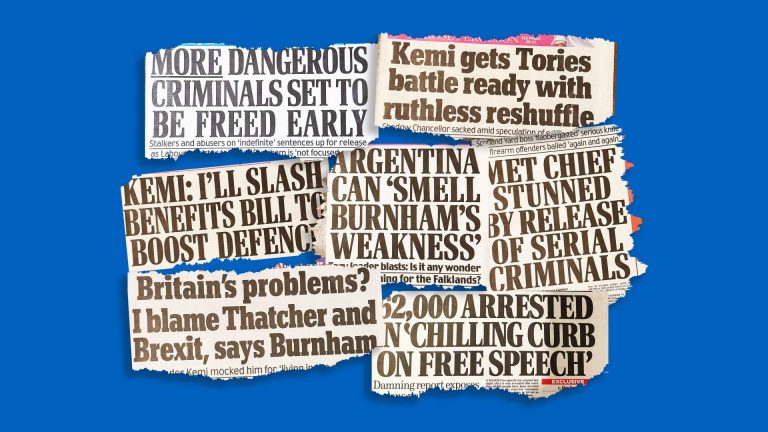

Spending a week inside the mind of the Daily Mail
When reporters were looking into the story a few years later, Dacre reportedly realised Lawrence’s father had once done some plastering work for him, and encouraged the team to dig more deeply and sympathetically into the case. The paper’s campaigning for Lawrence culminated in a genuinely courageous 1997 front page in which it ran photographs of the five men accused of killing Lawrence – who at that time had not been convicted, or even charged in relation to the crime – under a headline saying “MURDERERS”.
Minorities unfortunate enough not to have done Dacre’s plastering faced a rougher ride under his editorship. Long before today’s widespread hostility to asylum, the Mail would be five times likelier to refer to “migrants” than “refugees”, and coverage of such issues often zoned in on health risks – suggesting a spike in HIV rates in the UK was due to immigration from Africa, for example.
Coverage of migration, where it did quote someone seeking asylum, would often make sure they were talking about what they expected to receive from the British state. Only in the most shocking and tragic cases – such as when the body of three-year-old Aylan Kurdi washed up on a beach – would the Mail deviate from its long-term narratives.
Black people appeared most often in the newspaper as criminals, Muslims as potential terrorists, and LGBT people as some form of nebulous threat to your child, or to the very idea of family itself.
When Dacre took on the editorship of the Daily Mail in 1992, newspapers were things that got printed overnight, distributed via lorries, and sold in newsagents across the country. The business model and distribution of newspapers had remained largely unchanged for more than a century.
All of that was, of course, set to change: the internet was about to become the dominant technology of the news media, and the Daily Mail had perhaps the stuffiest, most staid editor of any major newspaper – at best utterly indifferent to the online world, and more often outright hostile to it.
Dacre’s indifference, though, ended up being more of an opportunity than a problem for the Mail. Because he wanted as little as possible to do with the internet – famously, he did not have a computer in his office – once it became clear the online world couldn’t be ignored, it was essentially spun off as its own operation: MailOnline was founded in 2003, and was run as a standalone operation from 2006 until 2022 by the bruising former Daily Record editor Martin Clarke, who was soon given near-total autonomy from Dacre.
MailOnline ran a brutally efficient and brutally effective operation, focused on maximising traffic at the expense of almost everything else. While the Mail’s print articles would appear online, the overwhelming majority of its content would be focused on celebrity, fashion and gossip.
Articles had strict rules: they must have a dozen or more pictures, everything should have an extensive picture caption, and they should appear quickly. Topics were chosen based on what was trending on Google on an hour-by-hour basis, and traffic and revenue alike soared – the Mail was quickly the biggest online news brand in the UK, and was soon one of the biggest in the world.
This led to a tale of two newsrooms. In print, the Mail’s scale and profitability – now boosted by MailOnline – meant that while Dacre was a punishing boss, it was still a good place to work. Trainees could expect to be sent out to do real-world reporting, learn their trade, and the talented ones could be promoted fast.
The glory days of Fleet Street lasted far longer at the Mail than most other newsrooms. Reporters could still file hefty expenses claims right up to the coronavirus pandemic, and most still had their personal phone bills paid by the office.
The Mail and Mail on Sunday maintained a fierce rivalry, even as most other newspapers saw their daily and Sunday operations merged into a seven-day week. Editors at the Mail would try to use binoculars to spy across the courtyard to steal scoops ahead of their Sunday “sister paper”.
But conditions for ambitious young journalists hired by MailOnline would be much more 21st-century. New hires would soon discover they were working in something resembling a factory production line. Their job was to find wire copy, rewrite it – putting in a call or email for a right to reply where necessary – and add pictures, captions, and headlines, all in less than an hour per story.
These stories became the staple of what became known as the “sidebar of shame”, an endlessly refreshed selection of guilty pleasure stories, usually written as little more than an excuse to look at photos of celebrities either looking good or terrible in various outfits. A female celebrity walking down the red carpet in a flattering dress would be “flaunting her curves”, while one who had gained a few pounds could expect to see her cellulite zoomed in and circled, for the titillation of an audience of millions of bored women on their lunch breaks.
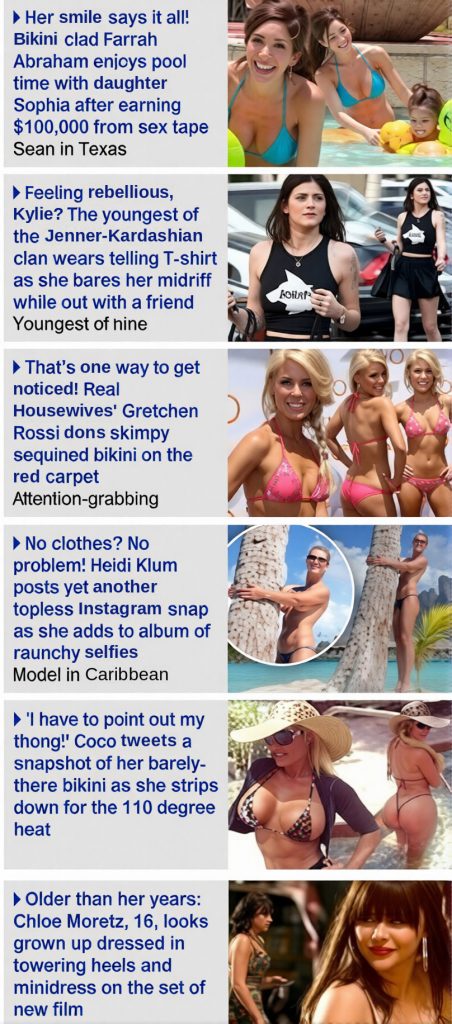
The overwhelming majority of MailOnline’s ‘sidebar of shame’ content is focused on female celebrities
Strict targets of eight stories per shift were set, and those who didn’t make the cut wouldn’t last. People would endure this monotonous, unsatisfying work, day after day because the prospect of a promotion to a job in which they could do some “real” journalism was dangled over them – though most would never actually be offered it. After a year or two, many quit, burned out and sick of it. Some left journalism altogether.
The Mail’s model proved irresistible to its rivals. Those who couldn’t trade off attracting subscribers to pay for quality found themselves imitating Clarke’s operation, hiring young journalists on low pay to deliver repurposed celeb stories at scale. The industry built up a dependency on attracting millions of views every day from Google – sometimes only making fractions of a penny on each, but making up for low revenue with high traffic.
The rise of the internet was mirrored by an acceleration in the decline of print circulations, which had been falling for decades. In 2000, the Sun still sold 3.6 million copies a day, while the Mail sold 2.4 million. In print, the Mail started winning by losing more slowly: the Sun stopped publishing its circulation figures in 2020, but its last available numbers showed sales of 1.2 million – while at that time, the Mail sold just over 1.1 million. A gap of 1.2 million had been cut to less than 100,000.
Suggested Reading

The Daily Mail’s dangerous obsession with Meghan
The Mail had held its own in print, and had avoided the phone-hacking scandals that had embroiled both the Sun and Mirror. While both newspapers have consistently denied any wrongdoing in connection to phone hacking, both have paid millions of pounds in settlements – with no admission of wrongdoing – over that time.
By 2020, the Mail had managed a win, of sorts, on print circulation, a clear reputational win amid the scandals, and had completely dominated its one-time rivals online – where tabloids never successfully found a place. Even as the press diminished, the Mail was still the dominant political force, a cheerleader for Brexit and Boris Johnson premiership. If there were any winners to be found among the old media dinosaurs, the Mail was surely one of them.
Yet in 2026 – with Brexit widely viewed as a disaster and Johnson kicked out of office in disgrace (though still in receipt of £1m a year for a weekly Mail column that insiders concede has been a deep and costly disappointment), the brand is in an existential crisis. Dacre’s editorship of the paper officially ended in 2018, but a full eight years later, he is still nominally in charge – first as the Mail’s editor-in-chief and then in the nebulous role of “editor-in-chief, Associated Newspapers”.
Geordie Greig, who managed to oust Dacre from the editor’s seat, didn’t last long in the role. In 2021, he was in turn shown the door in favour of Ted Verity, a longtime Dacre ally and favourite. With Dacre still looming large over them, neither man has managed to carve out an identity for the Mail that is distinct from the one he created.
The Mail is still probably the UK’s bestselling daily paper, though it is increasingly hard to be sure. In February 2026, it was selling 600,000 copies a day – but those are the last public figures we will ever get, as audited circulation figures are no longer published for any UK newspapers.
Most of the Mail’s rivals would love to sell 600,000 copies, but this is a fall by half in just six years – and represents an audience of less than 1% of the UK population. Print newspapers still shape the British news agenda, but they are driven by an ever smaller, older and less representative share of the public.
On its own, that would be manageable: print has been declining for decades, after all. Provided a newspaper is growing a vibrant online business, especially if it’s pulling in a younger audience, that’s fine. The trouble is that MailOnline has hit severe turbulence too.
The Google-driven, ad-funded model that the Mail pioneered has foundered. Google now sends far less traffic to news outlets, a trend that the widespread adoption of AI has turbocharged. Instead of search engines sending traffic to big publishers, big tech tries to answer the question with AI summaries on their own sites and apps, keeping any revenue for themselves.
This has hit the Mail particularly hard. According to SimilarWeb data, its online audience in the crucial US market fell 45% year-on-year, to 38.5m, making it the 25th-biggest news brand in the US, behind the BBC and Guardian, but also smaller fry like the India Times and Drudge Report.
Ipsos data suggests its decline in the UK has been less dramatic – down 16.7% year-on-year – but places the Mail outside the top 10 online news brands in its home market, beaten by the Telegraph, Sun, Mirror and even Yahoo! Digital revenue at the Mail group fell by 15% in 2025 and is expected to fall still further.
This has been matched by a turnover in top staff. Clarke’s departure in 2022 shocked staff, as he had seemed to be in the ascendancy, having won several internal power struggles. The Mail has struggled to keep senior online staff since: it has gone through at least two bosses in the US, and its attempts to find a new, post-Google strategy have foundered.
As most news outlets switched from relying upon advertising to trying to recruit loyal, paying subscribers, the Mail launched Mail+, but this initially struggled to attract paying users – not least because the Mail’s celeb-heavy online identity had for so many years been so divorced from the brand of the newspaper. What, exactly, were people supposed to be signing up for?
With more content moving behind the paywall, the Mail now has 400,000 paying global subscribers, but as many are on low introductory rates of £1.99 or $1.99 a month, few insiders are getting overexcited. Meanwhile, rumours of dysfunction and scandal in the senior ranks – particularly in the US – add to a sense among some staff that Mail executives have spent more time fighting one another than working out a future for the outlet.
Throughout all of this, the legacy of the Mail’s golden era was on the line. The vital need to win the lawsuit brought by Prince Harry and the other claimants meant keeping Dacre onside and in the tent was crucial.
This battle was particularly personal for him, due to the involvement of Doreen Lawrence: here was the person for whom his paper had, in his view, given so much, now accusing him of overseeing potentially criminal acts against her.
Thanks in part to a messy and undisciplined case, relying on unreliable witness evidence from a private investigator who changed his testimony several times, the claimants were roundly defeated in court – leading to Dacre’s triumphant declaration of victory – and some measure of the Mail’s reputation remained intact. But the lawsuit was still a years-long distraction, right at the time when the Mail’s bosses needed to be right on top of their game.
The current generation of leadership at the Mail is left with a print product that is losing influence and losing readers every day, and a rudderless online operation with no strong brand identity and no real purpose. More than that, though, the Mail has, ever since the editorship of David English, been the loudest voice of conservative values, and of the British right.
Today, though, the British right has fragmented, and much of it has radicalised. The Mail has spent a century railing against the dangers posed by immigrants, but the new right goes further than it ever has – calling for racial purity, an end to “suicidal empathy”, and mass deportations on a scale the Mail never dared.
Suggested Reading

The American right’s war on Britain
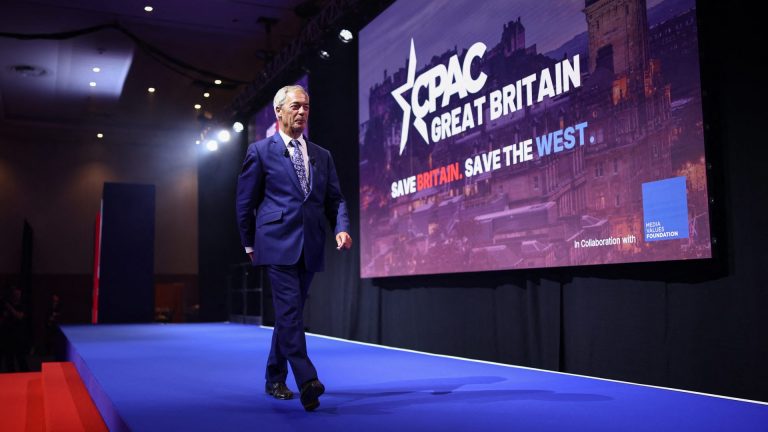
The new stars of the right owe the Mail nothing: they rose on YouTube, Discord, TikTok, and other online platforms. The political right has fractured between the Conservative Party, Reform and Restore. In print, despite a post-election dalliance with Nigel Farage, the Mail has stayed as faithful to the Tories as it always had been – and in recent weeks, has started attacking the far right in the same way it’s always gunned for the mainstream left.
But the Conservatives still look utterly lost, unsure whether they should fight Reform or try to become it, and the Mail has little idea either. The right has fractured, and there is no obvious home for the Mail in its new configuration.
It is left as a mirror of the institutions it – in theory at least – loves so much; the Tory Party and the Church of England. It is a dwindling, ageing congregation, looking out at a world that is leaving it behind at pace.
Few readers of The New World are likely to mourn the Mail’s diminishment. Instead they are likely to relish it. But any expecting the fall of the Mail to happen overnight are going to be disappointed.
The revenues of its parent company still topped £1bn in 2025, though some analysts expect them to drop below the totemic £1bn figure this year, since overall consumer media revenue at DMGT has now declined by 9% over three years. The group’s operating profit was almost £100m, even if restructuring costs and other charges meant it actually made a loss.
It will take more years of decline before panic sets in, but analysts are already itchy. The cost savings, restructures and job cuts that have been regular occurrences for years at less successful newspapers are now being felt by journalists and advertising staff at the Mail itself. And DMGT’s other titles are feeling the strain too – both the editor-in-chief and executive editor of Metro suddenly departed last week, ahead of “radical change” at the free paper.
One current staffer interviewed for this piece described a “sense of unreality” at play in the Mail’s offices. When compared with other publishers, layoffs have been relatively modest so far – several dozen in the UK last year and 10% of US staff – but given the danger to its business model, there is a feeling that more is to come, and soon. “Another shoe is surely going to drop,” the source told me.
The Mail can still spend money and make waves: in recent days it has dominated the news agenda in Britain thanks to its serialisation of Earl Spencer’s sensation-packed book about his sister, Princess Diana. Yet even this kind of big-money buy-up harks back to another media age, and a cynic would suggest anyone who bought up that book would’ve got the same attention.
As an institution, the Mail still looms large in the minds of its adversaries. A whole generation of left wing and centre left politicians grew up with it as their great imagined bogeyman, the dragon against which they would have to test themselves. That reputation still gives it influence beyond that of its still significant audience.
But as it stands, the Mail has no obvious route back to the kind of dominant position it once held. The business model that made it a giant no longer works. Print is diminishing, its website is adrift, and the brand no longer speaks to the modern right. For them, the Mail looks more likely to be replaced by something new – something that might end up being even worse – than to once again become the undisputed voice of British right wingers under 50.
The Mail’s rivals – the ones it seemed to have left for dust – have been looking into the abyss for more than a decade. Now the abyss may be coming to Kensington, too.