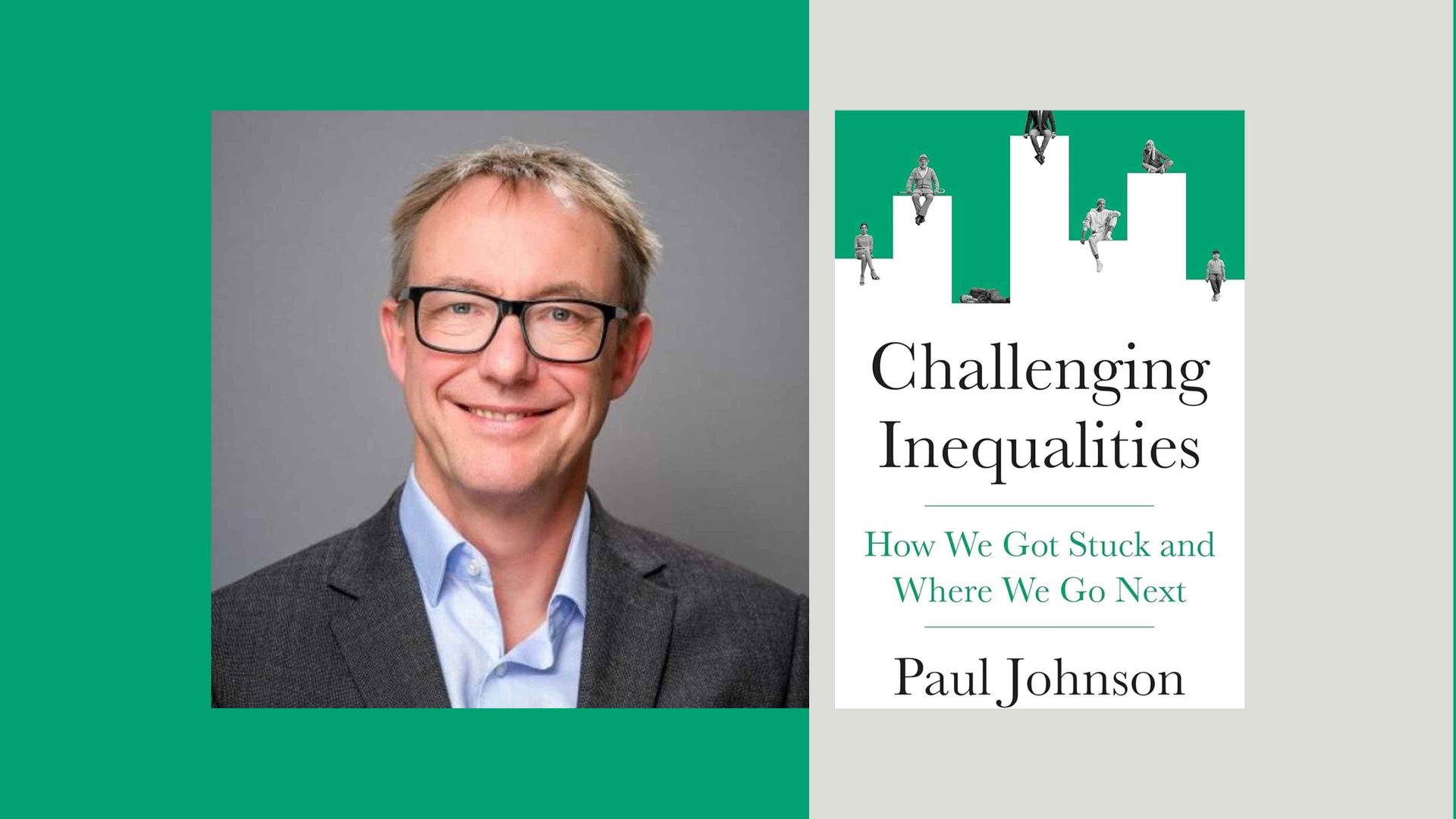
For over a decade, Paul Johnson was the unofficial arbiter of British government policy. The Institute for Fiscal Studies (IFS) is supposedly just one think tank among many – but thanks to the reputation of its research, its verdicts on budgets, spending plans and manifestos are widely reported across the UK media.
Johnson stepped down as the institute’s director last year – he’s now provost of The Queen’s College, Oxford – but is just now publishing his last IFS-related project, a book on inequality in the UK and what should be done about it. It is based on a years-long project involving more than 140 authors and dozens of research papers.
Johnson evidently cares a lot about inequality, and his book feels timely, as parties try to tap into anger at the rich getting richer and the 1% benefiting at the expense of the rest of us – but against that backdrop, the headline finding of much of his research is a surprising one: inequality isn’t rising. In fact, he says, inequality in the UK hasn’t changed much over the last 20 years.
In percentage terms, the share of income earned by the top 10% is the same as it has been for a long time. That often leads to suspicions that the top 1% or 0.1% must be breaking out ahead instead – but the data suggests otherwise. Even switching from income – how much we earn each year relative to one another – to wealth, the pattern holds. In percentage terms, the richest 10% of Brits hold around 60% of all of the country’s wealth: a huge proportion, yes, but one that hasn’t changed in quite some time.

“The 1980s saw huge increases in inequality of all kinds, massive increases,” Johnson tells me. “And then from 1990 to 2008 – and I’m just talking about income now – the top 1% or 2% continue to pull away, but nothing happened in the rest of the distribution. And then, since 2008, income inequality, if anything, has probably gone down a bit.”
If that’s what the data says, then why doesn’t it feel like that? It certainly seems like more of us than ever are struggling, and it’s hard not to notice the increasingly unhinged antics of the ultra-rich. Why do the statistics seem so out of line with our lived experience? Johnson has several answers to this question.
The first is that earnings have stagnated since 2008, meaning that on average we’re no better off today than we were nearly 20 years ago. When things aren’t getting better for us, we assume someone else is taking what should be ours. Another reason is specific to wealth. Even if wealth inequality has stayed roughly the same in percentage terms, it is now much bigger in cash terms – a gap of £50,000 in 2000 is about the same in percentage terms as £100,000 today. In our day-to-day lives, cash matters – if we’re saving to get on to the housing ladder, percentage terms don’t comfort us much.
Wealth inequality growing in cash terms creates a self-reinforcing doom loop between the haves and the have-nots. Nowhere is this more obvious than with inheritance. The average person in the 1960s could expect to receive a total inheritance worth about four years of their salary. The typical person born in the 1980s can expect seven years’ worth.
But even if inequality is not increasing, Johnson believes it needs to be tackled, both for the sake of societal cohesion and for ensuring that future generations have anything approaching equality of opportunity. While many people on the left would point to wealth taxes as an obvious answer, Johnson looks elsewhere (he says wealth taxes have “practical issues”).
“If you were unlucky enough to hear me wanging on before the last election, you would have noticed how frustrated I was, because it was obvious that the main parties were not being honest”
“Housing is probably the most important thing, bluntly, just building a lot more houses particularly where they’re needed, in London and around there… some people have rich parents and some people don’t. And the best way of spreading a lot of that wealth out – because a lot of that wealth is held in housing – is simply to have more housing, which means more people will own houses, and each house will be worth somewhat less.” Johnson is plain that he means actually building more housing stock, rather than trying to deal with a supply issue with rent controls or similar measures. “The answer is not to screw landlords,” he says. “The answer is add more houses.”
Johnson’s other long-term fix on inequality is vocational education for 14-19-year-olds. The UK’s educational outcomes are good up to age 14, he notes, but after that point they grow increasingly dismal for less academic young people. Government after government has promised to address this issue, but many have failed.
That story of government failure is not exactly an isolated one. As IFS director, Johnson seemed to grow increasingly irate with mainstream political parties for simply not getting to grips with the many problems facing the UK, a frustration he clearly still holds.

“If you were unlucky enough to hear me wanging on before the last election, you would have noticed how frustrated I was, because it was obvious that the main parties were not being honest,” he says – criticising them both for tying their hands on tax rises, while promising spending they knew would be unaffordable. “I mean, Labour had a so-called costed manifesto with £6bn or £7bn of tax rises in it,” he notes – only for them to then increase taxes by £40bn in their first budget.
Mainstream parties are failing to level with the electorate on either tax or spend, and saving up problems for the future, he notes. “It’s the failures to level with anyone about what actually we might need to do over the next 10 years,” he says. “You know, we’re going to increase defence spending by £30bn. Where’s that coming from? We’re obviously going to be spending way more on health, pensions. What are the issues?”
Johnson realises the politics of this is difficult – the public are unwilling to consider even small tax rises. Keir Starmer spent huge political capital on means-testing the winter fuel allowance for almost no financial benefit. Relatively modest steps to close a tax loophole making farmland attractive to billionaires looking to minimise inheritance tax were largely reversed, based on arguments that were “obviously nonsense”.


But failure is biting in two ways, he says. The first is that mainstream politicians aren’t making themselves popular through their inaction – economic growth hasn’t come back, public finances haven’t magically sorted themselves out, and the public are growing ever less trusting in politicians and the system as a whole.
That, in turn, is fuelling populism, not least by desensitising the public to impossible promises. “You have the Greens saying, basically, that we can print money and Reform saying that we can cut taxes by £150bn and save it somewhere. “It’s more extreme in its distance from reality. But the main parties have kind of left that open, because they’re not addressing the real issues either. That’s what frustrates me.”
Johnson seems as frustrated as any radical at the government’s failure to do what it has been elected to do – to fix things, make life better, and ideally spur much-needed economic growth that would give it the leeway to tackle some of the other problems.
Johnson has written a serious, thorough book summarising a huge project aimed at understanding and tackling inequality in the UK. Sadly for him, it’s not clear whether there’s anyone left in Westminster interested in even having that conversation.
Challenging Inequalities: How We Got Stuck and Where We Go Next is published by Princeton University Press