In a recent advert for discount clothing retailer TK Maxx, a ginger cat snuffles into its owner’s carrier bag and re-emerges wearing a TK Maxx loafer on its head. The owner’s phone photo of her moggie’s “shoe hat” becomes a viral sensation, replicated on the catwalk where models sashay in loafer headgear, while the ginger tom is ensconced in a limo speeding away from screaming shoe hat fans.
The ad’s absurd scenario would surely have appealed to the Italian couturière, Elsa Schiaparelli, who fabricated her own “shoe hat” in collaboration with the surrealist artist Salvador Dalí in 1937-8. It is one of the many startling sartorial inventions in the V&A’s Schiaparelli: Fashion Becomes Art.
The founder of the Parisian fashion house had a fondness for headwear. “The spirit of infectious good humour can be created even in women’s hats,” she said. “I like to amuse myself through some of my creations. If I didn’t, I should die.” Schiaparelli’s upturned shoe hat amuses. It makes the wearer look like a crested penguin.
The V&A charts the rise of Maison Schiaparelli, from its first collection launched in Paris in 1927 to the height of its success at its premises on Place Vendôme (described by Jean Cocteau as “the devil’s laboratory”). When the fashion designer pulled the shutter down in 1954, there was a hiatus of almost 60 years before the atelier opened again.
At the V&A, Elsa Schiaparelli’s garments intermingle with those of the current creative director, Daniel Roseberry, whose gold-spritzed fabrications out-bling even those of his predecessor. His rhinestone-encrusted jackets and evening gowns carved into phantasmagorical shapes would suit a mad dictator’s wife.
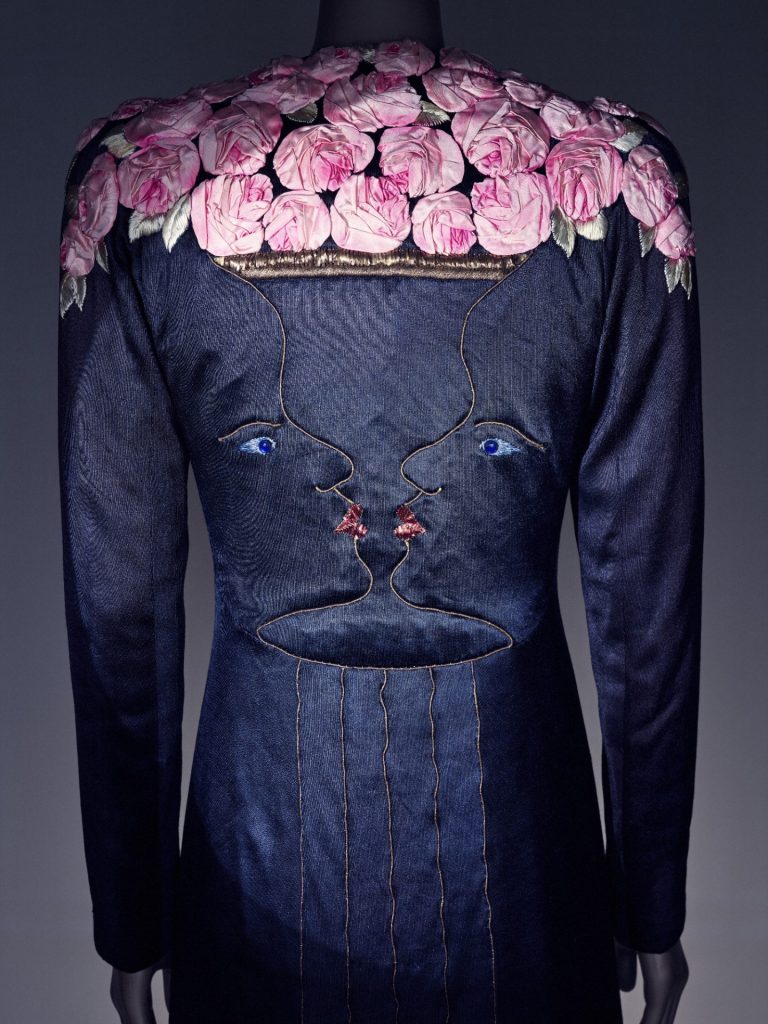
In a tribute to Elsa and Jean Cocteau’s trompe l’oeil Evening Coat (1937) Roseberry confects a dress with wing-like sleeves topped by crushed pink silk roses, twinned with a Stephen Jones hat. It is the poster image for the exhibition.
Meanwhile, his 2026 Fall Ready-to-Wear collection (not included at the V&A) recalls the “shoe hat” cat ad: models hit the runway in fearsome cat-head shoes, alarmingly realistic and caught mid-snarl. For Roseberry, Schiaparelli today is all about “… the pebble in the boot, that thing that’s going to make it memorable…that thing that gets under your skin.”
Like her rival Gabrielle “Coco” Chanel, Elsa Schiaparelli had no formal training in fashion or textiles. Unlike Chanel, she was born into a wealthy aristocratic family in Rome in 1890, but soon chafed against the strictures of her conventional convent education.
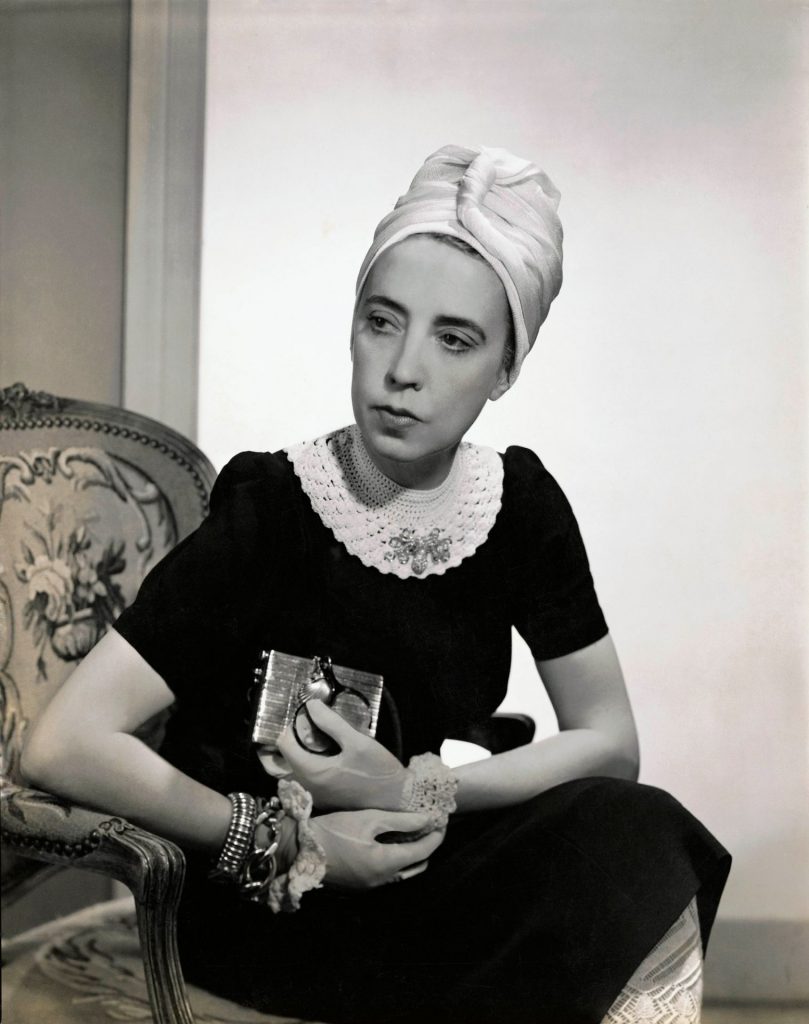
Compared unfavourably to her older sister, Schiaparelli recounted how she planted flower seeds in her nose and ears in the hope of making herself more beautiful. It is a dreamy image that chimes with the flower-headed woman in Dalí’s painting Necrophiliac Spring (1936) that was owned by Schiaparelli and displayed in the UK for the first time.
Conscious of the importance of personal appearance, it is not surprising that the young Schiaparelli paid attention to dress. In 1913, at the age of 23, she escaped to London, where she met and married Swiss theosophist Wilhelm Wendt de Kerlor, then moved with him to New York where their daughter (nicknamed “Gogo”) was born. Although the marriage very quickly dissolved and Schiaparelli and Gogo returned to Europe, her stay in the States had brought her into the orbit of influential figures in art, fashion and theatre, which would later prove useful in her career.
The fledgling designer arrived in Paris in 1922 at a time of cultural reinvention. The Surrealist manifestos by André Breton and Yvan Goll were soon to be published, and the French capital was drawing all manner of vibrant personalities to its bosom. Into the mix, the couturière added eccentric clothing.
The V&A’s shadowy and rather labyrinthine show winds round these early years, through shaft-like entrances, past ridge-panelled walls to vitrines and platforms where bullet-black mannequins in Schiaparelli suits and frocks cast distorted shadows on the floors. Spaced-out music sweeps over this dreamworld, and black-and-white footage of a night-time Paris from long ago, where the park benches are empty and the Eiffel Tower looks lonely, conspire to create an atmosphere of unsettling portentousness.
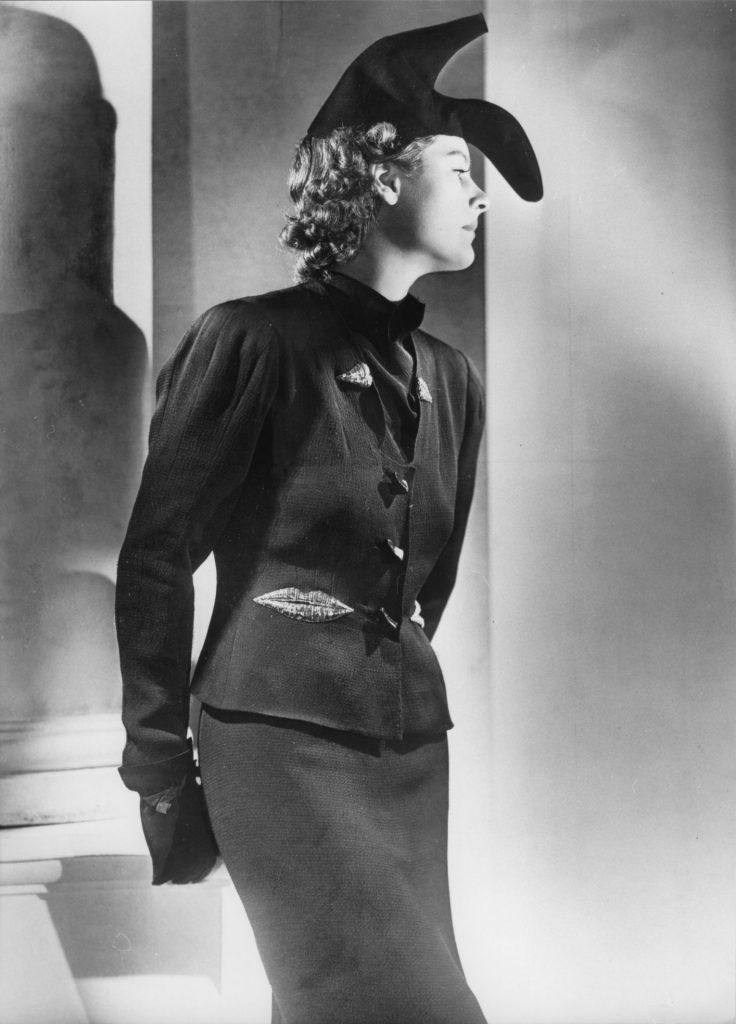
Schiaparelli’s first successes include a sweater knitted with a trompe l’oeil scarf motif, knotted and bowed around the neckline. She soon distinguished herself from Christian Dior and Chanel in the zaniness of her garments’ fittings. Her buttons are shaped like carrots and radishes, trapeze artists and tambourines; pockets are large enough to hold the contents of a handbag; visible plastic zips play across the shoulders or down one side of the body and new synthetic fabrics excited her imagination: from tree-bark crêpe to cellophane and glass (Rhodophane).
During the 1930s, partnerships with artists, photographers and sculptors led to her most outlandish and original garments. It is at this point, too, that the V&A’s installation is at its most bewitching: the Shoe Hat occupies a porthole window, as if it has been dredged up by submarine from the deepest depths of the ocean, and the perfume boudoir offers light relief with its fake furred walls and ceiling, and gold-coloured floor.
The Skeleton Dress at the entrance, coffined in a grey niche, sets the tone. “Dear Elsa,” Dalí had written in a note, with a drawing of a skeletal figure, “I like this idea of bones on the outside enormously.”
Schiaparelli made the garment in matt black silk crêpe with padded ribbing on the outside of sleeves, torso and the lower half of the body. Slinky and figure-hugging, it brings to mind Morticia from The Addams Family.
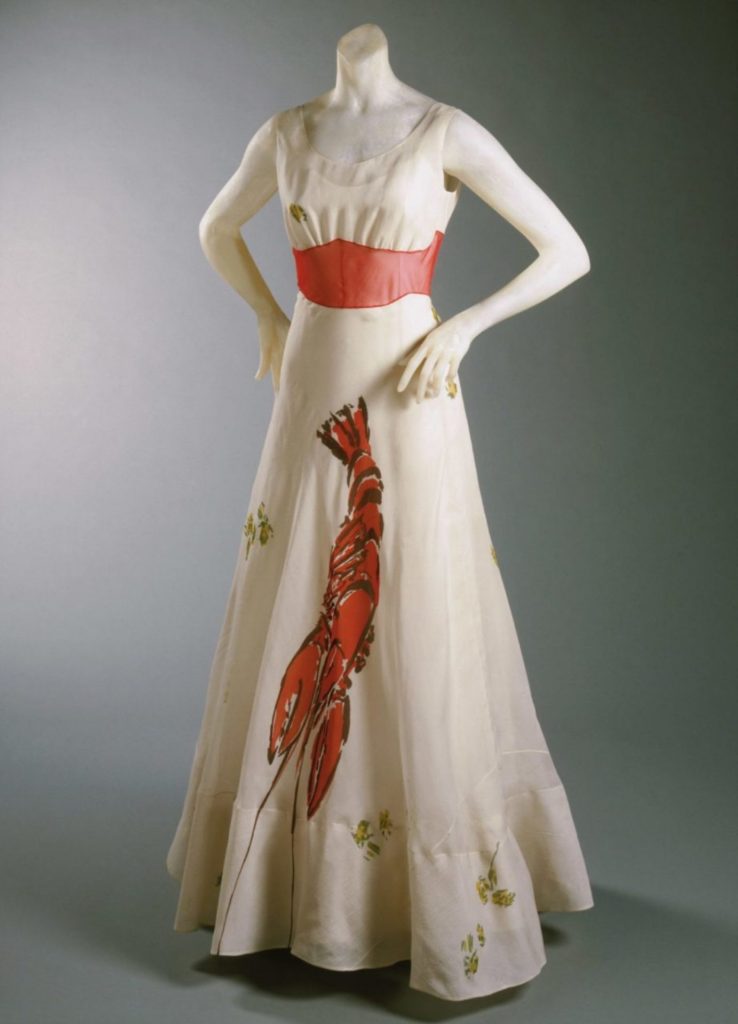
Key works are the Lobster Dress and the Tears Dress with Veil. They share a vitrine cramped by corresponding objects – the Lobster Telephone and dial-shaped compacts.
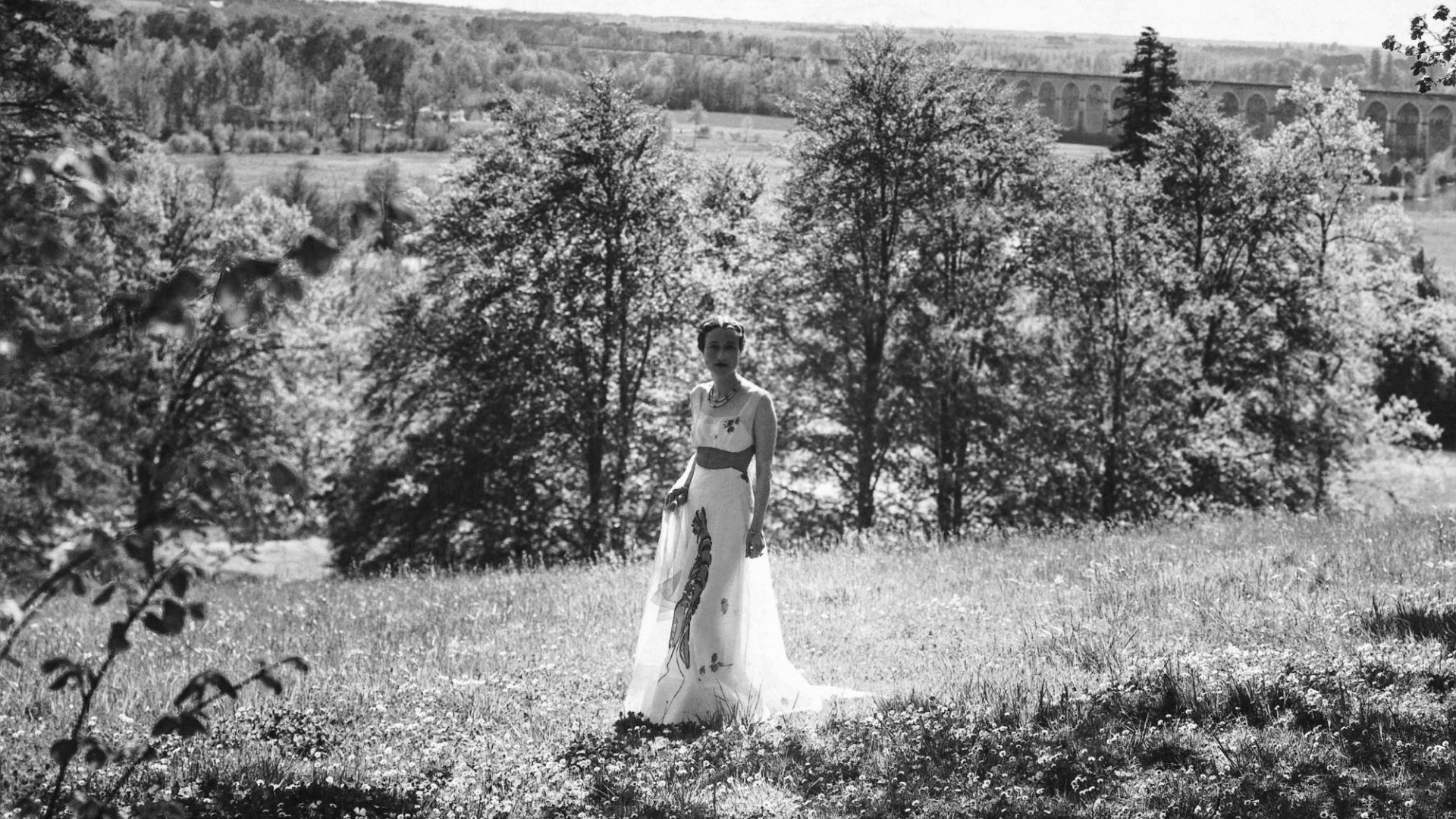
Dalí had proposed the lobster for the skirt of a high-waisted dinner dress. The outfit in white silk organza was printed with the bright orange crustacean, its fan-shaped tail provocatively close to the wearer’s pudenda, as if to tickle them. It’s astonishing that this erotically charged outfit was worn by Wallis Simpson, the future Duchess of Windsor, as part of her wedding trousseau.
Suggested Reading


How Van Gogh got yellow fever
The Tears Dress with Veil destabilises the idea of an evening gown as an intact work of beauty and perfection. The recurring print of flesh-like flaps ripped away to reveal flashes of livid pink are offset to dramatic effect by a shroud-like veil with 3D pieces stitched to the cloth and hanging down, suggesting something torn and violated.
As the ugly clouds of the second world war gathered, Schiaparelli completed a cash and carry collection in Paris, then followed the artists who had inspired her to the States, returning to France in 1945. When she left Place Vendôme for good, her atelier had created hundreds of looks for film stars, socialites and Surrealists.
“In difficult times, fashion is always outrageous,” Elsa Schiaparelli once said. Those difficult times have now returned, and as an act of resistance perhaps we all need to start wearing shoes on our heads and lobsters on our genitals.
Schiaparelli: Fashion Becomes Art is at the Sainsbury Gallery, V&A South Kensington, until November 1