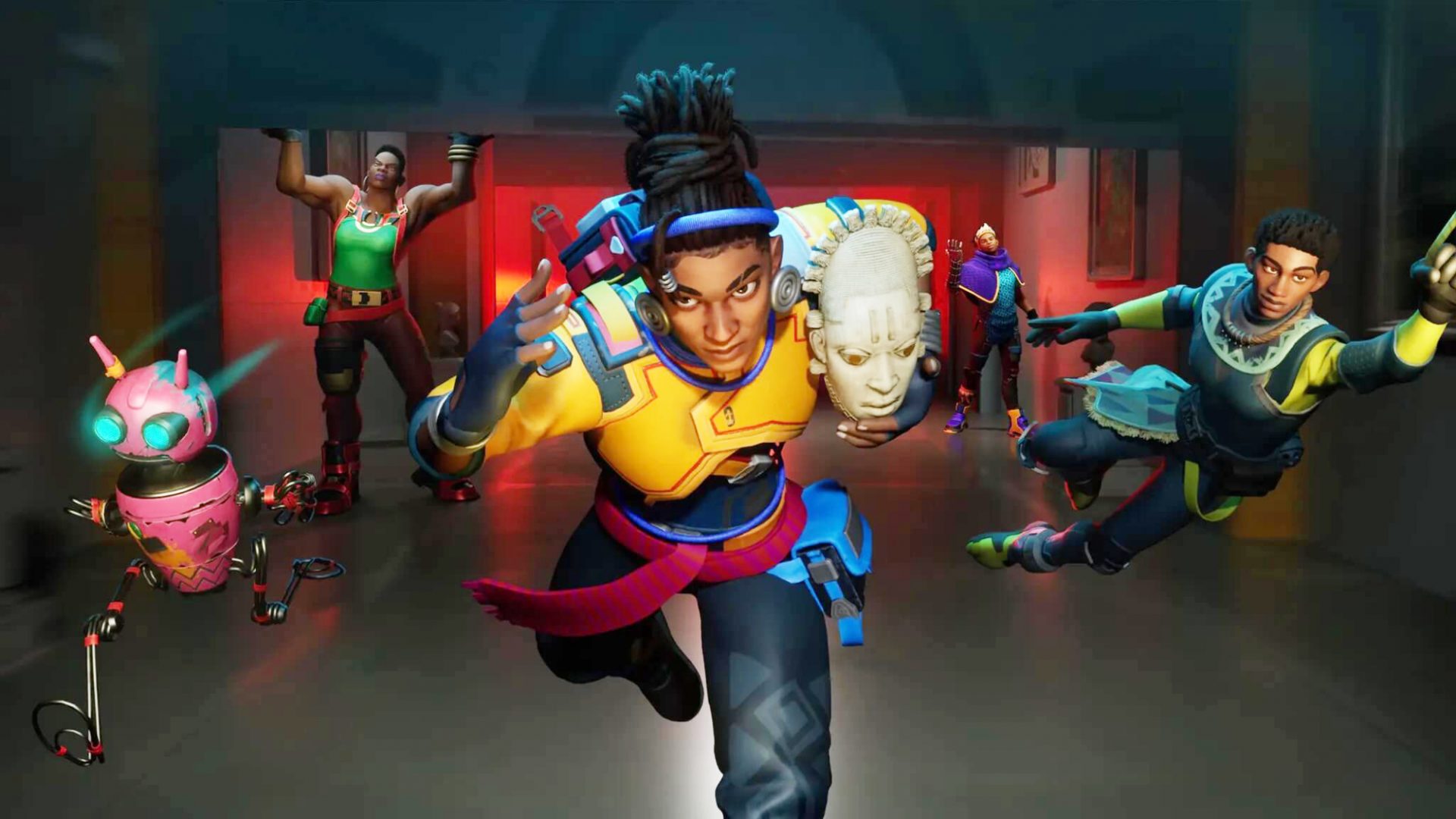
In Relooted, from South African studio Nyamakop, players are tasked with stealing artefacts from another culture. That’s par for the course for many franchises, even if more recent entries in the Tomb Raider and Uncharted franchises have addressed the immorality of doing so.
Where Relooted differs is in the artefacts being stolen – or rather, stolen back. Each relic in the game is a real-life item taken from Africa for display in the west, and the protagonists of the title are charged with reclaiming them from museums that represent well-known institutions across the UK, US, and Europe. It is an anti-colonial, aspirational story of reclaiming a stolen heritage – and by putting players in that role, it makes them active participants in the act.
The game’s creative director, Ben Myres, explains that the inspiration for the game came from a position of wanting people to understand what has been stolen: “These African artefacts, the way the west has spoken about them has been incredibly condescending to the people they were taken from… in some cases, the literal human remains of their ancestors.”
Relooted does not portray the real museums where some of these artefacts are held. Only the location in which the items are eventually rehomed, the Museum of Black Civilisations in Dakar, is depicted as it is. Instead, the western locations are deliberately made generic, to avoid dignifying the real-world locations holding these stolen artefacts.
Myres says this too is an extension of the game’s anti-colonial attitude. The team deliberately took this approach to parody the undifferentiated, genericised views many in the west have of “Africa”. Myres explains: “It’s about the artefacts. People always assume the British Museum is the worst offender, but it’s all of them. The British Museum is just the most famous one.”
Relooted may be the most visible example at the moment, but the increasing availability of game development tools is allowing many more non-western creators the chance to tell their own stories in their own words.
Despelote, for example, is set against the backdrop of the turn-of-the-millennium financial crisis in Ecuador – told through the medium of a child playing football in the city of Quito.
The game’s creator, Julian Cordero, drew heavily upon his own childhood for a game that contrasts the jubilation around Ecuador’s first-ever qualification for the football World Cup in 2002 with ongoing financial calamity. It is an authentic representation of a very specific time and place that could never have been told by a western developer.
Cordero said: “If I am to answer the question of why there aren’t so many authentic depictions of countries, it is because the US and European powers do such a good job of shutting down media and any kind of autonomous political movement in these countries.”
All Will Rise, currently in development, tells the story of a river in India that has been poisoned by industry – “murdered”, as the game says – and attempts to get justice for the river and its residents.
It, too, is a story that could never, and almost certainly would never, have been made without intimate knowledge of the ongoing impacts of western colonialism.
The game’s narrative designer, Meghna Jayanth, said: “A place like India is a hundred thousand different realities, layered on top of each other and intersecting. Any one person or even any team of people, no matter how large or small, can ever be truly ‘representative’ of such a vast thing as India, so we need to use imagination and curiosity and craft to get us the rest of the way there.
“Games are fundamentally about agency, and navigating systems. It’s endlessly possible to remake the way the world works every time we make a video game, and show us the absurdities of capitalism, colonialism, power.
“We’re not just showing an audience another way of living on a screen, we’re immersing them in it through designed agency, asking them to step into the role of someone else and understand a new ruleset of behaviour and possibilities.”
Suggested Reading

Could video games save satire?
All Will Rise, like Relooted, examines a real-world injustice through the medium of gaming, focusing on the communities and people harmed. Their anti-colonial narrative makes the player an active participant in first recognising those issues, and then working to undo them.
Jayanth hopes that, as game development and distribution become more open to non-western developers, we will see even more of that approach. She says: “What I’m most excited about are games from other cultures and traditions that can perhaps break out of the design paradigms of mainstream “western” game design – rather than just games which put a coat of cultural paint on established designs and systems and approaches.”
All games are available on Steam.
Chris Sutcliffe’s writing has appeared in the Guardian, TechRadar and Kotaku