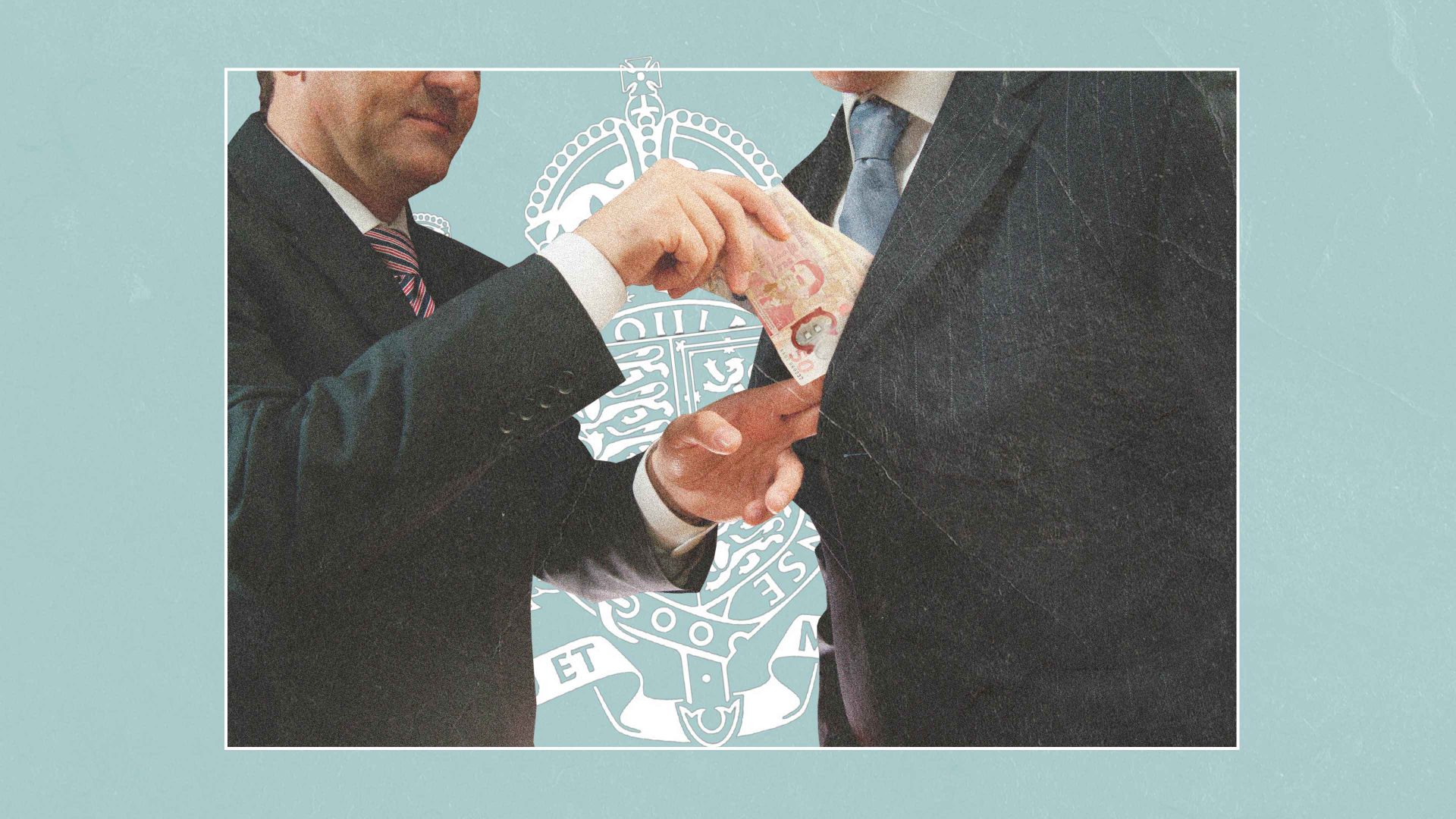
In the leadup to the 2010 election, the leader of the opposition David Cameron proclaimed that secret corporate lobbying “had tainted our politics for too long.” Speaking at an event at the University of East London, he told the crowd, “We all know how it works… the lunches, the hospitality, the quiet word in your ear… helping big business find the right way to get its way.” This, he said, was the “next big scandal waiting to happen”.
Just over a decade later, Cameron found himself at the centre of his own lobbying scandal. At the beginning of the pandemic the former prime minister sent a series of messages to his former ministerial colleagues and senior officials, urging them to extend financial support to his new employer, Greensill Capital. Although he failed in his efforts to raise capital for the doomed firm which collapsed the following year, Cameron did manage to secure several high-level meetings.
When news of the lobbying broke, the public backlash was ferocious, made far worse by revelations that Cameron had been paid some $10m in salary, bonuses and shares during his two and a half years with the company. Yet after a five day investigation, the Office of the Registrar of Consultant Lobbyists (ORCL) concluded that no rules had been broken. That watchdog exists to monitor lobbying activities. It had been created during Cameron’s own time in office.
Cameron’s case is no outlier. Analysis exclusively undertaken by The New World of every investigation carried out by the lobbying watchdog since its creation in 2015 shows that, of 83 inquiries launched, a breach of the rules was identified only four times. In other words, during the last decade, 95% of its investigations ended with no findings of wrongdoing.
How can a regulator overseeing an industry covering such a sensitive area of public life, and which employs thousands of people, uncover virtually no misconduct?
Suggested Reading
The People’s Army loves London lobbyists
When the coalition government passed the “Transparency of Lobbying, Non-Party Campaigning and Trade Union Administration Act 2014” – better known as the Lobbying Act – it was presented by the minister as an effort to “enhance transparency” and usher in an “open approach to government.”
In practice, the legislation contained numerous loopholes and exemptions that excluded large amounts of lobbying activity from the scope of regulation. Even the Chartered Institute of Public Relations (CIPR), the professional body representing the lobbying industry, described the legislation as a case of “failure by design” that has left “an expansive and open door” for lobbying to occur beyond public scrutiny.
For starters, it is only attempts to influence ministers and senior civil servants that must be recorded. Everything else falls outside the legislation, including efforts to influence special advisers, MPs or Lords.
Another significant loophole is the “employee exemption” which means the rules only apply to “consultant lobbyists”, i.e. those working for third-party firms. Lobbyists employed in-house by banks, technology companies, and other major organisations are entirely excluded.
A recent report by CIPR estimated that only 20% of lobbyists met the definition of “consultant”, leaving the vast majority unregulated. The Public Relations and Communications Association, a professional body for lobbyists, concludes that “the majority of lobbyists can make up their own rules and government is powerless to intervene.”
It was the “employee exemption” that allowed the lobbying watchdog to clear Cameron as an employee of Greensill Capital – he was an internal consultant, which meant that, for the former prime minister, the rules simply did not apply.
Another major loophole lies in VAT registration. Consultant lobbyists must be VAT-registered to fall within the regulator’s remit. It’s a technicality that again means much activity can avoid disclosure. Our review of ORCL investigations found that the VAT exemption appeared in 16 of 83 cases: that’s roughly one in five.
In 2023, Global Counsel, the now-defunct firm founded by Peter Mandelson, held several meetings with a minister at the Department for International Trade on behalf of the Qatari Free Zones Authority. When the campaign group Spotlight on Corruption questioned why these meetings had not been disclosed, ORCL launched an investigation.
It was later closed with no finding of wrongdoing after Global Counsel supplied “substantive and unequivocal written information” showing the client relationship was handled by its Middle East office, which was a separate foreign legal entity and therefore not VAT-registered.
Ministerial briefings obtained by Democracy for Sale under freedom of information requests offer some contrasting evidence. One records a meeting with senior Qatari officials as having been “requested by” the UK-based CEO of Global Counsel, Benjamin Wegg-Prosser. Another notes how Wegg-Prosser wanted to discuss “where international partners can support” plans for British free-ports.
Suggested Reading

It’s time for Parliament to become a museum
The implication of this is that the VAT exemption loophole allows a foreign state-backed enterprise to pay an overseas lobbying firm to engage with a UK minister, but with no need for any transparency.
It’s not just foreign companies that can benefit from this. The threshold for VAT registration in the UK is currently £90,000 meaning that lobbying companies with turnover below that level don’t need to declare their activities at all. The former Registrar himself expressed concern about this, telling a parliamentary committee that “you can do an awful lot of lobbying for £90,000”.
These loopholes and exemptions have created a system of rules which are basically unenforceable, and which, according to a report by CIPR, means “ORCL has been asked to catch smoke with its bare hands”.
The issues go beyond mere rules. The ORCL is also completely ill-equipped to enforce them. Its latest reports show that it has just “three staff members seconded from the Cabinet Office” while the position of Registrar responsible for overseeing it is “a part-time appointment with an expected commitment of 30-40 days per year”.
With such paltry resources, it’s difficult to see how the ORCL can work proactively to uncover wrongdoing. The former registrar seemed to tacitly acknowledge this problem, telling a parliamentary committee that “the main mechanisms for compliance were quite often journalists… contacting us”. While relying on the media to scrutinise politics might be cost effective, it’s hardly ideal for a regulator to outsource such an important function to the press.
One example which raises questions about how active the ORCL has been in trying to identify wrongdoing relates to the case of Lord Dannatt. The watchdog opened an investigation into Lord Dannatt after The Guardian reported that the peer had arranged and attended a meeting with a minister at the Department for Business Energy and Industrial Strategy on the 27th June 2022. The allegation was that he was seeking government support for the purchase of a fertiliser factory by a company to which he was linked. The investigation was closed after two months when the ORCL received “substantive and unequivocal written information” that he “did not receive payment for the meeting on 27 June 2022”.
A subsequent report by the Parliamentary Commissioner for Standards into the wider conduct of Lord Dannatt found that he had received a £2,000 payment on the 30th June, as well as three other payments later in the year. Again Lord Dannatt claimed that he was “not paid” for this as it was an “honorarium”, and he instead acted “pro bono” as he believed this was “very much in the national interest”.
The Commissioner took a different view concluding, “it does not seem plausible that payments which started three days after the meeting with the minister… took no account of the concrete activity very recently carried out in arranging then attending a meeting with a minister”.
When we contacted ORCL to comment on this discrepancy and whether they were aware of it, they told us that “the Registrar is currently on leave until next week”. Nonetheless, given that the Commissioner for Standards report has been publicly available for over four months, it raises questions as to why no action has been taken by ORCL before now.
Even in the rare cases where wrongdoing is identified, penalties are laughably weak. Analysis of transparency filings shows that total civil penalties issued by ORCL since it started a decade ago amount to just £35,389.33. Yet even that total doesn’t tell the full story as most of the penalties relate to minor administrative breaches, such as late submission of quarterly disclosures.
The largest penalty issued by ORCL was to Owen Paterson, the former cabinet minister and prominent Brexiter. In 2020, while a backbench MP, he was found to have made repeated approaches to the health secretary on behalf of his client, the healthcare company Randox. ORCL imposed the maximum penalty available under the Act: £7,500. For context, Paterson earned a £100,000 salary at Randox.
The timing further undercut its impact. The penalty was not issued until February 2025. This was more than two years after ORCL began its investigation, and nearly three and a half years after Paterson had resigned from Parliament over the same scandal. Hardly a model of swift or effective regulation.
Taken together, the picture is clear. The lobbying industry has a regulator with scant resources trying to uphold a porous set of rules. The result is a system that delivers the appearance of oversight and transparency, while almost everything happens in the shadows.
If Labour is serious about its election pledge to “restore confidence in government,” it will need to do more than tinker at the edges. Without a fundamental rewrite of the rules and a regulator equipped to enforce them, “the quiet word in the ear” that Cameron described, will continue to bend policymakers to its will.
 Most popular

Emily Maitlis’s diary: As I was saying to George Clooney just the other day…
A new film about Elon Musk reveals him as so awful it’s almost tragic. Almost

The strange case of the Lib Dem writer who fell for Farage

The right wing media hounded Jason Arday and ignored James Orr. It’s obvious why