
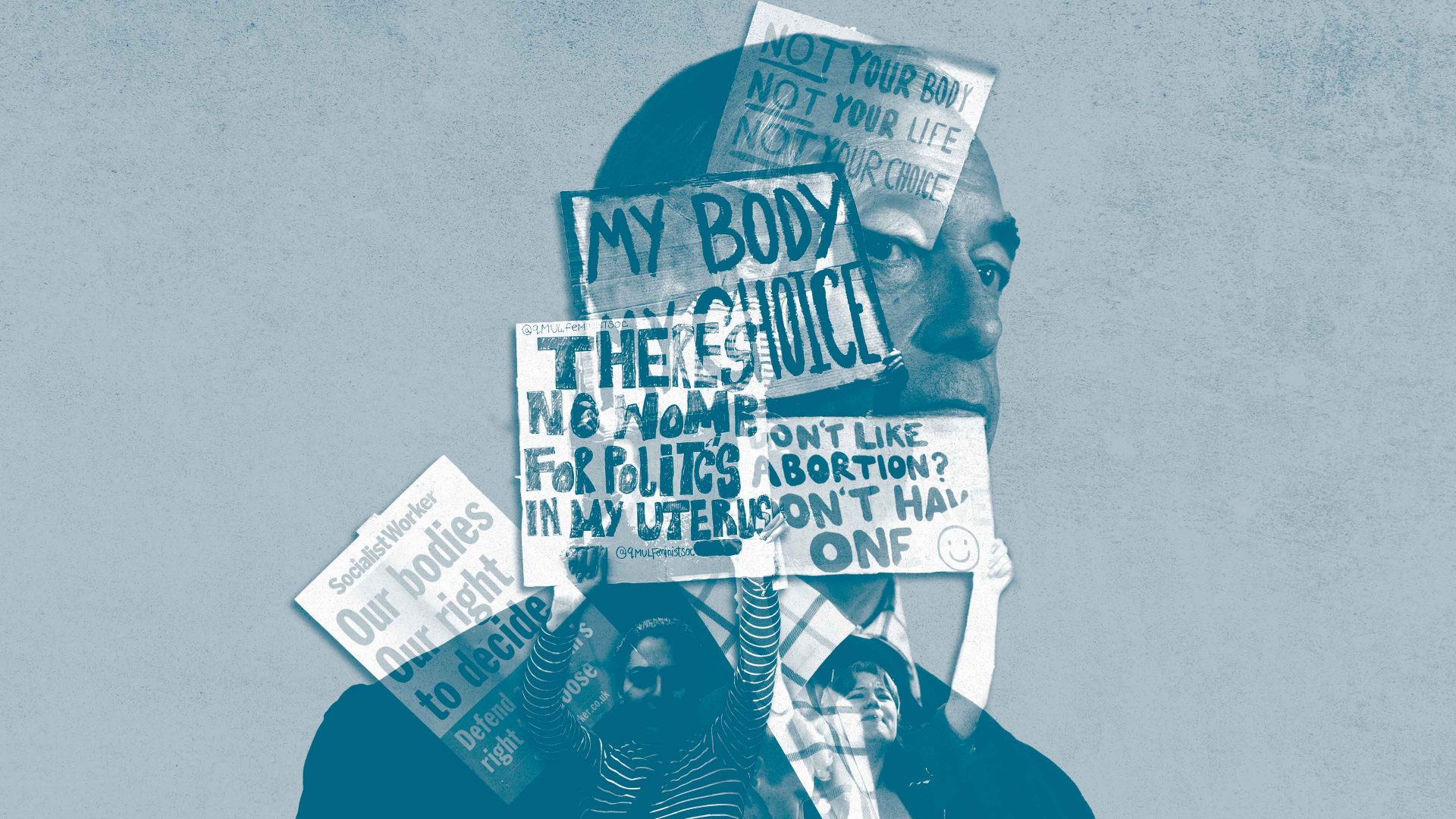
It’s 2029, and someone you love needs an abortion.
She calls the local NHS clinic, but she’s told that funding has been cut, and it is closed. She’ll have to travel further. You help her book another appointment, but the wait stretches on, edging her closer to a gestational limit.
Outside the clinic, people loiter at the entrance, leaflets in hand. They don’t shout, but their presence is enough to make her hesitate. Inside, the rules have multiplied: extra forms, a new ultrasound, a longer consultation.
When the appointment finally arrives, she is refused care. The clinician cites paperwork discrepancies and safeguarding concerns. Weeks of effort, travel, and planning for nothing.
A letter follows, asking for clarification, reminding you both that abortion is still a criminal offence outside certain conditions. You are both under suspicion, and access has quietly disappeared. This time, she cannot get the care she needs.
For years, British politics has comforted itself with the idea that abortion is settled. The procedure is legal up to 24 weeks of pregnancy when approved by two doctors and carried out within the healthcare system, and later than 24 weeks in specific circumstances, such as serious risk to the woman’s life or severe fetal abnormality. The law may be archaic, the criminal framework intact, but access exists, and the NHS has acted as a buffer against the kind of upheaval seen in the United States.
But that sense of security relies more on infrastructure than law. Abortion remains a criminal act except under certain conditions, and it is still a criminal offence for anyone to assist a woman in obtaining an abortion outside the law.
That distinction matters. Public opinion in Britain strongly supports abortion rights (nearly 90% support the right to choose) but experience in the US shows that access can be curtailed without sudden shifts in public sentiment. A small, organised political movement can restrict rights without ever winning a majority.
Enter Reform UK. The insurgent hard-right party is developing a relationship with the US conservative legal network Alliance Defending Freedom (ADF), the Christian advocacy group that helped engineer the campaign to overturn Roe v. Wade. This is not a loose affinity but an operational partnership. Over the past year, ADF has acted as a practical bridge between Reform UK and MAGA Republicans, facilitating Farage’s appearance before Congress and arranging a series of transatlantic briefings and meetings.
According to the American legal scholar Mary Ziegler, the Alliance Defending Freedom is a particularly influential political operation. Earlier anti-abortion movements in the United States were often “single-issue and secular… talking about abortion as a civil rights issue, that’s not ADF,” Ziegler tells The New World.
“ADF is involved in issues from same-sex marriage, transgender rights and contraception. They’re opposed to IVF. They’re working at the United Nations. They’re working at the European Court of Human Rights. They’re everywhere.”
Suggested Reading


Stop blaming women for Britain’s falling birth rate
“They have a much broader agenda for ensuring that policy reflects God’s plan for human flourishing,” Ziegler says, an approach that treats abortion not as an isolated moral question but as one part of a wider effort to reshape law and public institutions.
That strategy is increasingly visible in the UK. Since 2020, ADF has expanded its British operation, quadrupling staff and funding to more than £1 million. It has backed the high-profile case of Adam Smith-Connor, who was convicted for silently praying in a clinic buffer zone, and has supported legal challenges framed around free speech and religious liberty. In its own words, the organisation argues that “protecting the right to speak freely… is essential to proclaiming the Gospel.”
This framing matters. By shrouding disputes over abortion in the language of free expression and conscience, the argument moves away from healthcare and bodily autonomy onto more politically resonant ground. As Rishita Nandagiri, lecturer in global health and social medicine at King’s College London tells The New World: “The reframing is a tactic – it shifts the grounds of the argument.” Restrictions are introduced not as limits on reproductive rights, but as protections for speech and belief.
For Reform UK, free speech is familiar terrain. Farage’s appearance before Congress – facilitated by ADF – to argue that Britain faces a free-speech crisis made that explicit. Closer to home, he has embraced free speech as a political lever, most recently by bringing Lucy Connelly into the party, despite her conviction for inciting racial hatred over posts on X during the 2024 riots. At first glance, these causes appear unrelated to abortion. But that misdirection is the strategy’s strength.
Until recently, abortion barely featured in Farage’s political output. The Brexit Party had no formal position on the issue – it would have been an awkward fit with his cultivated image as the pub-friendly libertarian, allergic to moral instruction.
Then in late 2024, Farage began calling for a debate on the current 24-week limit, citing advances in neonatal care. By spring 2025, he was raising the issue more regularly, while insisting he had no newfound interest in reproductive politics.
The party’s renewed interest goes beyond Farage. Abortion Rights UK recently warned that Reform is “fast becoming the political refuge for anti-abortion hardliners,” citing a string of former MPs, including Danny Kruger, Andrea Jenkyns, and Maria Caulfield, who have joined the party. These are individuals who have previously voted against buffer zone protections, opposed early medical abortion at home, and advocated for tighter restrictions.
The lesson from the United States is not that anti-abortion views suddenly won popular consent, but that consent was no longer required. “If you look at polling, really, since the 1970s, the United States hasn’t been evenly divided,” Ziegler says. “It’s been about 60–40 that abortion should be legal.” What changed was strategy.
“What the anti-abortion movement realised – groups like ADF realised – was that this was not going to be a battle to change hearts and minds. It was a battle to pull certain levers.”
In September 2021, Texas introduced Senate Bill 8, a law that effectively banned abortion after around six weeks, before many women realise they are pregnant. The novelty of the legislation was not the restriction itself, but how it was enforced. Rather than empowering the state to act, the law delegated enforcement to private citizens, allowing anyone to sue clinicians or those who helped someone access an abortion, for a minimum of $10,000.
This design was deliberate. By outsourcing enforcement, Texas made the law difficult to challenge in court, since there was no clear state actor to sue. Within weeks, abortion services across the state had largely ceased, despite Roe v. Wade still formally standing. Abortion remained legal on paper, but functionally inaccessible.
Using civil liability, professional risk and procedural hurdles rather than outright prohibition became a template. In other states, so-called TRAP laws (Targeted Regulation of Abortion Providers) imposed medically unnecessary requirements on clinics, forcing many to close without banning abortion outright. Later, the same approach was applied to abortion pills: in 2023, a lawsuit backed by ADF sought to revoke the FDA’s approval of mifepristone by challenging regulatory decisions made decades earlier.
Suggested Reading


Farage wants to bring ICE tactics here. We can’t let him
These efforts were never designed to win public consent. “They realised they didn’t need it – because they were going to find other ways of achieving their goals.” Ziegler explains. For years, abortion technically remained legal while access steadily collapsed.
Britain’s legal and institutional setup leaves multiple points where abortion rights could be undermined. Its continued criminalisation, professional disciplinary rules and the lack of a strong constitutional rights culture all create pressure points. The same approach could threaten other civil liberties, from freedom of expression to bodily autonomy, once incremental administrative controls become normalised.
Nandagiri highlights the recent wave of police investigations into suspected “illegal abortions,” which have led to women being prosecuted for taking abortion pills at home, as well as changes to the Crime and Policing Bill that offer only limited protections (mostly for women themselves, not for providers) and tie abortion to broader laws that expand police powers. Access still depends heavily on the NHS, and for marginalised groups, high costs or legal uncertainty push people toward self-managed care.
The lesson from the United States is not that abortion rights were uniquely fragile, or that the public secretly opposed them. It is that rights can disappear even when most people support them.
Reform’s alliances matter not only because access to abortion could narrow, but because a governing style first tested on reproductive autonomy could spread into other areas of public life, quietly reshaping rights that people assume are secure. In Britain, abortion feels stable because we expect change to be noisy and obvious. Power does not always work that way.
The warning is simple: no single ban or dramatic vote. Just the slow erosion of rights, one restriction, one delay, one decision at a time.
 Most popular


Matt Goodwin’s road to derision


Screen scandal: How Ofcom lets GB News get away with it


How Jon Stewart told me the brutal truth about Trump and Hegseth

The race to save the Beatles