As the energy-sapping humidity of the afternoon gasps to its full height, 67-year-old Ignacios raises himself onto an elbow in his hammock to tell me about life inside Venezuela. It’s as much physical exertion as he can manage.
We are on the veranda of his family’s hut in a nameless place somewhere in the nebulous territory between Guyana and the vast South American socialist state which Donald Trump has in his sights.
From the crest of a hill on a bumpy journey from the river port of Mabaruma along jagged dirt tracks, my guide pointed out a verdant summit marking the Venezuelan frontier. But the exact border is hard to pinpoint.
Ignacios and his family, who belong to the indigenous Warao people who inhabit this region, have crossed back and forth between the two countries for as long as anyone can remember.
But these days, Ignacios explains, staying full-time at the settlement in the Orinoco Delta where he was born and continues to farm ginger, plantain and cassava is complicated by economic entrapment, and personal danger.
“The biggest problem in Venezuela is that it has become so difficult to sell anything,” Ignacios relates. “You have to try and keep up with inflation, which is a daily battle. You sell something for a price in the morning; by the evening the money you get has lost much of its value.
“Food prices started spiralling under Hugo Chávez, and that has just continued, and got even worse with Maduro. Then there are the syndicates and gangs who control everything. They extort you. If you don’t pay, you will end up being killed. You just cannot live that way.”
Suggested Reading
Why Trump should never be given the Nobel peace prize
Ignacios, who has two daughters, is technically a refugee here in Guyana, although no one is really taking note. That might change soon though.
If Donald Trump’s mooted military action against Venezuela does happen, there could be a sharp increase in people coming through this settlement, which is at the end of a lagoon near a tangle of rivers that penetrate the dense jungle.
People here understand Venezuela all too well, for its instability and problems and it remains a deeply corrupt and treacherous place.
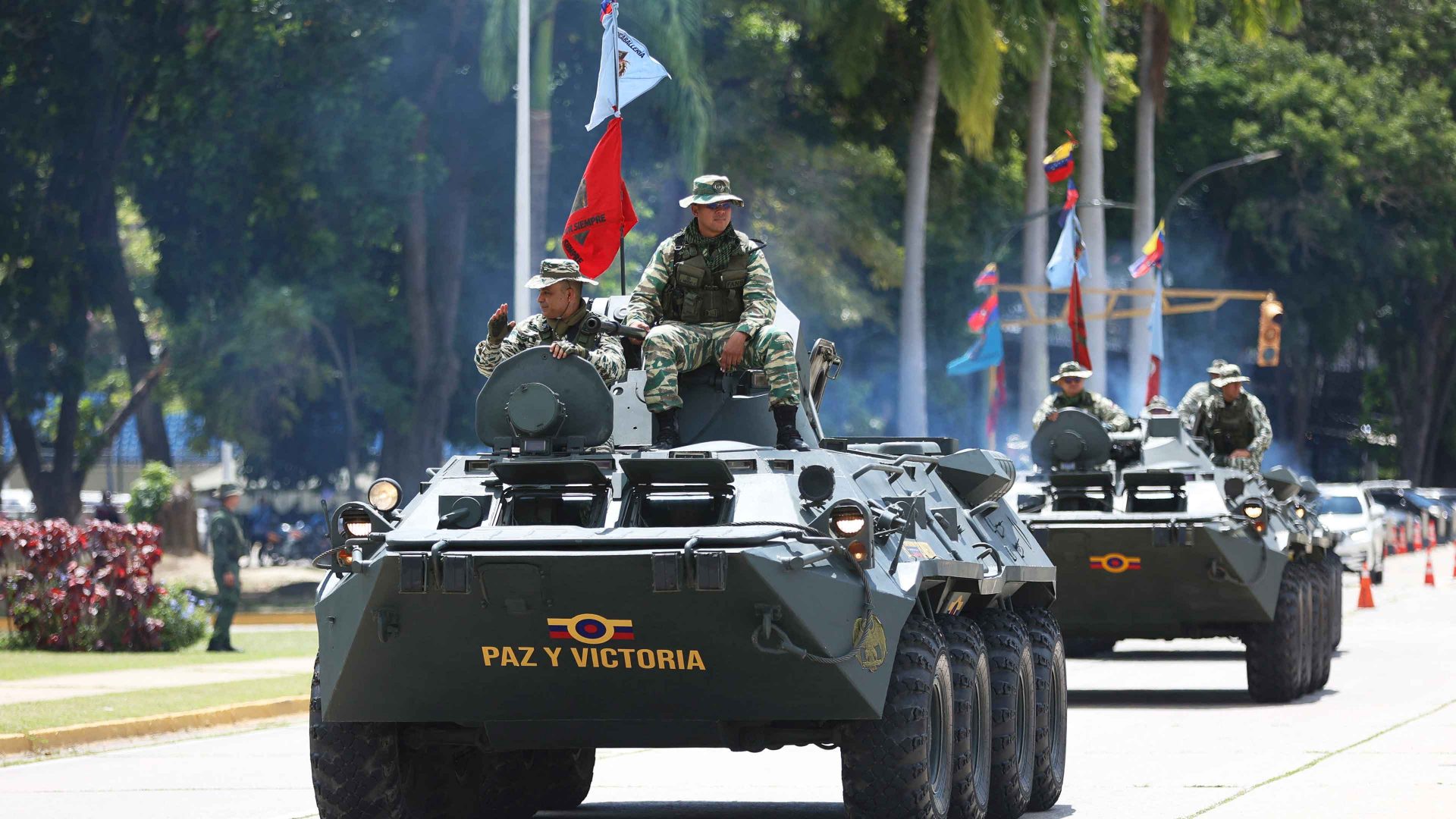
Trump, however, is believed to be considering missile strikes against the regime led by president Nicolas Maduro. Maduro – who is now paranoid about being assassinated – and his key allies have recently been designated members of a foreign terrorist organisation, which could pave the way for decisive action.
The week before I was there, at least six US aircraft conducted fly-by shows of strength off the coast of Venezuela, with a squadron including a supersonic F/A-18E fighter jet and a B-52 strategic bomber. A few days earlier, the USS Gerald R. Ford, the Pentagon’s most advanced aircraft carrier, arrived in the Caribbean. It was the largest build-up of American firepower in the region for decades, and it takes place against a backdrop of 21 US strikes on alleged drug boats, said to be crewed by Venezuelan and Colombian traffickers. Those attacks killed 83 people. Washington has not produced any evidence to show that these individuals posed a threat to the US.
Behind this, Trump and his defence secretary Pete Hegseth claim, is the Cartel of the Suns, a state-embedded criminal network with Maduro and Venezuelan military generals at the helm. The cartel allegedly controls the flow of narcotics and arms for profit to prop up the regime.
The welcome shade of Ignacios’ shack seems an unlikely place to be debating the merits of a Trump-led military incursion, but no one here is short of an opinion.
Most have firm convictions about the Maduro regime based on their own grim experiences. They are, however, wary of applauding the White House’s bullish imposition because it represents an unknown future that might conceivably be even worse.
“In Venezuela it’s hard to get anything done without being threatened,” says Luis, 37, from his own hammock in the adjoining shack. “There are syndicates running protection rackets.
Suggested Reading
Trump goes to war
“I worked in an artisan gold mine; they were always coming to take their cut. Some members of my family were shot because they refused to pay up. All of it links back to the government and the military, to the cartel which runs everything over there. They are all getting paid off.
“It would be wonderful to go back to our farm in Venezuela,” Ignacios affirms. “We used to have functioning schools, and the hospitals were of the highest standard. People like us want their lives back.”
His words drift off as lethargy takes over. Another Venezuelan farmer splutters off into the murky creek beyond in a simple wooden boat, having repaired his ailing outboard motor.
Two Rastafarian men pass through with bags of second-hand clothes which they drape over bales of ginger root for display, but no one seems interested.
Back at the bustling boat landing in Mabaruma, touts jostle for fares to take people downstream. Many of those clustered in the shade by stalls selling fish and wriggling sacks of fresh crabs are from Venezuela. Latin salsa music blares from a grocery stall on which written inscriptions from the Bible are pinned.
The people here are incredibly isolated, with no road connection to Guyana’s capital Georgetown. Fuel and food have to be shipped in; the entire economy depends on the river.
But it’s substantially better than the toil of subsisting in one of Venezuela’s struggling cities, all seem to agree.
“Guyana has given me a lifeline,” declares Javier, 22, who has been working at a vegetable stall at the waterway hub since 2019. “There is no work in Venezuela, so I have no plans to return there. There is nothing left for me.”
There is of course a revolutionary yearning among the thousands of refugees who have fled Venezuela for sanctuary over the eastern border – as well as substantially more who have resettled in Colombia and Brazil – although it is dissipated by the ferociously debilitating heat.
More than 25,000 people have arrived since the lowest point of the economic crisis in 2018, when inflation reached 1,300,000%. This influx now accounts for roughly 3% of Guyana’s total population. Even though the flow has slowed in recent times, many still make the treacherous journey.
At the regional police headquarters in Anna Regina, on Guyana’s Atlantic coast commander Khemrej Shivbaran controls a floating base at the mouth of the estuary which most Venezuelan people traffickers use.
“The journey from Venezuela can take them four or five days,” he explains. “They head out to sea and then cut inland near here. It can be very dangerous. Sometimes there are up to 90 people in a small metal boat, all with luggage, so the boats are very overloaded.
“All of these people are escaping because of the terrible state of their economy. They are fleeing for a better life, to find a job.”
With the International Monetary Fund projecting that Venezuela’s end-of-period inflation rate for 2025 will be approximately 549%, it’s impossible to dispute that under Maduro the country is a basket case in need of urgent reform.
But despite it all, people here are very wary of any intervention from the north. “If the Americans start firing missiles it could become even worse,” says Luis, from his hammock. “Maduro won’t just give in. The ones with power have nothing to lose.”
Ignacios musters the energy to agree with his neighbour, despite the breathless conditions. “Si, claro,” he murmurs. No one else moves. His children are lying completely still in another hammock.
 Most popular
‘Operation Epic Fury – as it happened’
Is Star Wars dead?
Morrissey returns.. and heaven knows he’s mythical now

Iran War: Trump has now sealed his own fate