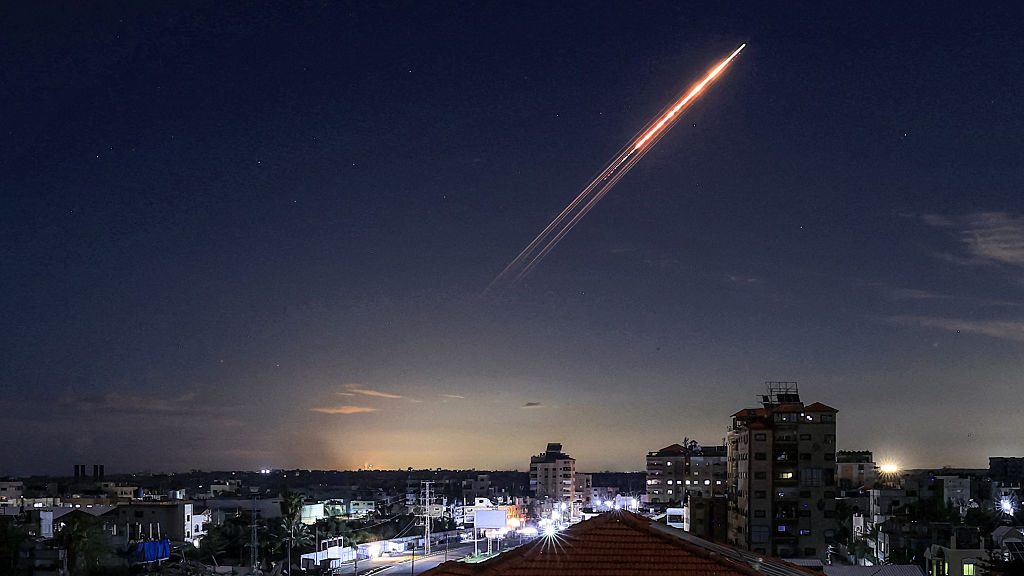
The Gulf states stand directly in the middle of the firing line between Iran and the US. Before the fighting started the Gulf countries hosted 50,000 American troops in 19 different locations. Bahrain alone is the base for America’s Fifth Fleet. There are 10,000 US soldiers in Qatar.
Each of the American bases is fully equipped with state-of-the-art Patriot and Terminal High Altitude Air Defense (THAAD) systems. They are proving reasonably – but not totally – effective at shooting down Iranian short-range and intermediate-range missiles aimed at the US bases and local economic infrastructure.
The Gulf States themselves are also equipped with their own Patriot and THAAD systems as well as French and British systems and some of the best-equipped fighter jets in the world.
They also have some of the best equipped militaries. The United Arab Emirates has been nicknamed “Little Sparta” and its special forces have had a major impact in fighting in Sudan, Yemen and Somalia. Saudi Arabia has the fifth largest defense budget in the world and its forces are combat hardened after years of scrapping in Yemen.
But Iran’s aim is not to defeat the US or its Gulf allies. It is to survive by creating economic chaos that will make the cost of attacking it intolerably high for the Gulf States, Europe, America and the rest of the world. To do that it does not require tens of thousands of its Shahab missiles. It only needs a few of them – or some other weapon – to keep landing on carefully chosen regional targets.
Missiles are not even necessary. Iran is a major manufacturer of military drones. They are also adept at cyber warfare and the millions of Shi’ite Muslims scattered throughout the region provide a vast reservoir of potential saboteurs.
The Gulf States are vulnerable on all fronts. Their cities and refineries are easy targets packed into small areas. Their economies are heavily dependent on the export by ship of oil and gas and the help of an estimated 30 million expatriates whose labour and expertise keep the wheels of industry moving.
Geography is a major lever in Iran’s aim of economic chaos. Its main geographic asset is the 30-mile-wide Strait of Hormuz at the entrance to the Persian Gulf. Block that and they have stopped 20% of the world’s energy from reaching the marketplace. The Islamic Revolutionary Guard claims it has closed the waterway. America denies this.
What is confirmed is that the Honduran-registered tanker Athene Nova is on fire in the strait after being hit by an Iranian drone and that 119 tankers are currently backed up in the Gulf. The price of oil has jumped 15% and marine insurance rates have leapt 50%.
It is almost impossible to fully protect a port, oil terminal or oil refinery. They cover hundreds, if not thousands of acres. A fire started in Saudi Arabia’s largest domestic oil refinery, Ras Tanura, after it was hit by an Iranian drone. Saudi Arabia was forced to shut all of its oil refineries and terminals as a precaution against further attacks. All it took was a single Iranian drone.
Suggested Reading
It’s time for a European bomb
Qatar was also forced to close its oil installations after several Iranian attacks and Israel shut down offshore gas fields.
Iran has also been targeting airports across the region. So far airports in Doha, Abu Dhabi, Dubai, Muscat and Bahrain have either closed because they were hit by Iranian missiles or drones or closed because they feared an attack.
The airports were filled with expats fleeing the region, all of them highly-paid and well-heeled individuals living the high life in the tax-free Gulf states. But their lives are more important than their lifestyles and they will take some persuading to return.
Missiles and drones are not the only weapons available to Iran. The Islamic regime has also become expert at cyber warfare. It is reckoned to be the world’s fourth most active cyber warrior after Russia, China and North Korea.
On several occasions it has taken down the main computer system of Saudi Arabia’ s state oil company, Aramco and has also forced temporary closures in government offices of all the Gulf States. Its most successful cyber attacks have been against American financial institutions. Bank of America, JP Morgan Chase, Wells Fargo and Citigroup have all suffered losses as a result of Iranian cyber attacks.
The animosity between the Arab Gulf states and the Persians of Iran goes back centuries – and yet the Gulf states are not their primary target. They are being hit only because the main target – the US – is out of reach. They can, however, damage the US and its allies in the West by undermining the economies of the Gulf States.
When the economies that produce that oil are damaged then the price of oil – which affects the price of everything else – goes up. And the ability of Western consumers to swallow higher prices is considerably lower than the Islamic regime’s ability to swallow American bombs.
 Most popular

‘Operation Epic Fury – as it happened’

Is Star Wars dead?

Morrissey returns.. and heaven knows he’s mythical now


Iran War: Trump has now sealed his own fate