
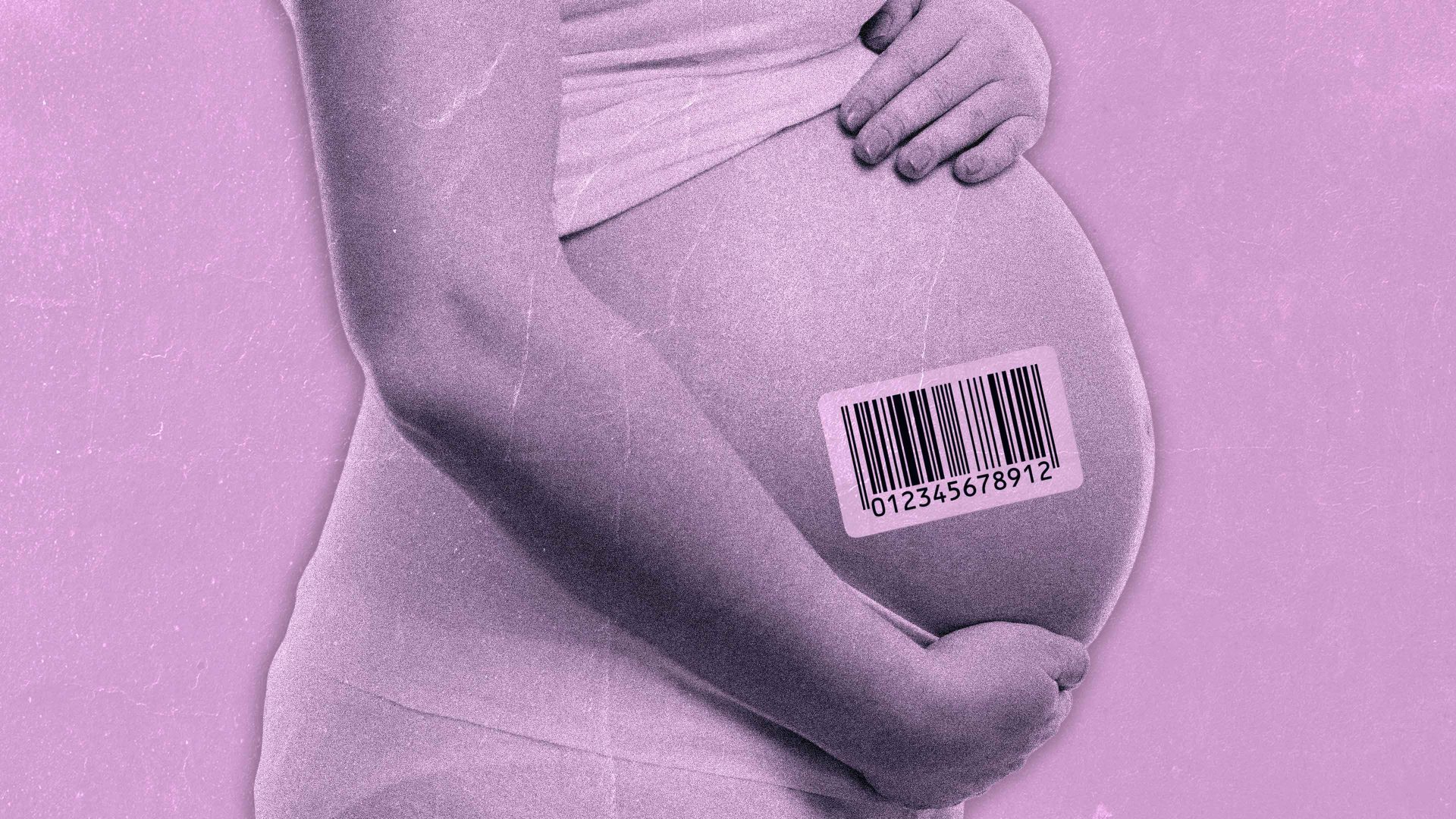
I’m now 33, an age at which many of my friends are having children. I’m surrounded by newborns and pregnancies in various stages, and by various means. One of my oldest friends is carrying a child for one of my other oldest friends, as he is a gay man in a relationship with another gay man. She is an “altruistic” surrogate, which just means she is doing it with no financial motivation, as commercial surrogacy is illegal in Australia.
I have long been interested in the arguments against paid surrogacy as they have a lot of cross over with arguments against sex work – women selling a service with a part of themselves that is deemed sacred, that is only supposed to be given for higher reasons.
I was discussing paid surrogacy with my friend one day when he reacted strongly: “Yuck – I don’t want to talk about that kind of surrogacy, it makes me feel sick, it’s nothing like what we’re doing.” This surprised me as I felt only luck divided him from people accessing the services of those kinds of surrogates – luck that he had a friend that was able and willing to carry a child for him for free.
And I am conflicted by the fact that the labour of a woman’s body, that is so high risk as it is in pregnancy and birth, would go unrenumerated; to me if it’s exploitative to coerce a woman into it out of her financial need it is equally as exploitative of the bond between you to expect her to do it for free. Who is to say she doesn’t feel pressure due to the strength and longevity of your relationship?
I can understand being against surrogacy completely, but I can’t understand being against it when it’s paid, and for it when it’s unpaid, as if the money is what dirties the interaction. Besides, did he think only those who were privileged enough by the ties of friendship and family to have someone who could be an altruistic surrogate were deserving of a child? Did not those gay men or infertile straight couples or single fathers who didn’t have the same opportunity as him deserve one too?
Of course, what Australia and many other countries are trying to avoid by making commercial surrogacy illegal is a market, where there are competitive prices and people making choices based on money. I understand these ethical reservations.
However, to me it is completely naïve, as making commercial surrogacy illegal hasn’t decreased the demand for children via surrogate. It has only pushed the market into other countries, and on to women who are more vulnerable to exploitation. These women face language barriers and difficulty in making legal arrangements across borders.
This has been demonstrated quite clearly in recent years, since Russia made commercial surrogacy illegal. It had a huge surrogacy market, driven largely by China, where the one-child policy had led to a shortage of women of child-bearing age. When Russia’s surrogacy market shuttered, the demand moved to Georgia, where Thai women were brought in to meet the increasing need. Georgia has its own complicated history with feeding the demand for children. From the 1970s into the new millennium, hospitals and healthcare workers were complicit in a ruse, where Georgian women were told their babies had died during birth when they were actually sold on to wealthier adoptive parents.
The New York Times did an investigative deep-dive on the surrogacy industry in Georgia involving foreign women, specifically Thai women. The women are often brought into the country under deceptive terms and physically prevented from leaving. The language barrier makes them extremely isolated and unable to communicate with the doctors and nurses who treat them during pregnancy.
One woman told reporters that her experience of being taken to Georgia was far worse than when she was tricked into going to Bahrain to be a sex worker. At least in Bahrain they received cash tips and knew what was being done to their bodies.
Thai women are common in this industry for two reasons; one, because the exchange rate means they can be paid less than women from other countries and two because Thailand itself once had a booming commercial surrogacy industry, but it was shut down in 2014 after a child with Down Syndrome was supposedly abandoned by its Australian parents.
Suggested Reading

The chilling future of pregnancy without women
As the law was being changed, there was an international scandal as many Australian parents of the surrogate children were not allowed to take the children back to Australia. In neighbouring Cambodia there was a similar situation two years later, when Cambodian women who had carried for Chinese parents were only allowed to be released from jail if they agreed to keep the children themselves.
I couldn’t see how this helped anyone – already impoverished women were made more impoverished by being forced to raise children they hadn’t wanted, and they didn’t even receive the payment they were promised. It reminded me of people who paid human traffickers to help them across borders, only to be discovered and deported back to their original country. They are back where they started, and in debt to the traffickers.
There is an obvious way to limit the impact on poorer countries and on poorer women, and that would be to legalise commercial surrogacy. A country like Australia, which is far wealthier and could afford to implement proper oversight and regulation, could make sure demand for children wasn’t displaced on to women in other places. We won’t do that though, because we prefer to think of it as a problem for less-developed countries, as if our own citizens aren’t the ones procuring the services. But they are – currently in Georgia half the clients of surrogates are Australian parents.
Simply allowing commercial surrogacy within your own borders doesn’t end all of the issues. There have been many high-profile positive stories of commercial surrogacy to have come out of the United States in the last decade, such as Gabrielle Union and Kim Kardashian, both of whom were unable to sustain a pregnancy safely.
There has been much coverage of the birth circumstances of Olympian Alyssa Lui too, who is the child of a white surrogate to a Chinese father, who picked the surrogate because he wanted his children to have “genetic diversity”. There has been far less coverage though of Guojon Xuan, a Chinese man who had dozens of children via different surrogates and raised them in abusive and militaristic homeschool compounds in the hope that one would end up being US president.
The children were eventually removed by the state. The surrogates were distressed by the false stories they had been told in order to carry the children, with some wishing they could have kept the children themselves and raised them as their own.
People also have children without the use of surrogates for selfish or egoistic reasons, and plenty of parents who conceive traditionally are abusive. The issue here though is the sheer numbers that the surrogacy market allows, the commodification and production of children by the wealthy through renting the wombs of women who are not wealthy.
Chinese billionaire Xu Bo has sired over one hundred children to surrogates in the US, all boys. For all we know Elon Musk may have similar numbers, and he definitely shares similarities with Bo. He also uses IVF and gender selection, preferring boys, which is partly why he has been so outraged by his daughter Vivian Musk’s transition.
Both men approach child-making the way they do their businesses, as if it were a factory. Although he doesn’t engage in traditional surrogacy, you could argue that Musk engages in veiled surrogacy, given his reaching out to women on X, formerly Twitter, to carry his children (viewing them as vessels to gestate his genetically superior kids) and his penchant for taking the children from their mothers and violating custody agreements.
His pro-natalist views are also transparently white supremacist – this reminds me of Xuan and his desire to create a president. They both view children as a means and a reflection of their own ego and power. There should certainly be a cap on children, but how can that be policed when it’s done through the private avenues used by someone like Musk?
It is not only wealthy men who feel this entitlement to children. WIRED recently covered venture capitalist Cindy Bi, who blamed and publicly attacked the surrogate of her child after the child was stillborn and who believes surrogates have too many rights and that the safety of the foetus should come before the safety of the surrogate.
That idea is borrowed from anti-abortion campaigners except it’s perhaps even worse when the carrier of the child is someone in service to someone else’s desire – an employee. Many of these people show not only that they feel entitled to have a child, but that they feel entitled to have a certain kind of child.
IVF is the usual route taken in surrogacy arrangements (though it can be done through DIY means). This allows people to select aspects that match their vision of the child they would want, whether that be gender as in the case of Musk and Bo, or race as in the case of Liu’s father.
Undercutting all this is our belief that we have a right to have children, and the right to enlist the help of others. As a queer person, who has often had to think beyond the usual when it comes to creating a family, I have nothing against surrogacy, regardless of whether it is paid or unpaid. But people need to be realistic in their approach, and recognise that their desire and demand for having their own children feeds a market and industry that is at times inhumane.
We can take responsibility, as Australians, for this wish. We can introduce laws that allow commercial surrogacy in order to spare women elsewhere from more precarious arrangements, as people within their own place of citizenship always have more labour protection and bargaining power.
Otherwise, the only other thing that could really be done to lessen the current exploitation is to interrogate our own right to have children – are we justified in having children just because we want them?
 Most popular

Matt Goodwin’s road to derision
GB News Scandal: How Ofcom let GB News corrupt British media


GB News sets its lawyers on to The New World
Matt Goodwin’s new book: The missing chapter