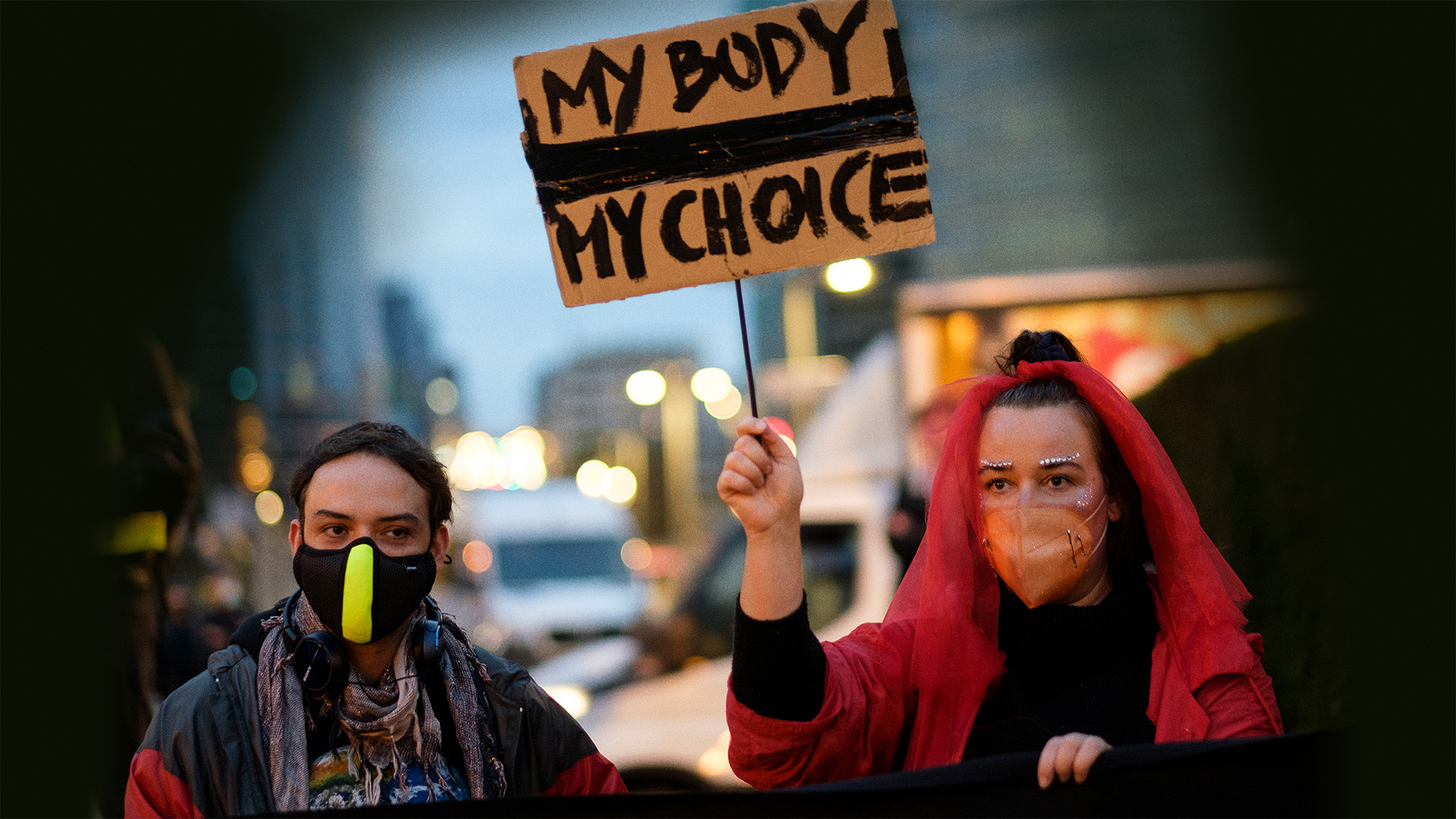
There were hugs, celebrations and sighs of relief among pro-choice campaigners after the European Commission confirmed EU money can be used to help ensure access to safe abortion across the continent
Commissioner Hadja Lahbib said she had been struck by the mobilisation behind the My Voice My Choice campaign, which through a European Citizens’ Initiative demanded that Europe step up financially. No new pot of money was unveiled, but she made clear that existing social funds could be used.
“Nearly half a million unsafe abortions take place in Europe every year,” she told a press conference. “This is not the Europe we want to live in. From now on, we are granting member states the possibility to use the European Social Fund to improve access to abortion.”
No country will be forced to change its laws. But for Slovenian activist Nika Kovač and her team, who were repeatedly told Brussels had no role to play in abortion policy, the moment still mattered hugely.
It marks the latest chapter in a journey that began more than three years ago, when Nika was living temporarily in America. For her, the overturning of Roe v. Wade wasn’t just another headline, but a warning. If rights that once seemed untouchable could disappear overnight in one of the world’s most established democracies, then nowhere was immune, including home.
Within days, she was on a flight back to Slovenia, determined to understand whether anything could be done in Europe.
At first, the answer seemed to be no. Again and again she was told abortion sat firmly within national competence. Instead of accepting that, Nika and a small group of friends began searching for other possibilities. If the EU couldn’t legislate directly, perhaps it could influence access indirectly.
And so, what began in 2023 as late-night meetings across Ljubljana culminated this week in a European Citizens’ Initiative landing on the desks of EU commissioners in Brussels.
Signed by 1.2 million people, it became one of the strongest grassroots democratic attempts to reach Brussels in recent years. Parliament backed it with a large majority. And while this week’s announcement doesn’t rewrite the rulebook, it does something campaigners insisted was possible: it acknowledges that EU money can help women access safe abortion.
The initiative never sought to force countries to change their laws. Instead, it proposed channelling funds into clinics in willing countries so that women, whatever their nationality, could access a safe procedure free of charge. In practice, that means a woman living under a government that bans abortion could travel elsewhere in Europe and receive care.
Because while abortion is legal across much of Europe, access remains deeply uneven. In Malta, it is banned in almost every circumstance, with no exception for rape. In Poland, it is legal only in extremely limited cases.
“With far-right politics gaining ground in Europe, we constantly hear from women living in fear,” Nika says. She has the gentle voice of someone who might easily have chosen life as a librarian rather than the relentless activist she has become. She speaks often of the pressure of not letting down the women counting on her.
“Supporters in countries like Croatia and Italy, where abortion is a legal right, tell us doctors are refusing to carry out the procedure on moral grounds. And banning it doesn’t reduce the number of abortions, it just pushes women towards more dangerous options.”
Suggested Reading

Stop blaming women for Britain’s falling birth rate
The road to Brussels has not been smooth. At first, the team feared they would never reach the one-million signature threshold required for an initiative such as this to be considered. Momentum shifted only when high-profile supporters amplified the campaign, including Greek presenter Natasa Giamali and Croatian singer Severina, helping secure the final signatures.
The last time I saw Nika was in September, when she and fellow organisers had moved to Brussels. Their two-bedroom apartment – part home, part headquarters – was filled with half-eaten takeaways and volunteers trying to decode EU bureaucracy. Everyone wore pink T-shirts branding themselves “reproductive fairies,” and cigarette smoke drifted in from strategy sessions on the balcony.
Back then, she was optimistic. They were preparing a symbolic handover of the signature boxes. When I asked if she had a feminist icon who gave her hope, she didn’t hesitate: Pippi Longstocking.
“She was the first girl I knew who could control a horse and have so many adventures. She was strong and independent and was never defined by pleasing others. Whenever I think I can’t do something, I think of that little girl with orange hair who accomplished so much.”
In the weeks before the Commission’s announcement, the mood grew more complicated. Setbacks piled up. Votes were cancelled on technical grounds. Attacks from anti-abortion groups and far-right networks intensified. Campaigners said their social media reach suddenly dropped. Nika woke one morning to find pornographic deepfake videos of herself circulating online. As the stakes rose, so did the intimidation and the personal cost.
This week, supporters, on edge and exhausted, did not get everything they wanted. But what they did get, they are taking as a win.
Something has shifted. The outcome will not transform access overnight, but it has changed the political language around abortion in Europe. A door has been opened. Whether anyone walks through it now depends less on activists in Brussels than on governments back home and the courage they are willing to show.
Three years ago, Nika boarded a plane believing Europe might protect what America had lost. This week’s outcome is neither a clear victory nor a defeat, but proof that institutions can move when there are enough people to push.
Pippi never accepted the limits set for her. Neither did Nika.
 Most popular

Matthew Goodwin’s by-election diary
The big secret of Small Prophets
I’m in Ukraine, a nation let down by America
The Queen, the palace and the media were accomplices in the Andrew fiasco