MATT KELLY
Oasis at Wembley
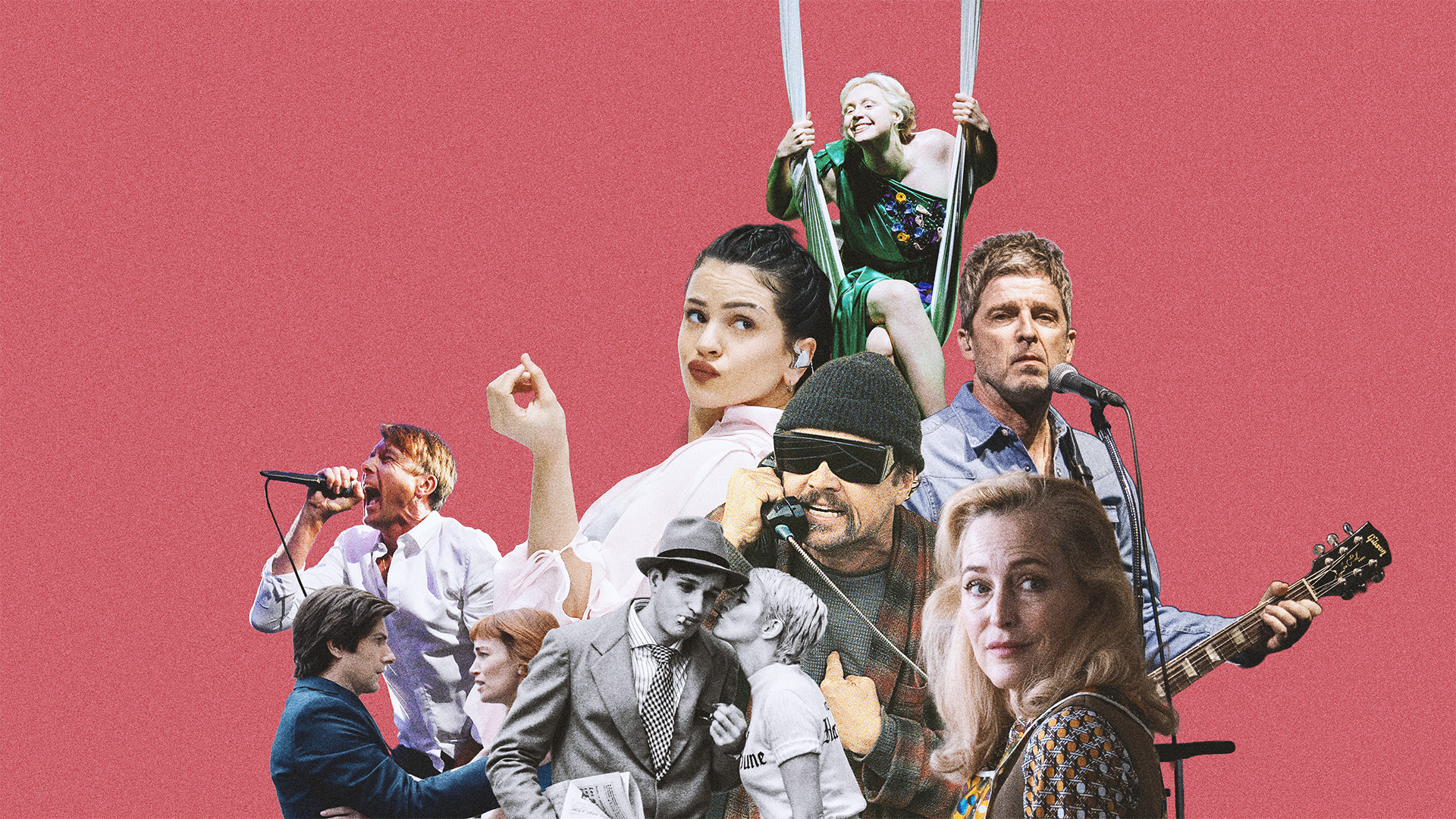
As Tony Blair made mention in 1998 (the year Oasis released compilation album The Masterplan) this is not a time for soundbites. But Wembley wasn’t shaking that night; it was beating like a heart.
Noel, accountant-poet, tallying anthems as if they were balance-sheet miracles. Liam with a fucking tambourine on his head somehow the most serious man in the stadium.
Two hours of time travel, back to when Britain really was something to behold; beach-ball buoyant, bouncing, fabulous. The guy in front of us, solo, from Canada, just for this one night, weeping with disbelief that here he was, back to before it all turned to shit. Live forever? If only.
MARIE LE CONTE
The Years by Annie Ernaux
I loved The Years so much that I struggled to see how the book could be both translated to English and turned into a play while keeping all that made it so special. I’ve rarely been happier to be wrong: the sweeping, epic, intimate portrait of womanhood across the 20th century worked beautifully on stage. Not only did I laugh and cry, I also burst out laughing while my cheeks were still wet with tears.
Elsewhere, I found Rosalía’s LUX to be a remarkable piece of work; an album truly unlike anything I’d ever heard. She’s a genius.
JAMES BALL
Clair Obscure: Expedition 33
This enthralling game, developed by French studio Sandfall Interactive, has occupied my head – rent-free, as they say – ever since the first time I picked up a controller to play it. On one level, it’s a fairly standard role-playing game: you wander the world, fight monsters, upgrade your weapons, and level up your characters.
The gameplay is like the golden era of the Final Fantasy franchise (VII to X, since you ask), but the plot is all grown up. You live in something resembling an alternative universe France, in which the Gommage causes everyone above a certain age to instantly die. As you begin the game, that age drops to 33 – meaning the oldest person alive is 32.
What follows is an exploration of mortality, meaning, art, and more, set against a visually stunning backdrop of a doomed world. What better form of escapism could there be?
ROS TAYLOR
Adolescence and Fit to Teach
Most West End theatres are cramped, archaic places that are wholly unsuited to the job of transporting you somewhere else for the evening. But the Bridge Theatre is designed for audiences to have a good time. Squeezed into the cheapest seats for Nicholas Hytner’s arid Richard II and a lush, hilarious Midsummer Night’s Dream, I loved both.
On TV, the BBC’s Mix Tape was enthralling and Adolescence made me shake. But the Substack I enjoyed most, Fit to Teach, is by a PE teacher in Harlem who spends his life trying to engage teenagers. I wish I could write like that.
SONIA SODHA
Suburra: Blood on Rome
This was the year I finally gave in to the DuoLingo craze and started learning Italian after a holiday to Sardinia. And what better way to boost my streak than watching a subtitled Italian series? That’s how I found my way to Suburra: Blood on Rome. It quickly upgraded itself from language homework into my watch of the year: I blitzed all three seasons of this mafia crime drama in a matter of weeks. Dark, moving and superbly acted, it left me wanting more.
MATTHEW D’ANCONA
One Battle After Another
Having picked up nine Golden Globe nominations, Paul Thomas Anderson’s 10th feature One Battle After Another looks set for a bountiful awards season. From its thrilling opening sequence, in which the revolutionary group, the “French 75”, liberates a detention facility at the Mexican border, the movie is a rollercoaster ride that hurtles through the American landscape and political imagination at maximum velocity.
As the fascistic Col Steven Lockjaw, Sean Penn is at his brilliant best – on the trail of Perfidia Beverly Hills (Teyana Taylor), “Ghetto Pat” (Leonardo DiCaprio) and their daughter Willa (Chase Infiniti). Years pass, but Lockjaw needs to tidy up loose ends to ensure his membership of a white supremacist group known, absurdly, as the “Christmas Adventurers Club”.
Though the contemporary resonances are razor-sharp, the drama compels on its own merits. The best movie of the year.
SIMON BARNES
Re-reading Shakespeare
The second-best literary adventure of the year was reading all Shakespeare’s plays – 39, counting the collaborations. Even better was to start again from the beginning, but slowly, taking in all the footnotes.
Reading the plays as if they were novels is a simple, as well as a complex joy: the brilliant plotting, the inextricable nature of tragedy and comedy, Hamlet the genius, glorious Rosalind, that bastard Iago, the wisdom of Juliet, the Macbeths’ sweet marriage – and above all else the ineffable grace of language. Romeo and the Dream were written back-to-back: why not start with them?
JONN ELLEDGE
Trespasses by Louise Kennedy
Trespasses is a doomed cross-community, intergenerational and adulterous love story that takes place against the backdrop of the Troubles. Set in a small Northern Irish town in 1975, it gives a real sense of a place and a time and a political situation, not to mention the heart’s annoying habit of wanting what it wants.
The book actually came out in 2022 – but it’s just been turned into an extremely good Channel 4 adaptation starring Gillian Anderson as the lead’s mother. Read and watch; you won’t regret it.
LUCY READE
Severance
In an age of binging and instant gratification, it’s remarkable that a weekly programme with a slow and confusing plot, set in a sterile office, became Apple TV’s most-watched series of all time. But it did. Severance season two, set in a world where people “sever” their consciousness between work and leisure, had fans arguing endlessly over Easter Eggs, trying to solve the larger mystery at play.
The show is an exploration of identity and the self, but its brilliance lies not only in its mind-bending absurdity but also in the tiny, superbly acted character moments. Season three cannot come soon enough.
EMMA-KATE SYMONS
Nouvelle Vague
Richard Linklater’s Nouvelle Vague transports you back to an intoxicating Paris on the cusp of the 1960s, when the New York Herald Tribune still existed and the French New Wave was in full bloom. The city sparkles with creativity and rule-breaking artists like the ambitious young Breathless director Jean-Luc Godard, played with prickly intensity by Guillaume Marbeck, François Truffaut, Claude Chabrol, Éric Rohmer; la chanteuse Juliette Gréco, and the whole audacious Cahiers du Cinéma crew. Zoey Deutch is sublime as l’Américaine Jean Seberg opposite Aubry Dullin, as cheeky and adorable as the real-life Jean-Paul Belmondo.
A beautifully acted black-and-white homage to an iconic film – and its making – and to a cultural tipping point that changed cinema forever.
JOHN OSBORNE
The end of WTF
The Ballad of Wallis Island deserves to be hailed not just as the film of the year, but as a masterful celebration of pathos, with an Oscar-worthy performance by Tim Key playing a well-meaning man full of love who tries hard but gets things wrong.
The most significant audio highlight has been Marc Maron’s WTF podcast coming to an end. His final episode with Barack Obama grabbed the headlines, but for those who have listened since the early days, it was the penultimate episode – where Maron reflects, takes stock and accepts that possibly he is happy – that felt like the perfect ending.
ELEANOR LONGMAN-ROOD
Riot Women
I come from a family of riotous women. At a rugby match recently, as I released the guttural scream “COME ON YOU BATH” into the sideways rain, a man sitting next to me remarked that I had “quite the set of lungs on me”. “Thanks,” I smiled, “I got them from my mother.”
My mum isn’t the only one. In fact, if you trace my paternal line back to 1930s Berlin, Joseph Goebbels called my great great great aunt, Else Lasker Schüler, a degenerate for defying Nazi rule. Watching screenwriter Sally Wainwright’s Riot Women felt like an ode to all of them. Wainwright’s six-part drama is about a group of menopausal women starting a rock band and has been coined as feminism’s answer to The Full Monty but to me, it was far more than this. It was a reminder that if you ignore women’s voices it’s at your own peril. It’ll only make us louder.
FLORENCE HALLETT
Bill Nighy’s Ill-Advised
Has escapism ever felt more urgent? Not for me, and that’s why my cultural highlights this year have taken me far, far away – to Tudor England, via Elizabeth Goldring’s lavish, captivating biography of Hans Holbein the Younger, and to 1960s America at the Courtauld Gallery, where the souring American Dream is captured in the luscious melancholy of Wayne Thiebaud’s paintings of cakes and pie counters. Sally Wainwright’s Riot Women brought a typically irresistible hit of fresh, hard-hitting joyfulness, packed with star turns from Joanna Scanlan to Amelia Bullmore, and for easygoing grumpiness about things that don’t matter at all, try Bill Nighy’s Ill-Advised podcast.
Suggested Reading
2,000 years of punk rock
JOHN KAMPFNER
Amrun
The islands in the north of Germany have lately become hotspots for reality TV celebrities. Not back then, not in 1945. The island of Amrum, straddling the Danish border, is the setting for one of the unsung films of the year, the elegiac story of a 12-year-old boy who does everything he can to scavenge white bread, butter and honey for his depressive and malevolent Nazi mother – just as Hitler’s death is announced. Cinematographically, Amrum is both dazzling and spartan, and it poses uncomfortable questions about decency in the heart of darkness.
ZOË GRÜNEWALD
Perambulations
Post-Covid, my appreciation for London’s architectural beauty grew (mostly because there was little to do but wander around), and my favourite free hobby became imagining every wonderful house I passed could be mine. Then I discovered Perambulations, Stefi Orazi’s quirky walking guides, which turn these strolls into treasure hunts: big brutalist 1960s blocks, elegant postwar villas, grand self-designed homes that look straight out of a James Bond film, secret courtyards…and usually a lovely pub somewhere en route.
Cheap, and with 25p per guide going to the Homelessness charity Shelter, I’ve spent countless weekends roaming new corners of London, Cambridge and even Europe. For anyone craving design, history or just a walk with intention (rewarded with a pint, obviously), they’re perfect.
IAN WINWOOD
Graydon Carter’s autobiography
Graydon Carter was the editor of Vanity Fair at a time when the phrase “we don’t have a budget” meant that there was no ceiling to what the magazine would spend to get a feature on the page. As the editor of the savage New York magazine Spy, he also coined the phrase “short-fingered vulgarian” to describe Donald J Trump.
In When the Going Was Good: An Editor’s Adventures During the Last Golden Age of Magazines, his memoir of these rollicking times, the stiff Canadian hops with the jet-set at VF’s Oscar parties; realising that writers often lead chaotic lives, he also made sure that his contributors were paid in part before their articles were filed. As an account of a media age that has long passed, his book is hard to beat.
SOPHIA DEBOICK
Blood Relatives
This will be Jeremy Bamber’s 40th Christmas in prison. Blood Relatives, the latest series from the New Yorker’s Pulitzer prize-winning investigative podcast In the Dark, questioned whether he should ever have been sent there in the first place. Heidi Blake dives into the case files of the White House Farm murders – the shooting of Bamber’s adoptive parents, sister and twin nephews on a summer night in 1985 – and impressively charms grizzled ex-Essex Police officers into making new revelations.
One such revelation made headlines for its potential to exonerate Bamber. But beyond the questionable thrills of “true crime”, this is a cautionary tale of vested interests eclipsing the principle of “beyond reasonable doubt”
OLIVE POMETSEY
The Studio
Two things I didn’t have on my 2025 bingo card: Zoë Kravitz urinating herself on screen; the collapse of Hollywood via a legacy studio’s sale to a giant, monopolistic enterprise. Those are both plot points in The Studio, Seth Rogen’s relentlessly funny satire of the film industry, but as Netflix battles to buy Warner Bros, it almost feels like he wrote it with a crystal ball.
Darkly prophetic screenwriting aside, The Studio is the most hilarious comedy produced in years, packed with in-jokes and artfully deployed slapstick gags (see: Kravitz’s accident). But best of all, Rogen convinced Martin Scorsese to cameo in an episode that sees him weep over the news his final film has been axed. For that alone, he deserves an Emmy.
LUCY ASH
The Reckoning
The Reckoning, a Dash Arts play at the Yard Theatre inspired by a project that trains journalists to record war crimes in Ukraine. The script draws on verbatim testimonies from victims, making the experience inevitably harrowing, yet threaded with resilience – a reminder that life persists even in the darkest moments.
In one scene, a survivor from a village ravaged by Russian forces chops tomatoes, cucumbers, radishes and dill on stage, as he wearily recounts his story to a Ukrainian journalist. Everyone got a taste of the salad at the end – although not from the batch prepared on stage for hygiene reasons. I was also blown away by Matthew Xia’s adaptation of The Harder They Come at Stratford’s Theatre Royal. An amazing cast and an electrifying soundtrack. RIP Jimmy Cliff.
HANNAH FEARN
Antidepressants by Suede
It’s rare to see a band put out some of their best work three decades into their career, but that’s what 90s legends Suede achieved this year with their tenth album, Antidepressants.
Where he once made the squalor of modern life exotic, Brett Anderson has now turned his attention inwards, to questions of ageing, mortality and the anxieties of parenting. My highlights include the album’s title track, in which Anderson employs a sneering Sprechgesang with characteristic sexual aplomb, and Disintegrate, a lesson in embracing the vicissitudes of midlife with forthright acceptance, even a dark joy.
Suede are touring Europe in the spring. A ticket to see the pioneers of Britpop might, ironically, be the best antidote to 90s nostalgia.
JOHN BLEASDALE
Pynchon’s Shadow Ticket
There was a time when Thomas Pynchon was considered a recluse. In 2025, you can’t leave the house without tripping over him. If it wasn’t Paul Thomas Anderson’s blockbuster movie adaptation of Vineland, renamed One Battle After Another and starring Leonardo DiCaprio, Chase Infiniti, Teyana Taylor, Benicio del Toro, Regina Hall and Sean Penn, it was his new novel Shadow Ticket.
As a connoisseur of the artistic recluse and an appreciator of the filigreed entwining of conspiracy theory and pastiche, I’ve been a fan of Pynchon since reading Gravity’s Rainbow. Shadow Ticket, similarly to his last two novels – Bleeding Edge and Inherent Vice – is a much more accessible playful genre exercise, this time in Dashiell Hammett-like crime fiction with PI Hicks McTaggart hunting down a missing cheese heiress from Prohibition Chicago to prewar Europe. It’s a time when everything tinkers on the edge of something and the rise of dark forces rhymes disconcertingly but urgently with our own times.
TIM BRADFORD
Sprints
A rainy November evening. I’m anticipating a glass of red and a slow 2005 Dickens adaptation on iPlayer. Then friends offer us tickets to see Dublin band Sprints at Troxy. The wife checks them out on Spotify: “These guys are good – let’s go!”
Sprints’ lyrics are witty ranting poetry, the tunes sweet post-punk pop that swirls with influences my dormant teenage brain can still decipher – Swell Maps, Pixies, Killing Joke, SLF, Joy Division, Au Pairs. We re-find that fire-in-the-head rush of seeing a great guitar band. “But I am alive/But I am alive…” Bleak House can wait.
DALE SHAW
Chump’s
I have a rocky relationship with stand-up comedy. A great deal that I’ve been exposed to over the years has felt lazy, hackneyed, obvious. But a comedy revolution in my home town of Margate has opened my eyes to the brilliance of stand-up.
Chump’s is a free-floating comedy enterprise that brings top acts to Thanet and its environs. This year, I’ve witnessed Fern Brady, Helen Bauer, Lou Sanders, Stewart Lee, Rob Auton, Judi Love, Phil Wang and many more perform work in progress or fully fledged shows. I’ve been surprised, moved, inspired and thoroughly entertained, instilling a freshly formed love and appreciation for stand-up. Thank you, Chump’s.
JAY ELWES
Raye
Out here in the West Country, the biggest cultural event of the year is the Glastonbury Festival, which as everyone around here knows, doesn’t actually go on in Glastonbury at all but on farmland in the nearby village of Pilton. Each year, as a way to say “thank you” and also “sorry”, to Pilton, there is a second, much smaller Glastonbury show on the main stage – and this year, the star turn was from Raye.
I’ve seen a lot of people over the years on that stage, including some very big female performers: Miley Cyrus (brilliant), even (under duress) Kylie. But I have never seen a solo performer command the stage like Raye, not only with the force of her presence but with the brilliance and range of her musicality. From club bangers to jazz standards, via her nu-soul Mark Ronson collaboration, she can do it all. A megastar on the rise.
MICK O’HARE
Behind the Wall by Ines Geipel
Behind the Wall: My Brother, My Family and Hatred in East Germany, Ines Geipel’s memoir of family discovery, is sometimes challenging. Once a promising international athlete, the DDR authorities heard she planned to defect and sabotaged her career by slicing through her stomach muscles under the guise of an appendectomy. She later discovered her abusive father was a Stasi informer and it was he who betrayed her. She also learned her maternal grandfather was a Nazi responsible for murdering Jews in Latvia.
Her book is traumatic – its writing prompted by the premature death of her brother – but bullish, culminating in her elevation to professor of verse at the Ernst Busch Academy. This literary background imbues her story with novel-esque prose, adroitly separating it from its melancholic narrative.
STEVE ANGLESEY
Flesh by David Szalay and Weirdo by Emma-Jane Thackray
Ten unforgettable moments of 2025: István’s big decision in Flesh by David Szalay. The bit that starts at 1:20 in Emma-Jane Thackray’s Wanna Die, off the brilliant Weirdo album, when she sings “die” six times in succession and it still feels joyous. The end of George and Kathryn’s dinner party in Black Bag. Gillian Welch and David Rawlings stepping to the edge of the London Palladium’s stage for an unamplified finale of Long Black Veil. A revived Cabaret Voltaire blasting through a reworked Nag Nag Nag at Manchester Gorilla. The “coke bar” brawl in The Chair Company. Encountering Dale Figgo’s deranged, masturbation-powered Proud Boys breakaway group, the Strokers for Liberty, in Carl Hiaasen’s hilarious Fever Beach. Lassie, a wonderful female duo from Norwich, harmonising by the lake at the always great Red Rooster Festival. Parker Posey saying “grand mal seizure” and “tsunami” in The White Lotus. The lovely fuzzy coda of Melodie Is a Wound by Stereolab. Here’s to an artful and peaceful 2026.