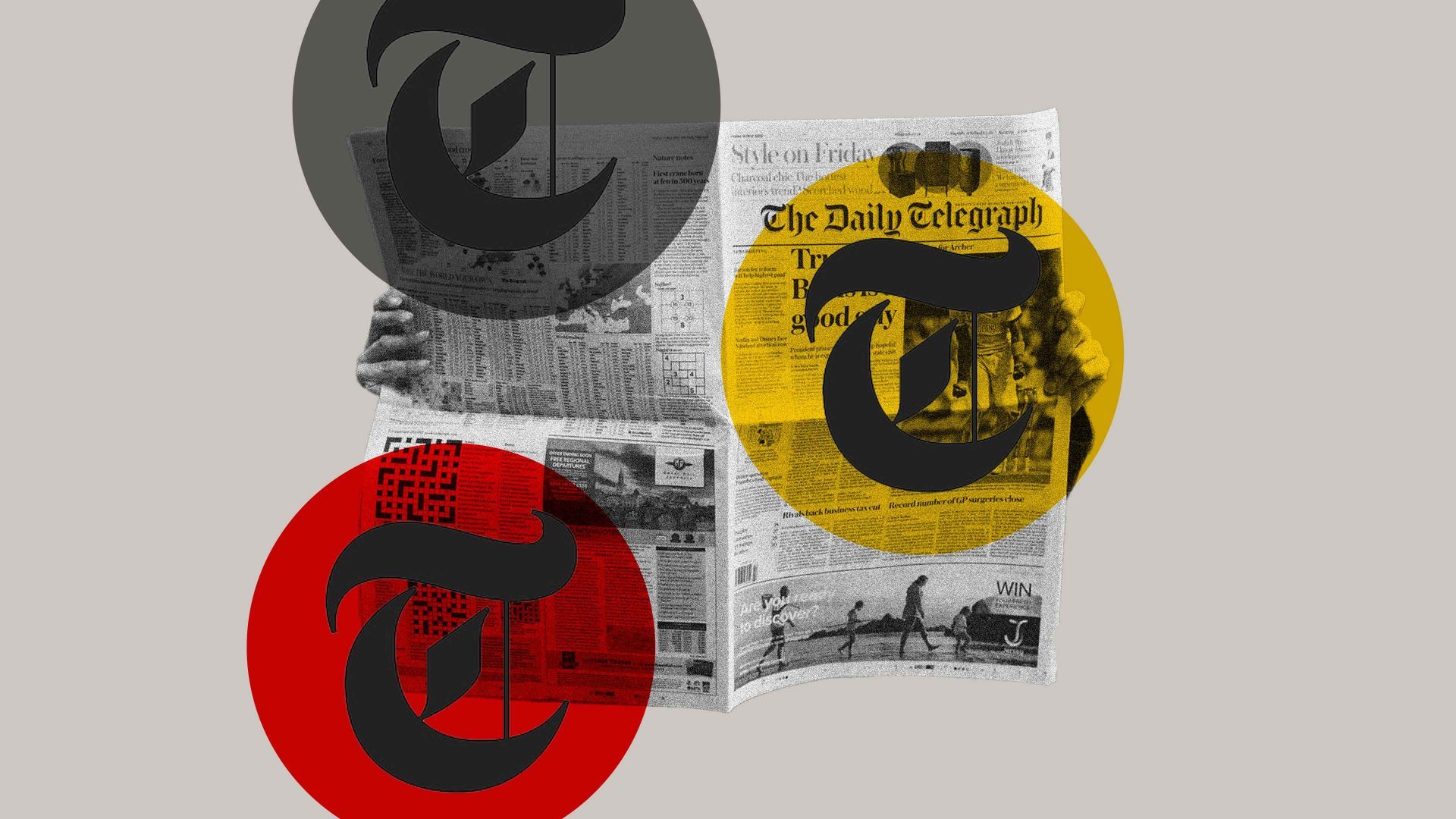
We’ll get to Axel Springer buying the Telegraph in a moment. But first: have you ever wondered why the German publisher failed in its bid for another British newspaper icon, the Financial Times, in 2015?
It may simply be that Nikkei outbid them. But shortly after I left Springer in 2018, however, a senior FT colleague told me a story that may be no more than anecdotal – but it’s far too good not to share.
In the summer of 2015, after months of due diligence under utmost secrecy, the mood in the executive corridors of the German publisher was one of eager anticipation. The purchase of the Pink ‘Un was considered a done deal.
Around that time, so the story goes, an FT representative came for yet another meeting in the golden tower the company’s founder had built right next to the Berlin Wall in 1965 – his way of raising the middle finger to the “GDR“ (all of his papers used quotation marks when referring to the German “Democratic“ Republic).
The FT guy’s task: to discuss a few final details. He arrived early, and while he was waiting, an assistant led him into a small, empty meeting room.
If you believe the story, this is what cost Axel Springer the Financial Times.
Because in that room stood a flipchart with ideas about the paper. Including names. And missing names. All of which, apparently, had not been communicated to the other side.
The visitor took a picture. Was then called into the meeting. And returned to London – where it was quickly decided to call Tokyo. With an owner that far away, editorial independence seemed in safer hands.
When the news broke, the atmosphere on the 17th and 18th floor at Axel Springer turned into that of a morgue. An Axel Springer source just told me that this is what Lord Rothermere probably feels like now.
The company has since acquired US-media outlets Business Insider and Politico, but it may be the prospect of soon owning a UK legacy brand that finally heals the trauma.
Its purchase of the Telegraph from RedBird IMI is a coup. It has everything to do with Axel Springer CEO Mathias Döpfner, who owns around a fifth of the company, and thanks to the founders’ widow Friede Springer, effectively controls 95 per cent of the voting rights.
A few years ago, the German business title Manager Magazin featured Döpfner on its cover under the headline “Der Scheinriese” – the pseudo-giant. A catchy title, but hardly factual. Not because of the media mogul’s height of 6ft 7ins. But because he turned a medium-sized German publisher (albeit with significant political influence, thanks to the tabloid Bild), into an international player.
Now, the Telegraph will be a “mega booster” for transatlantic growth, people within Axel Springer say.

The company has recently split, with American private equity firm KKR taking over most of its classifieds business but giving up its oversight of media operations. With no outside shareholders or investors left to answer to, Döpfner went all-in. He acquired The Telegraph at remarkable speed.
His cash (£575m), his decision. His risk. Seizing his chance meant bypassing lengthy corporate evaluations and rigorous scrutiny that a listed company would have had to undergo.
Since KKR’s exit, some have questioned whether Döpfner would stay true to his pledge to focus on journalistic growth. They seem to have been given an answer.
But what about The Telegraph’s concerns from 2016? “It’s not war we should fear, but what the Germans do in peace“, the paper worried ahead of the Brexit referendum. They should be clear about what is to come.
First, the new owner has a history of tech-driven transformation. It is results-oriented, to put it mildly, which also means unleashing its inner Sparfuchs (saveaholic) tendency. Springer wants profitable journalism.
Second, Fleet Street will not face a German invasion. In all of Springer’s international ventures, editorial leadership remained local. Nor will Telegraph journalists have to sign the company’s “core principles” in their work contracts, as their German colleagues do.
Contrary to Richard Desmond, who taunted Telegraph executives in 2004 – the last time Springer made a bid – about the prospect of being “owned by Nazis”, those principles are hardly radical: support for freedom, democracy, Israel’s right to exist, the transatlantic alliance and a (social) free-market economy, along with a rejection of extremism, antisemitism and discrimination.
Axel Springer’s titles also keep an equal distance from the AfD and the far left. The publisher has, however, drawn criticism for schmoozing up to the Trump camp. Döpfner, whose hostility to Merkelism is legendary, is on texting terms with Elon Musk. And Peter Thiel recently backed one of Döpfner’s sons with $50m for a new venture capital fund.
Third, what made me smile when reading the press release, was the line: “Editorial independence is sacrosanct at Axel Springer.” That holds true when it comes to outside pressure.
A journalist himself, however, Mathias Döpfner is highly uncomfortable on the sidelines. So one thing the Telegraph can count on is an interfering CEO. And if not directly, there’s always pre-emptive obedience to rely on.
Tanit Koch worked at Axel Springer between 2005-18, including two years as editor of Bild
 Most popular

How Epstein used sex as a weapon

Iran’s war strategy – to create chaos

Morrissey returns.. and heaven knows he’s mythical now


What Ken Burns’s new documentary tells us about America