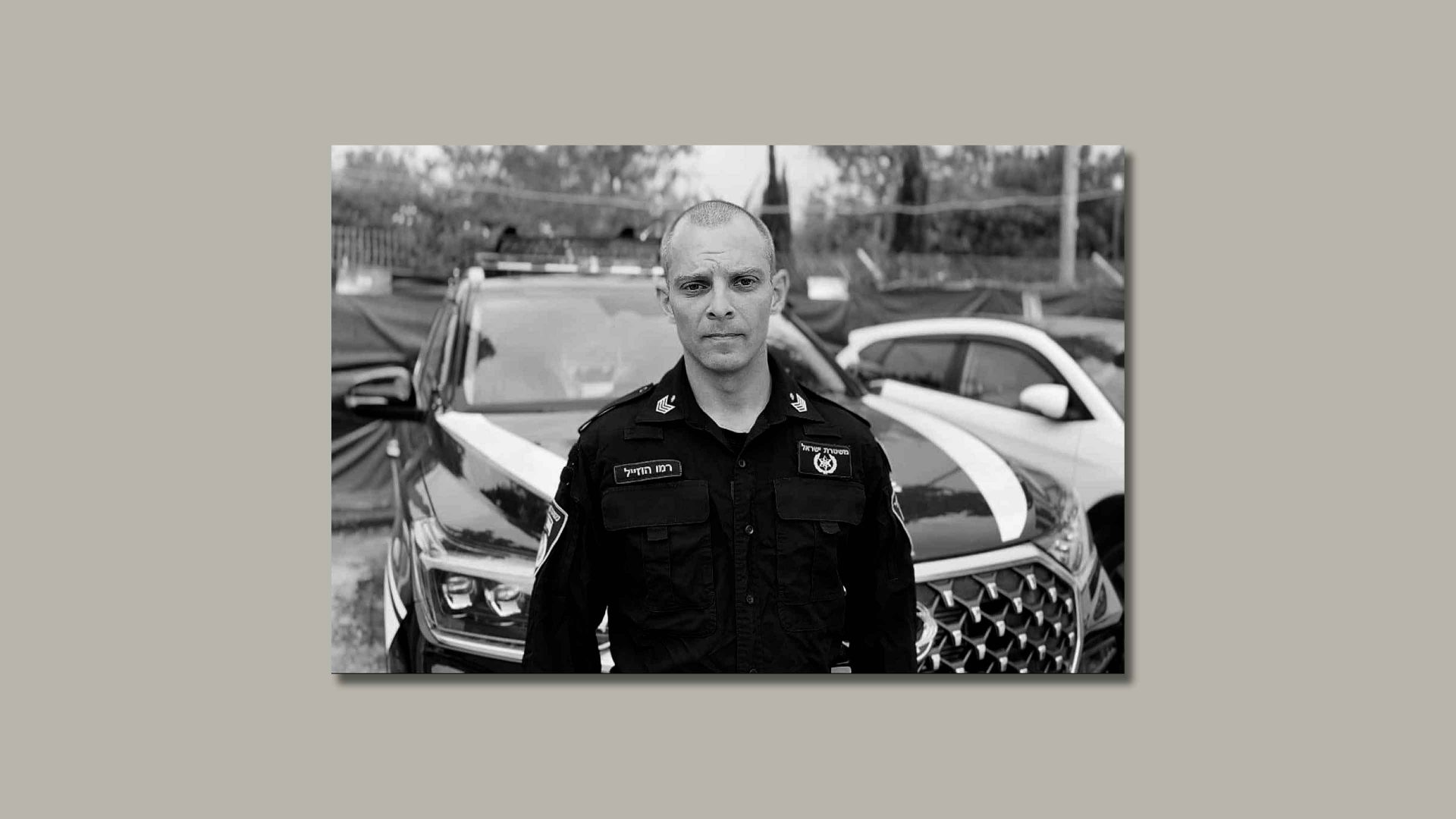
“Spreading the light”, Israel’s president Isaac Herzog wrote next to an Instagram clip showing him with a police officer lighting the seventh Hanukkah candle. The man was Remo El-Hozayel, 38, from Rahat in southern Israel. I met him only a few weeks ago at the Nova Festival Victims Memorial in Re’im, Israel, with other German journalists attending a seminar at Yad Vashem, the World Holocaust Remembrance Centre. After three days there, we went to the Gaza envelope and met survivors from the kibbutzim attacked by Hamas.
And we also heard Remo’s story. Police officers, he told us, can earn extra money by guarding football matches or festivals. But as an investigator, he never had predictable shifts, so couldn’t take the overtime.
In October 2023, for once, he was talked into it by a colleague: “It’s 1000 Shekel and all you have to do is stand around.” Remo has two small kids. £230 isn’t nothing. Still, his wife wasn’t happy, he recalls. But he agreed to do the morning shift at the Nova Festival, starting at 6.30am.
He arrived at 6.22. By 6.40, gunfire had erupted. His first thought was that the Israel Defense Forces was involved in a battle, not knowing their bases were falling one after the other. At 6.50, he recorded rockets overhead – “we’re used to that, but not that many, hundreds, thousands” – and joked with one of his detectives: “If we die, at least we have a video.”
He remembers how the first teenagers came running towards them from the road, one badly wounded. How in his mind maybe one or two groups of terrorists had made it past the defensive lines – not hundreds, coming at them from three directions.
Facing them were 36 police officers armed only with pistols. “It’s a party, you don’t come to a party with heavy weaponry,” Remo said. Twenty of his colleagues would die that day.
Suggested Reading

The paradox of Palestinian protest
At 7.59, a truck full of terrorists arrived, “driving very slowly, like they had all the time in the world”. Hamas had brought heavy weaponry to the party – AKKs, RPGs and grenades. We had to wait, he recalls, until they came closer. “Each bullet we shot had to hit the target because we were running out of bullets.”
When holding the line became impossible, Remo told everyone to run east towards the potato fields and ditches. He saw teenagers surrendering to Hamas, and a girl in a blue dress being shot in front of him.
In a split second, he recalls, he made a decision: not to die fighting with his colleagues but to try to save the teenagers around him. He managed to make it out of the line of fire, found a black Nissan Juke (“small car”), and crammed eight teenagers inside, one on top of the other.
More youngsters came out of the bushes; he promised to come back for them. He drove the first teens to a greenhouse, then shuttled in and out of the shooting zone for three hours. “Each time I went in, I didn’t know if I’d make it out again,” he said. Then he shrugged. “Protect and serve,” he said, which to him has a very literal meaning. He rescued more than 200 people that day.
When the IDF finally arrived at half past two, Remo was considered missing. His phone had run out of battery. He recharged it at a police station, tried to get a rifle – but they were all in use, “even those from the evidence room”.
Before getting there, he had met a cousin – also a policeman – and convinced him to help, until he saw the shrapnel in his cousin’s leg. The paramedic who treated him? Another cousin.
Remo has a large family. His grandfather was the head of the El-Hozayel Bedouin tribe and had 29 wives. Elders from smaller tribes would ask his grandad to marry one of their daughters, Remo explains, grinning, and it would have been rude to decline.
He’s half-Bedouin, half-Swiss. You hear it when he speaks a little German. He’s also an Israeli Muslim. “Hamas doesn’t care who you are: Jew, Muslim, Christian or Druse,” he says. “They twist the Qur’an to their benefit. They just wanted to kill and kidnap as many as they could.”
October 7 is still very much with him. Shirel Golan, a woman he saved, killed herself last year, aged 22. Remo, too, was at the brink several times, he told us. He suffers from PTSD, which nearly cost him his marriage. But he is full of hope.
Here in Israel, he said, “Not everything is perfect. But we are trying to make it perfect.” That is a great New Year’s resolution, for everyone.