One of my more uplifting moments lately was listening to Mark Carney’s Davos speech. If everyone had listened, the next catastrophe might have been prevented. On the downside, I wouldn’t have had a topic for Germansplaining.
In just 17 minutes, the Canadian prime minister delivered a confident, bold and unapologetically values-based to-do-list of how middle powers should respond to coercion by larger ones.
Act together, was his call to action. Because, as he memorably put it: “If we’re not at the table, we’re on the menu.”
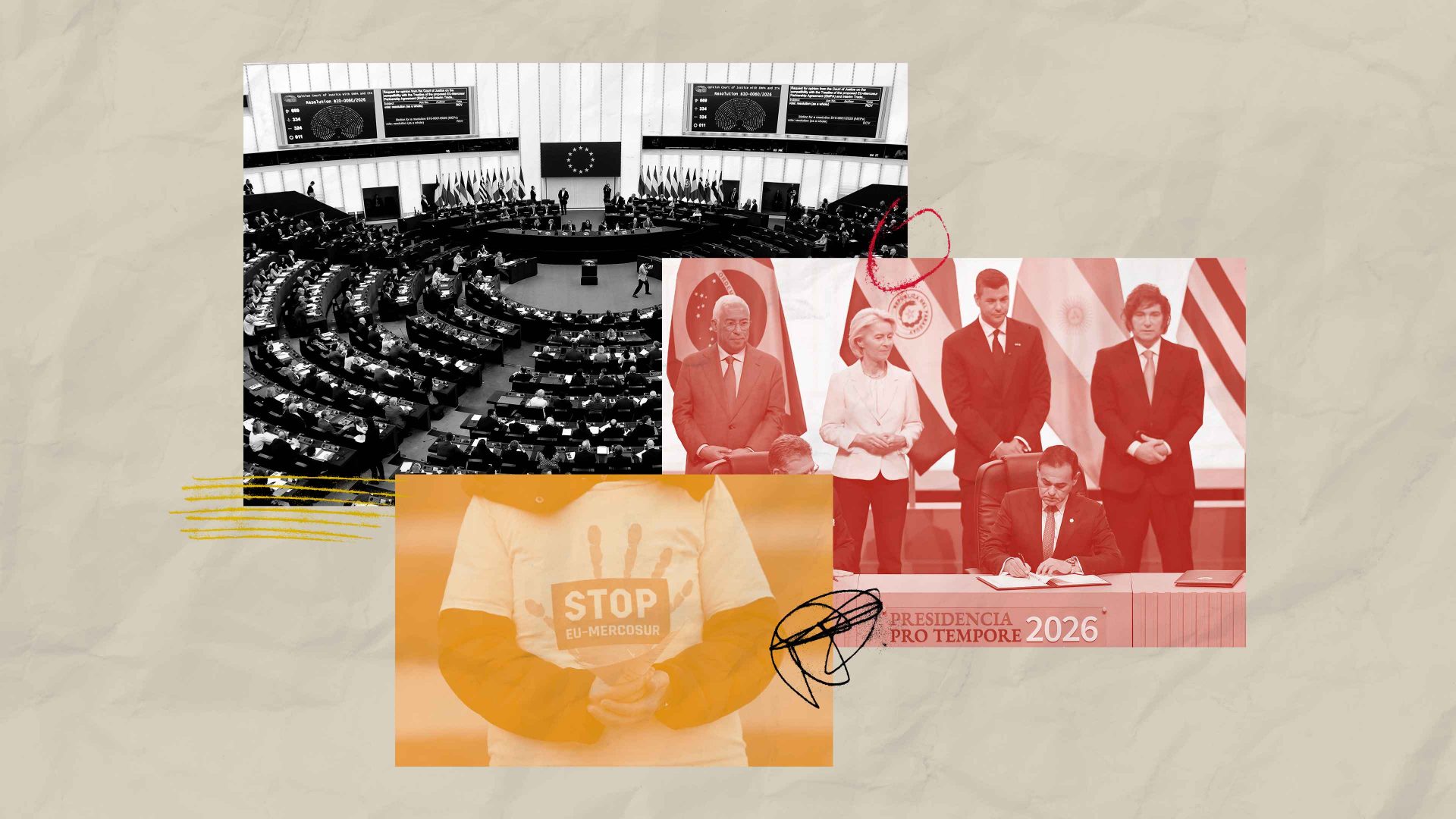
It seems, however, that the European Parliament prefers to be slow-roasted. Because just one day later, a majority of MEPs blocked the Mercosur trade deal – one that would slash tariffs on trade with Argentina, Brazil, Uruguay, and Paraguay – and instead voted to send it to the European Court of Justice for review. Admittedly, the deal had only been 25 years in the making, clearly far too little time to assess its legality.
But jokes aside: pretty much at the same moment Donald Trump was rambling at the World Economic Forum about “a piece of ice”, the EP offered the world a masterclass in hopeless European decision-making.
Quick background: at a state level, France, Poland, Austria, Ireland and Hungary had voted against the landmark deal, bowing to a powerful agrarian lobby worried about, among other things, cheap Argentinian beef. But thanks to Giorgia Meloni, the deal was adopted with a qualified majority.
For economic experts, this is a no-brainer: Europe needs larger markets if it wants to avoid dependence on great powers that weaponise tariffs or throttle supply chains to force submission. The EU-Mercosur treaty would create one of the world’s largest free-trade zones, of 700 million people, and represent some 18% of global GDP.
Sounds like a lot. Not enough for Strasbourg, though, where MEPs fretted about meat quotas and farmers. Or demanded a “fair, ecological and post-colonial agreement” – as if the very much non-colonial countries of Latin America could not decide for themselves what a fair deal looks like.
Suggested Reading


The men who made AI think it might kill us all
Had the centrist parties – EPP, Socialists and Liberals – stuck together, the treaty would now be under way. Instead, they fell 10 votes short because of a united front of the far right, the far left, and the Greens. Eight German Green MEPs voted alongside 13 AfD members. Ever since, the Greens back home have been in shock. Everyone else is calling out the Greens’ hypocrisy, given their usual moral high ground when it comes to the Brandmauer.
Last year, thousands marched to the CDU headquarters in Berlin when Friedrich Merz (not yet chancellor) attempted to rely on the AfD to pass a measure curbing immigration. A “black day for democracy”, said the Greens.
Now that they have committed the same sin themselves, it is, at most, “regrettable”. That’s what Erik Marquardt, head of the German Green delegation in Strasbourg, said about his own voting behaviour. For his colleague Anna Cavazzini, the Greens’ trade spokesperson, it was merely a “decision about the legality of the agreement – nothing more and nothing less”.
Nothing more? Just hours before the vote, Cavazzini had warned that badly designed trade deals risk destroying jobs in European countries, thereby strengthening the far right.
One wonders which country she had in mind. Because in Germany, tens of thousands of jobs have already vanished – partly because prominent Greens find it perfectly acceptable if energy-intensive companies relocate to places where electricity costs only one or two cents per kilowatt hour.
So in addition to the scandal of signalling “Trump’s lesson not learned” across the globe, there is another: the breathtaking hypocrisy surrounding it.
The same Greens who solemnly intone “the firewall must never crumble” had no qualms about creating a parliamentary majority with Germany’s anti-Europeans.
The Mercosur treaty now faces up to two years of legal uncertainty. Yes, it may still be provisionally applied – which would be regarded as an EU Commission middle finger to France. It would also underline the absurdity of the Greens’ argument: they claim to be strengthening parliamentary control by triggering a court review, while now calling for a process that sidelines parliament altogether.
It is the worst of all worlds: Europe looks indecisive, unreliable and internally paralysed – precisely at a moment when trade policy is a geopolitical necessity.