Usually, when an A-list marriage comes apart, it detonates on the celebrity pages. Last September, the separation of Collien Ulmen-Fernandes, German TV presenter and actress, and her husband, the actor and producer Christian Ulmen, was such a case. Or so everyone thought.
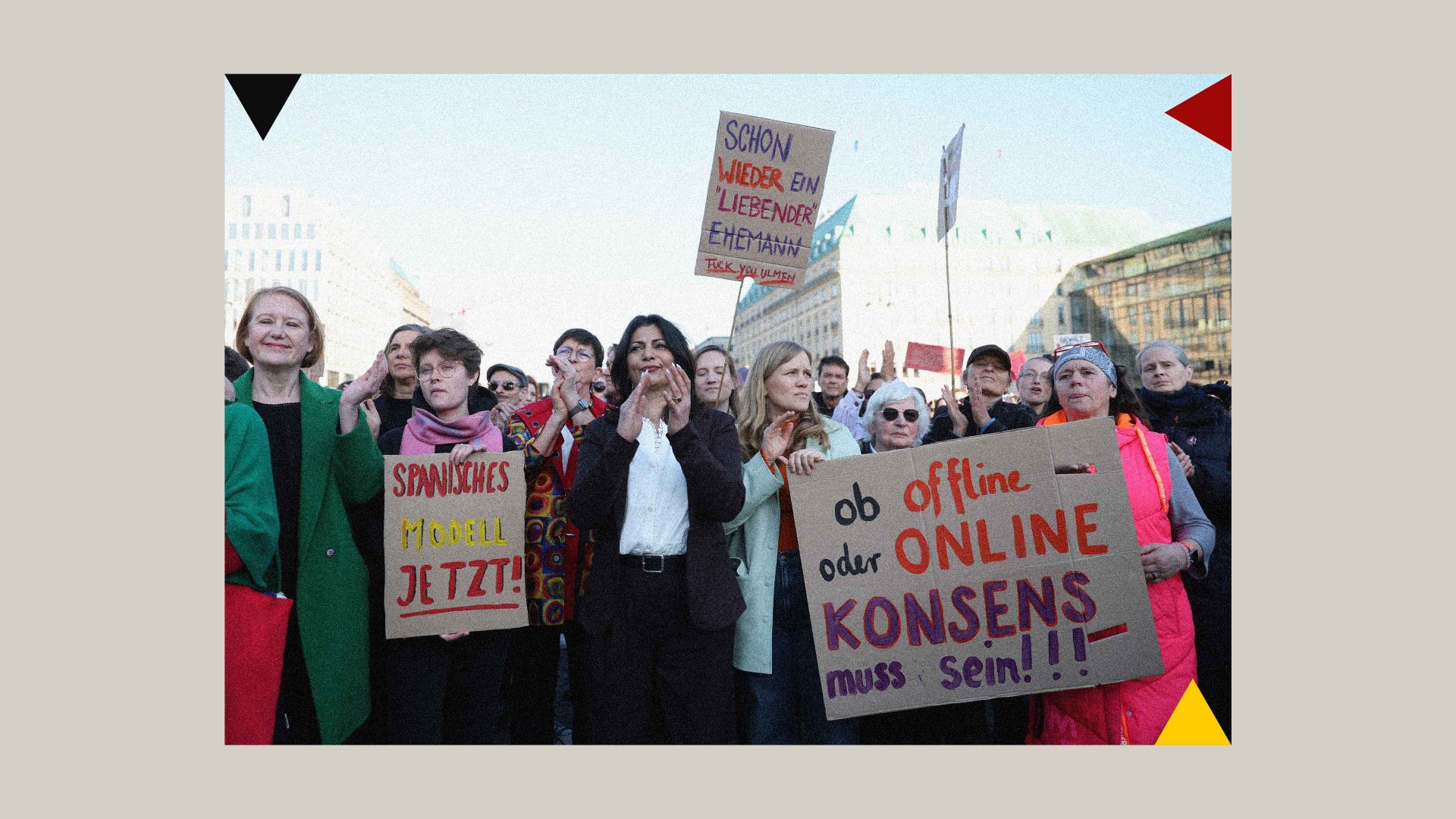
The real explosion followed on the cover of Der Spiegel this week, with Fernandes accusing her ex-husband on the front page: “Du hast mich virtuell vergewaltigt” (“You’ve raped me in the virtual world”).
In Germany, the former MTV hosts are household names. Ulmen produced the Netflix series Jerks, Fernandes is the ship’s doctor on Das Traumschiff. Together, they appeared in a string of TV adverts. Now Fernandes has told Der Spiegel about what she says are the real reasons for the divorce.
At the heart of it is her year-long fight against pornographic deepfakes of her circulating online, along with social media accounts impersonating her, luring men into explicit chats by sending porn featuring women who looked strikingly like her. Some of those men grew suspicious and alerted her agent.
Fernandes has been in therapy for years, suffering from panic attacks and PTSD. She fronted a TV documentary about the difficulties of bringing – what she believed to be – vicious trolls to justice. But she never found out who was behind the digital abuse. Until, as Collien Fernandes recounts it, she informed Ulmen that she had filed criminal complaints “against unknown”.
His response, she says, was to confess to having set up the fake accounts himself. Der Spiegel reports that Ulmen subsequently wrote to a lawyer, admitting that he had “unfortunately” developed a fetish that led him to create the fake profiles using his wife’s identity.
Since the news broke, Fernandes posted that one of the fake profiles sent an “erotic story” in which she is raped by 21 men. According to Der Spiegel, such messages were sent to unknown men but also to the couple’s acquaintances.
Ulmen’s lawyers argue that the reporting is unlawful on several grounds and say they have been instructed to take legal action against Der Spiegel, adding that the article contains “false facts based on a one-sided account”.
As Ulmen himself has yet to comment, it is, for now, a one-sided story indeed. And, as criminal lawyers point out, there have been past allegations of sexual misconduct involving prominent men that later proved unfounded.
The case of Fernandes vs. Ulmen, however, could make legal history.
Here’s why: the criminal proceedings, should they materialise, will take place in Mallorca. The couple have been living there. But more crucially, Fernandes’s decision to file the complaint in Palma – accusing her ex-husband of impersonation, breach of confidentiality, defamation, ongoing abuse and serious threats – reflects the fact that the Spanish criminal law is more progressive than the German Strafrecht.
Suggested Reading
How Germany turned a bookshop prize into a culture war
To give you an idea: last year, a man in Leipzig filmed two naked women in a sauna (German saunas are, by default, nude). The women alerted the authorities and the man’s phone was seized. Yet months later, prosecutors informed the victims that, while the behaviour was morally reprehensible, filming in public spaces – even in a sauna – does not per se constitute a criminal offence.
Unlike in the UK, Germany’s criminal justice system completely relies on the letter of its codified law. And in the digital age, that letter is ageing fast, with loopholes widening by the day.
There is no dedicated “deepfake offence”, for instance, to reflect the particular harm of having one’s face mapped onto a stranger’s body. You always need a specific offence, such as coercion or violation of intimate privacy, under very specific conditions.
Whatever may become of the case against Christian Ulmen – the court in Palma is currently investigating whether a criminal offence has been committed and the presumption of innocence applies – the German justice minister, Stefanie Hubig, has already said that a new law to criminalise pornographic deepfakes was in the making, to identify and effectively prosecute perpetrators.
The draft also includes giving police more powers to search suspects’ devices and civil measures to make it easier for victims to act against platforms, including rights to obtain information on perpetrators and enforce account suspensions.
Until then, the question in Germany isn’t just what perpetrators do to victims online. It is also about what the law still fails to do.