My Instagram feed – always keen to show me different perspectives (hardly) – recently served up a clip of a man in London holding a sign saying “We stand with Britain’s Jews”.
The protesters in keffiyehs weren’t happy. Nor were the Met Police. Officers reprimanded him for “breaching the peace” and ordered him to leave.
I was stunned.
The man is Mark Birbeck, a non-Jewish campaigner against antisemitism who founded OurFight.uk shortly after October 7, 2023.
But scrolling through Instagram, I didn’t know any of this. I just cursed myself for largely skipping Comparative British-German Law in my second semester, because I didn’t understand why a single individual holding a placard with a non-controversial slogan should have an altercation with the police at someone else’s protest.
When I turned to my personal Britsplainer, he told me that because the man had deliberately walked into an organised pro-Palestine march, his presence was seen as a provocation.
My common sense reaction: even if so, it’s thousands versus one. Live with it. My legal reaction: puzzled. Under German public assembly law, a counter-demonstration – the kind police can regulate – needs at least two people.
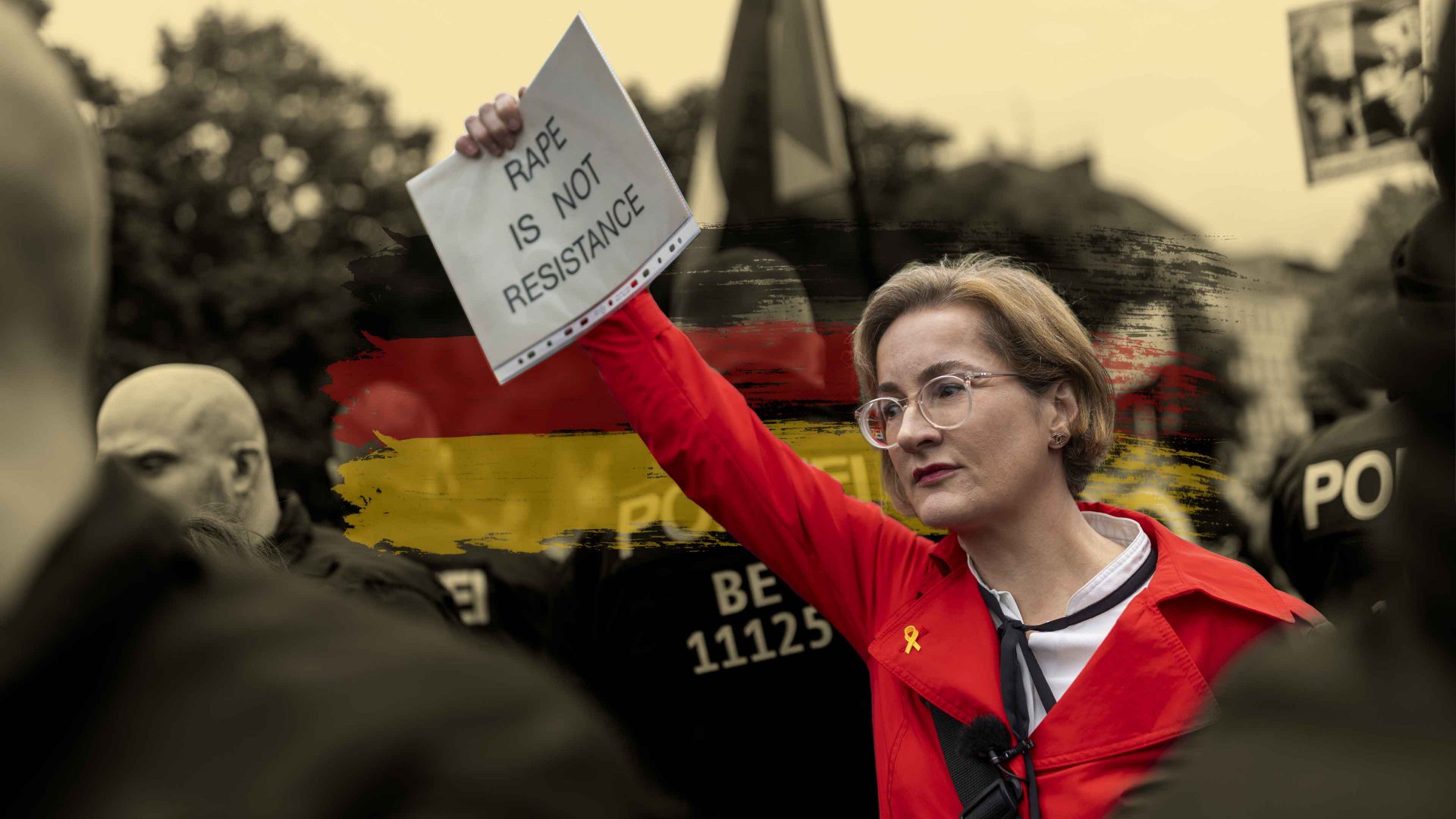
There’s a woman who makes exceptionally good use of this: Karoline Preisler, an FDP politician and lawyer.
During the pandemic, she served as the dissenting opinion at anti-restriction marches. Same at neo-Nazi rallies. And since October 7, the 54-year-old from the former East Berlin has been to hundreds of propalästinensischen demos, two to three times a week.
She carries a sign reading “until the last hostage”, “rape is not resistance” or “believe Israeli women”. Always in English. The demos are aimed at social media, she says, so she wants reach, too.
Suggested Reading

Nathan Gills are everywhere
In her other hand, she usually carries a photo of Israeli hostages or victims like Shani Louk from the Nova Festival, always with a small bouquet of flowers. It de-escalates things, she believes, signalling that she’s not seeking confrontation but conversation. Sometimes that works, Preisler says.
More often, it doesn’t. She’s been harassed, spat at, insulted, screamed at. There have been death threats against her four children and she has been beaten with a wooden flagpole.
But once violence breaks out or becomes imminent, the police protect her. There are photos of Preisler in the middle of a demo surrounded by up to eight officers shielding her.
While German law in the area is fairly straightforward, the courts are deeply entangled in a separate question, and were even before October 7: is the slogan “From the river to the sea” illegal?
The words appear in the 2017 Hamas charter, linked to the “full and complete liberation of Palestine”, which means the annihilation of the state of Israel.
That’s why the Federal Interior Ministry, prosecutors and some courts treat the slogan as a Hamas identifier, banned under the laws against using symbols of unconstitutional organisations (originally drafted to outlaw Nazi symbols).
But it isn’t that clear-cut. For other courts, it falls under the freedom of expression because they say it can be used without violent intent. Some courts demand evidence of ideological closeness to Hamas before treating the slogan as illegal. And yet others assume the connection unless proven otherwise, especially when used in the weeks following the Hamas massacre.
If you run an Insta profile by the name of “Hamas Lounge”, as was done in one case, and show photos of Qassam Brigades with approving emojis – it will be hard to convince a judge you want peaceful co-existence.
Same with the chant, “Yalla, yalla, intifada”. It is viewed in the courts as far less ambiguous. Given the violent history of the first and second intifada, it makes restrictions easier to justify.
On “From the river to the sea”, however, there’s legal patchwork as long as there is no Federal High Court ruling.
Preisler, meanwhile, has just been honoured by the Central Council of Jews in Germany with the Paul Spiegel prize for Civil Courage. In an interview with Jüdische Allgemeine, she said she was concerned about growing radicalisation.
However, she also mentions positive experiences: “There is a woman who has been coming to the demonstrations for two years. Recently, we hugged each other. She said to me: ‘Look, your hostages are back, I’m happy for you.’
“And then she went back into the crowd and chanted ‘Death to the IDF’. But I’m not giving up that easily.”