“Why German cities feel like war zones on New Year’s Eve,” the Economist Germansplained in late December. The publication isn’t drawn to hysterics and this headline wasn’t, either. More of a health and safety warning.
Obviously, people living in actual war zones will consider the comparison laughable. Germany’s police, fire brigades and ambulances, however, may find it rather accurate. For years now they have been fired at with Feuerwerk – fireworks – a pretty name for explosives on sale to the public.
I spent Silvester, as Germans call it, unusually sober in central Berlin, working in Kreuzberg and Neukölln – aka where the action is. Our cameraman was a bit of a hindrance for undercover reporting, as were the security guards accompanying us. I assume they were the reason we were attacked with pyrotechnics only once.
It happened at the exact moment I removed the Oropax from my right ear: a flash, a massive bang in our midst, luckily no one was hit, complete silence, and then a high-pitched beep in that ear. It graciously disappeared after 20 seconds. Naturally, we retreated.
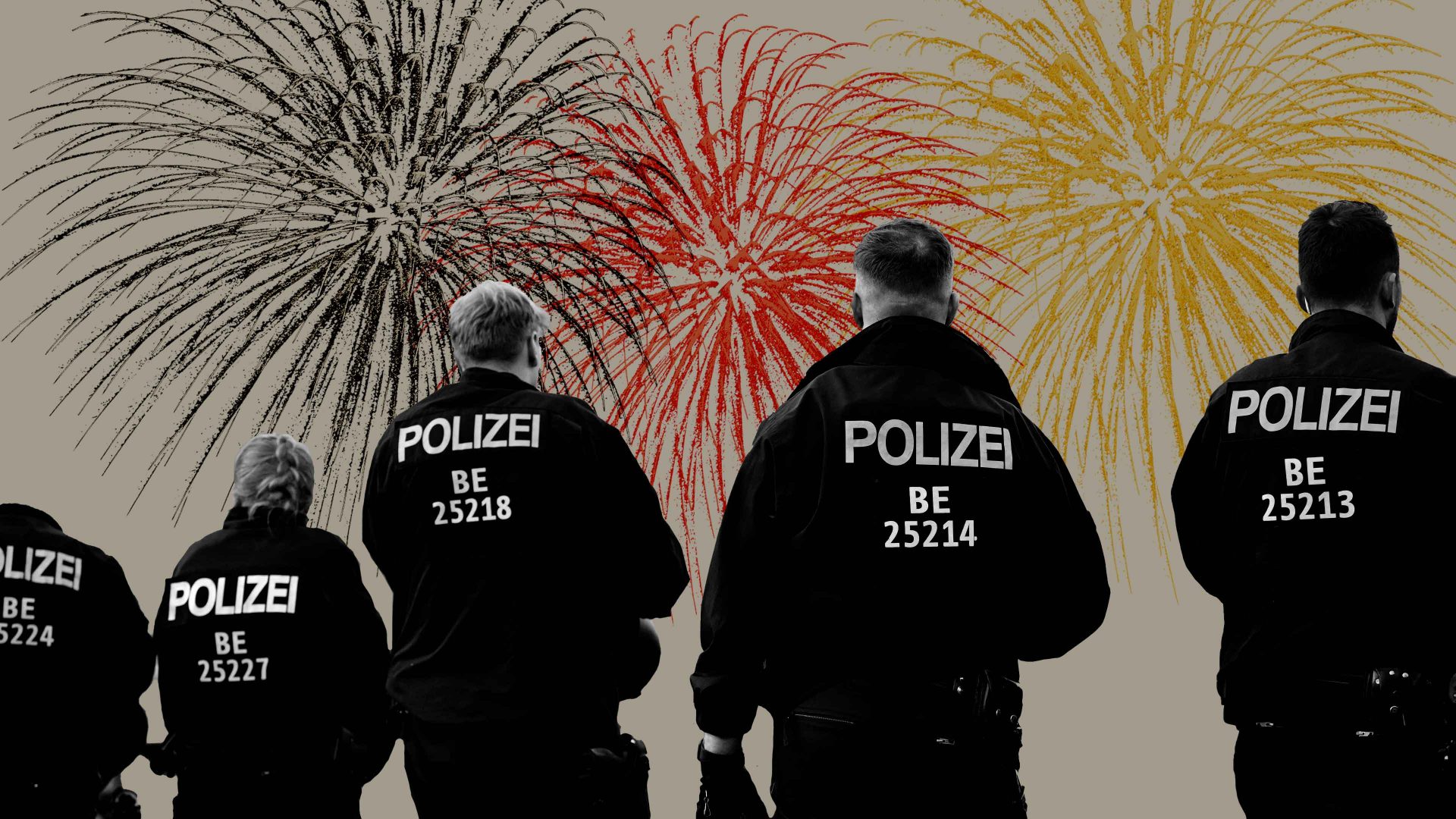
This is where journalists differ from firefighters and paramedics, whose job description does not include “run away”. They stay while rockets whizz past their heads, aimed at them and their vehicles. Frequently, fires are not even accidental. Emergency calls are placed specifically to lure first responders into ambushes, where they are greeted with explosives. Hence Berlin’s new Silvester tradition of escorting ambulances and firefighters with police units in full body armour.
This year, in Moabit, 500 people rioted on a single street. The attacks were so severe that the fire brigade couldn’t even get there. Only a police water cannon and targeted arrests calmed the situation.
Police complain that most perpetrators never see the dock. And that, in the rare cases of conviction, punishments tend to be modest – “three hours of babbling circle and dolphin therapy”, as one union rep recently put it. More than 4,000 police officers were on duty in Berlin this new year, from across Germany. They apprehended 430 people. Fourteen were detained preventively and seven were brought before a judge.
Suggested Reading


I don’t need New Year’s resolutions, but our politicians do
Because of the numerous attacks with fireworks, 35 officers were injured, two seriously enough to be hospitalised. Nevertheless, Berlin police officially declared the night “less problematic” than usual. This is technically true, in the same way that falling down four flights of stairs is less problematic than falling down five. The fact remains: each Silvester, people revel in a state of emergency and lawlessness.
Once again, Kugelbomben made an appearance – spherical bombs intended for professional use only, if at all. Windows shattered. Lessons were not learned. One Berlin trauma centre alone treated two dozen severe hand injuries, including amputations.
This phenomenon isn’t just a big-city-problem in Berlin or Hamburg. In Bielefeld – a town in east Westphalia – two 18-year-old men died within hours of each other in unrelated accidents involving homemade pyrotechnics. Both suffered fatal facial injuries.
In Würzburg, a quiet Bavaria university town, an 88-year-old woman died – probably after fireworks from the street first set her balcony and then her flat on fire. Such fires occur nationwide.
Fireworks are banned from sale for 362 days a year, but during the remaining three, Germans queue with religious fervour, car boots open, ready to be filled. People are allowed up to 50kg of fireworks in their cars. You get the idea.
In most of the country, fireworks may be used freely in public spaces. Exceptions include the vicinity of churches, hospitals, care homes, houses with thatched roofs – and Berlin’s expanding Böller-freie Bereiche.
Pretty much everywhere else, people may fire away. An estimated €180m worth of fireworks are detonated each year, not including clean-up costs, environmental damage or lifelong medical treatment for people whose new year’s resolutions didn’t – initially – involve prosthetics. Naturally, Germany has been debating a Böller-Verbot for years. A ban would make policing easier: currently, officers must distinguish between legal and illegal explosives while being shot at with these devices.
Polls suggest a majority support a ban. Still, millions of passionate and responsible fireworks enthusiasts insist on their right to sparkle safely. Their argument is simple: why should their fun be restricted just because a minority of mostly young men temporarily turn parts of the country into urban warfare zones, abusing the sacred Böller tradition? To be continued.