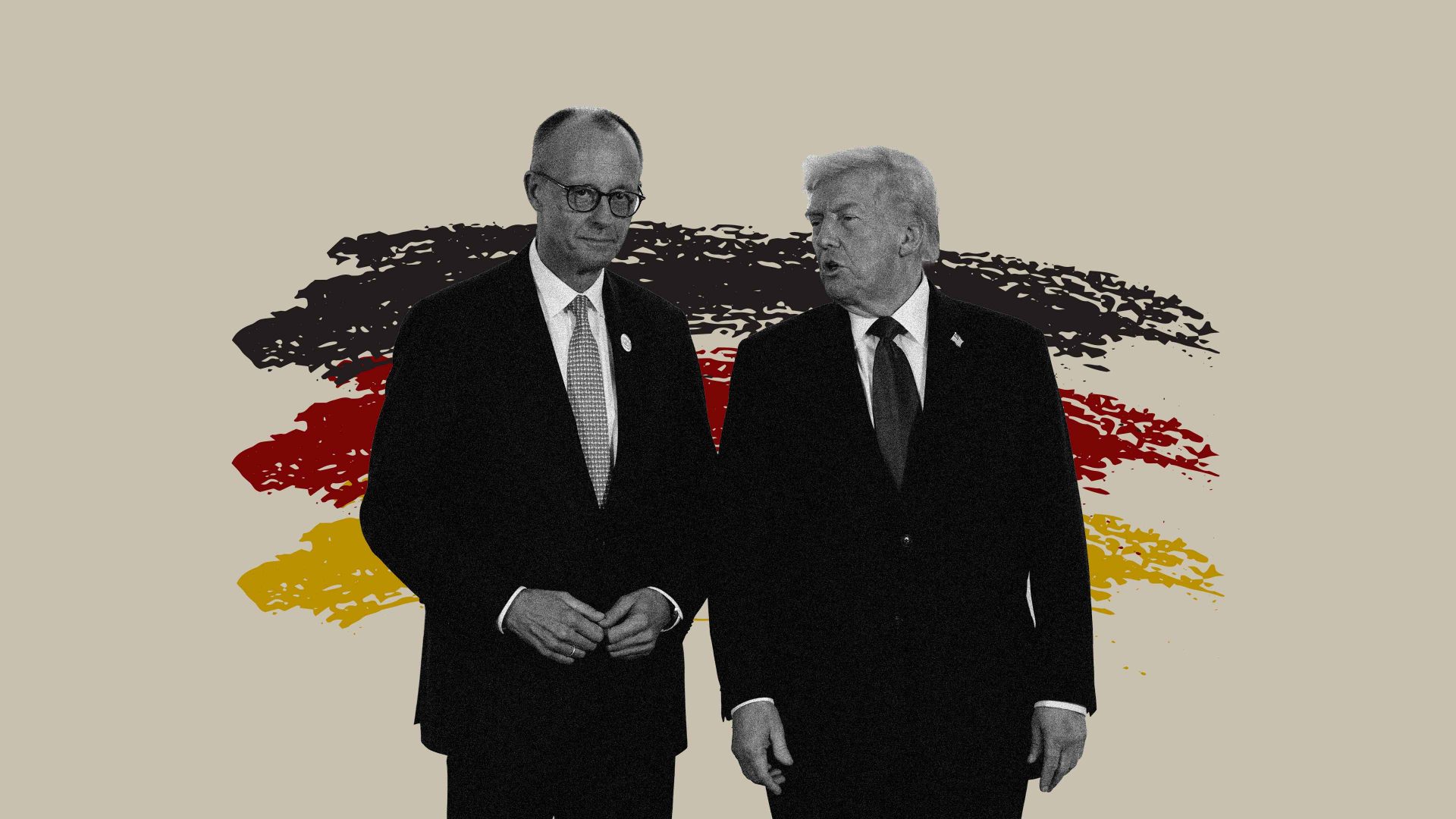
The German Chancellor is about as much Transatlantiker – that’s German for staunchly pro-American – as it gets. Even with the perpetual challenge named Donald Trump, Friedrich Merz has so far managed the delicate art of not attracting the president’s wrath without descending into full-scale boot-licking.
His Oval Office strategy, at least when cameras are rolling, is disarmingly simple: say nothing, and you can say nothing wrong. It’s a discipline he has elevated to near-Olympic standard – so much so that it recently earned him criticism. During Merz’s last visit to Washington DC in early March, Trump laid into Spain’s PM, Pedro Sánchez, over his refusal to allow US access to Spanish air bases for strikes on Iran, and for failing to meet Nato’s defence spending target of 5% of GDP. Merz, seated next to Trump, kept schtum.
The Spanish press branded him a coward, German papers accused him of lacking basic European solidarity, and Spain’s foreign minister, José Manuel Albares, suggested that his predecessors Angela Merkel and Olaf Scholz would not have stayed silent.
Spain’s deputy PM, Yolanda Díaz, went further, accusing leaders like Merz of behaving like “vassals who pay homage to Trump”.
Strong words, though Sánchez and his government are of course playing to a domestic audience that is traditionally sceptical of Nato and the US. Merz, for his part, had already criticised Spain for not committing 5% of its GDP to military spending long before Trump did.
The chancellor later said that publicly contradicting Trump would only have “aggravated” matters. He insisted he’d told the president behind closed doors that sanctions couldn’t be imposed on a single EU country such as Spain.
Suggested Reading
The lose-lose politics of dealing with Trump
And yet, Sánchez somehow missed Merz’s calls for a fortnight, and it is still unclear whether the voicemail message from Berlin was ever met with a return call. But at least the two were back on speaking terms at the EU summit in Brussels.
Now, however, Merz seems to have reached the limit of Trump’s goodwill.
It was always going to be temporary. After all, whatever passes for Trump’s respect seemed to rest in no small part on Merz’s 6ft 6in frame – and whatever some may say, size alone isn’t a sustainable basis for a relationship.
More importantly, Merz is not built for prolonged quiet. He is outspoken by default, often to his own detriment. The longer the US approach to Iran has looked like improvisation, the more blunt Merz has become.
And here domestic politics intrude. Merz’s authority at home hinges on reviving Germany’s economy. A task already complicated by bureaucracy, a sputtering car industry, high energy costs, Chinese competition, the war in Ukraine, and, of course, Trump’s tariffs.
Another Middle Eastern conflict threatening energy supplies is not part of his growth plan, which showed tiny signs of success – and is now going downhill again.
So Merz has repeatedly stated that Germany is not part of this war and does not wish to be. At a conference hosted by Frankfurter Allgemeine Zeitung, he criticised Trump for not discussing German support in the Iran war with him beforehand but “afterwards via the newspapers”. He questioned whether Washington had any coherent strategy at all, describing its actions as “a massive escalation with an uncertain outcome” and finally asked: “What do they actually want?”
If a ceasefire were reached, Germany would of course help, but he ruled out any German military role as Nato is “a defensive alliance, not an interventionist one”.
All perfectly reasonable. The only snag: Trump does not do “perfectly reasonable”.
At a rally in Miami, he took aim at European allies – France, Britain – and then Germany: “The German chancellor – all of these are my friends – Friedrich, the German chancellor, said: ‘This is not our war’.”
Trump retorted that Ukraine, by the same logic, is not America’s war either. It’s his familiar refrain: the US as an overworked security provider, the allies as ungrateful freeloaders.
So whatever Berlin is currently offering for the Strait of Hormuz, is, quite evidently, not enough.
And as we can witness every day: the US commander-in-chief has a long and well documented habit of settling scores. So this latest fallout could linger well beyond the end of the Iran conflict. And sadly, Germany has a lot more to lose.