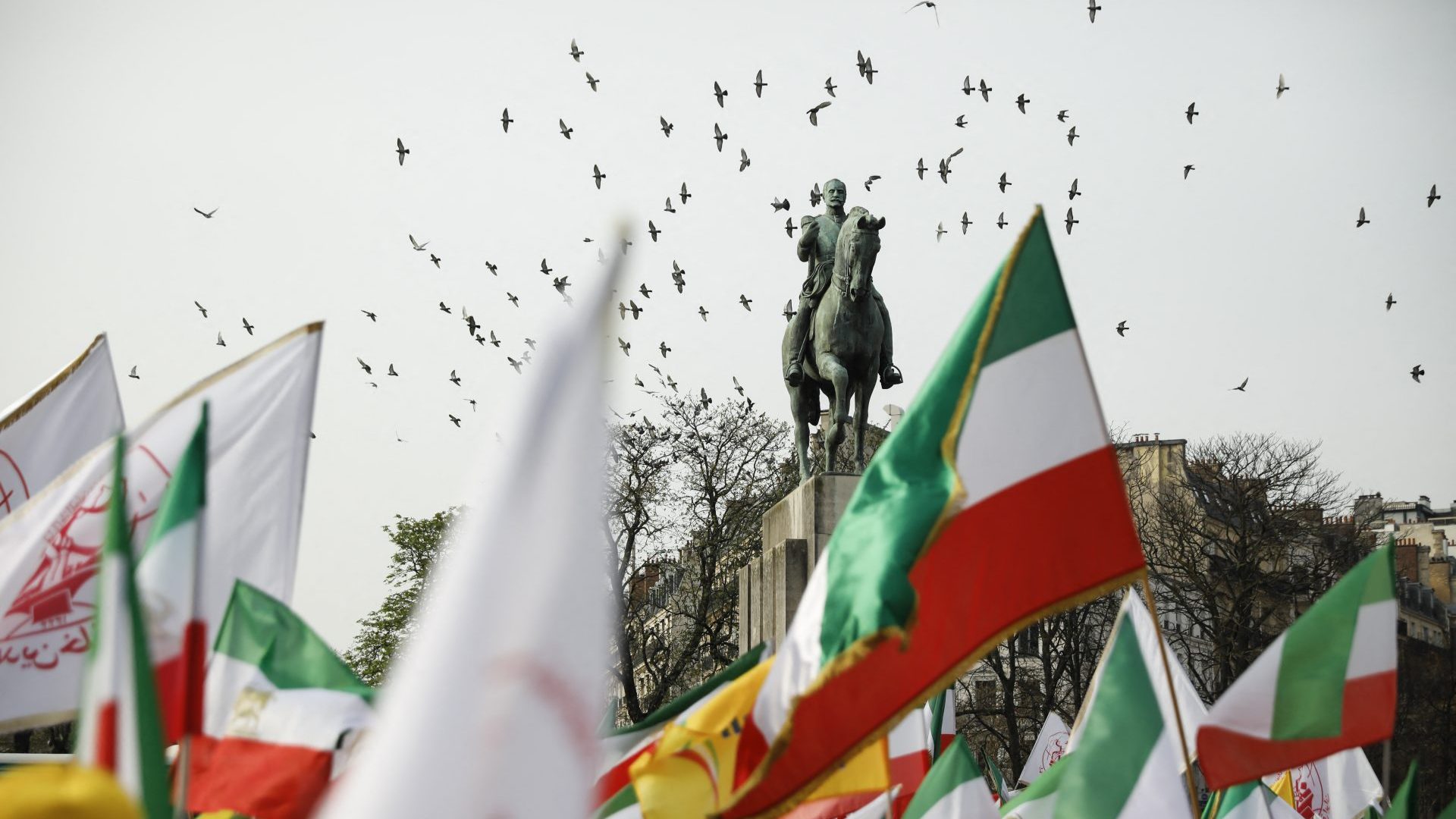
“No shah, no mullahs,” chants a crowd of Iranian activists gathered on the Trocadéro square, facing the Eiffel Tower. After the US and Israel carried out strikes on Iran, killing the country’s supreme leader, they have come to reiterate their rejection of the Islamic regime and their hope for democracy.
After 40 consecutive days of rain, the sun is finally back in France. Flowers have appeared across Paris. In the midst of the rally, a bouquet of daffodils has been tied to an Iranian flag bearing the sun and lion, the state emblem banned after the 1979 Islamic Revolution.
Vida Amani, a 39-year-old architect from Switzerland, has no memory of the country she left as an infant. She crossed from Iran into Turkey at night on horseback, carried by her 22-year-old mother. Her father, who had been involved with the dissident group MEK, the People’s Mojahedin Organisation of Iran, had already spent four years in prison and expected to be arrested again. Thanks to contacts in the United Nations, he obtained Swiss citizenship, allowing the family to leave.
Amani travelled to Paris to attend the demonstration, which was organised by the National Council of Resistance of Iran (NCRI), a group that presents itself as the only democratic alternative to the Islamic Republic.
She felt compelled to act “while the blood of the murdered heroes is still fresh in the streets of Iran,” she says, referring to the wave of protests that erupted at the end of 2025. Around 30,000 people were killed, according to local health officials.
“We want to show the world that there is an alternative to the current regime, the ‘third option’, as we call it,” Amani says, as the crowd echoes, “No shah, no mullahs!”; and “The people of Iran deserve a real democracy”.
She insists that any political change must come from within the country and rejects foreign military action. “War has never been the answer to anything,” she says. “Neither the US nor Israel are truly worried about the Iranian people, only about their own agendas.”
Across the street, sitting on a bench away from the loudspeakers broadcasting a speech by NCRI leader Maryam Rajavi, are Majid and Kamal, who have travelled here from the Netherlands.
Suggested Reading

Trump’s Iran war is becoming a fundamentalist Christian crusade
Like Amani, Majid does not believe the recent strikes bring freedom any closer. “The Iranians cannot change the regime with bombs falling on them from the sky,” he says.
Majid left Iran 37 years ago, crossing the mountains with his sister, who is standing nearby at the rally. His brother was executed by the regime.
A short distance away, Sasan, who travelled from Germany, waves an MEK flag. Because he took part in armed resistance in the early days of the Islamic Republic, he knows that any link to him could be fatal for relatives there, and he avoids all contact with them. The thought alone, he confesses, “brings tears to my eyes every single time”.
Among the sea of green, white and red flags, patches of blue and yellow stand out. A group of Ukrainians have come to show solidarity. In the fifth year of Russia’s full-scale invasion of their own country, they say they recognise the pain of those struggling for freedom.
“Every country deserves to live in peace,” says Daniel, a 22-year-old Ukrainian student.
As the rally turns into a march, demonstrators unfurl a long white banner printed with the faces of people killed during the recent protests in Iran. The cloth stretches across the square, face after face, row after row.
An elderly Iranian man looks on.
“This is just a fraction of all those who were murdered by the regime,” he says. “The real numbers we may never know.”
Svetlana Lazareva is an independent multilingual journalist based in Paris