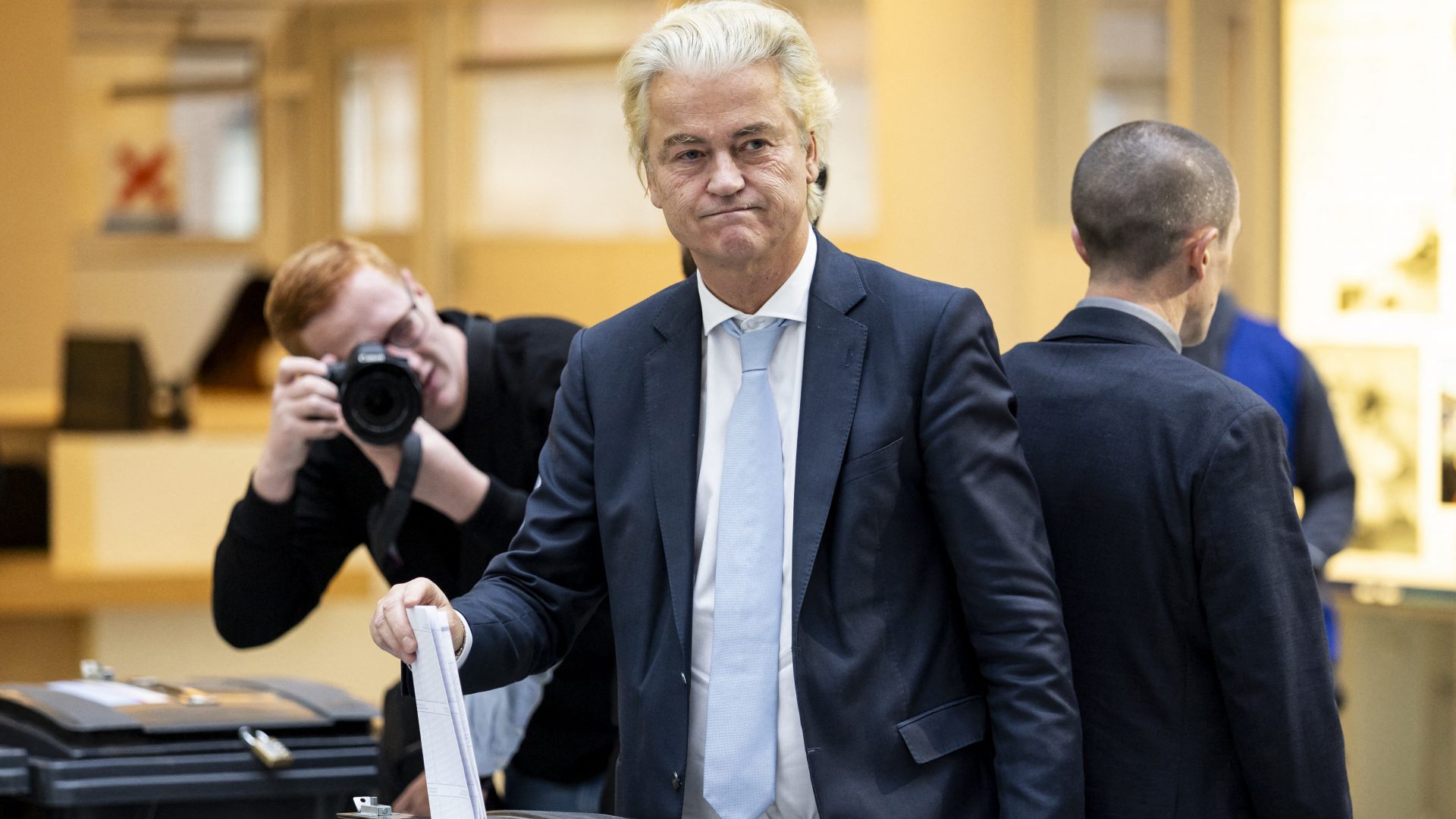
It couldn’t have happened to a nicer racist. Though the final vote tally in the Netherlands’ general election may not be known for days, the despicable Geert Wilders’s dream of becoming the country’s next prime minister is over. Yet those eager to weave his failure into the narrative of an unstoppable fightback against far right populists should be careful.
The preening Wilders collapsed the Dutch government earlier this year, eager to push through the kind of extremist agenda on migration – including ending all immigration from Muslim countries and stopping asylum – that might have been proposed by Nigel Farage or Katie Lam. Wednesday’s election was a referendum on his plan, and the Dutch rejected the man with bleached blonde pompadour, with his Freedom Party (PVV) dropping 11 seats.
Although PVV may still end up with the most votes, in which case Wilders would demand first crack at forming a new coalition, he knows the game is up. Other major parties will not work with him. “The voter has spoken,” Wilders wrote on Wednesday night. “We had hoped for a different result, but kept our backs straight. We are more combative than ever.”
Could this be another sign of a decisive turn in the tide? Can we put the Dutch result with Reform’s surprise loss in the Caerphilly by-election, Donald Trump’s plummeting favourability ratings (now at a new low for his second term of minus-19), tanking poll support for Viktor Orbán ahead of Hungary’s elections next April and positive recent results in Moldova and Romania, and deduce that the sun is going down on the populists?
Suggested Reading
The Netherlands’ Geert Wilders nightmare is over – for now
It’s tempting, but resist for now. Populism isn’t over in the Netherlands by a long shot. Wilders’s lost 11 seats went instead to parties of the right or far right, with 30% of PVV’s votes from the December 2023 election ending up with the nearly as unpleasant JA21.
Victory for Andrej Babiš in Czechia at the start of October doesn’t fit with the post-populism narrative. Orbán’s vote in 2022 confounded the pollsters, and his message that money should be spent on the cost of living crisis and not Ukraine may resonate again. Trump might be deeply unpopular, but his opponents are in disarray. Farage took a hit in Wales, but Reform have led the last four opinion polls by an average of over 11 points.
So, don’t get too carried away by Dutch encouragement. But do remember two things about the Netherlands’ election.
First, the likely next prime minister is Rob Jetten of liberal centrist D66, whose positive manifesto, with its talk of massive investment in housebuilding and green energy, sounds like the sort of thing Keir Starmer and Rachel Reeves used to promise before grim financial reality (thanks partly to the UK leaving the EU) set in.
And second, Geert Wilders may be vile, but he is not stupid. Having noted the British experiment, his plans for the Dutch to follow us out of the European Union (‘Nexit’) featured nowhere in his manifesto. Take note, Nigel.
 Most popular

‘Operation Epic Fury – as it happened’

Is Star Wars dead?
Morrissey returns.. and heaven knows he’s mythical now


Iran War: Trump has now sealed his own fate