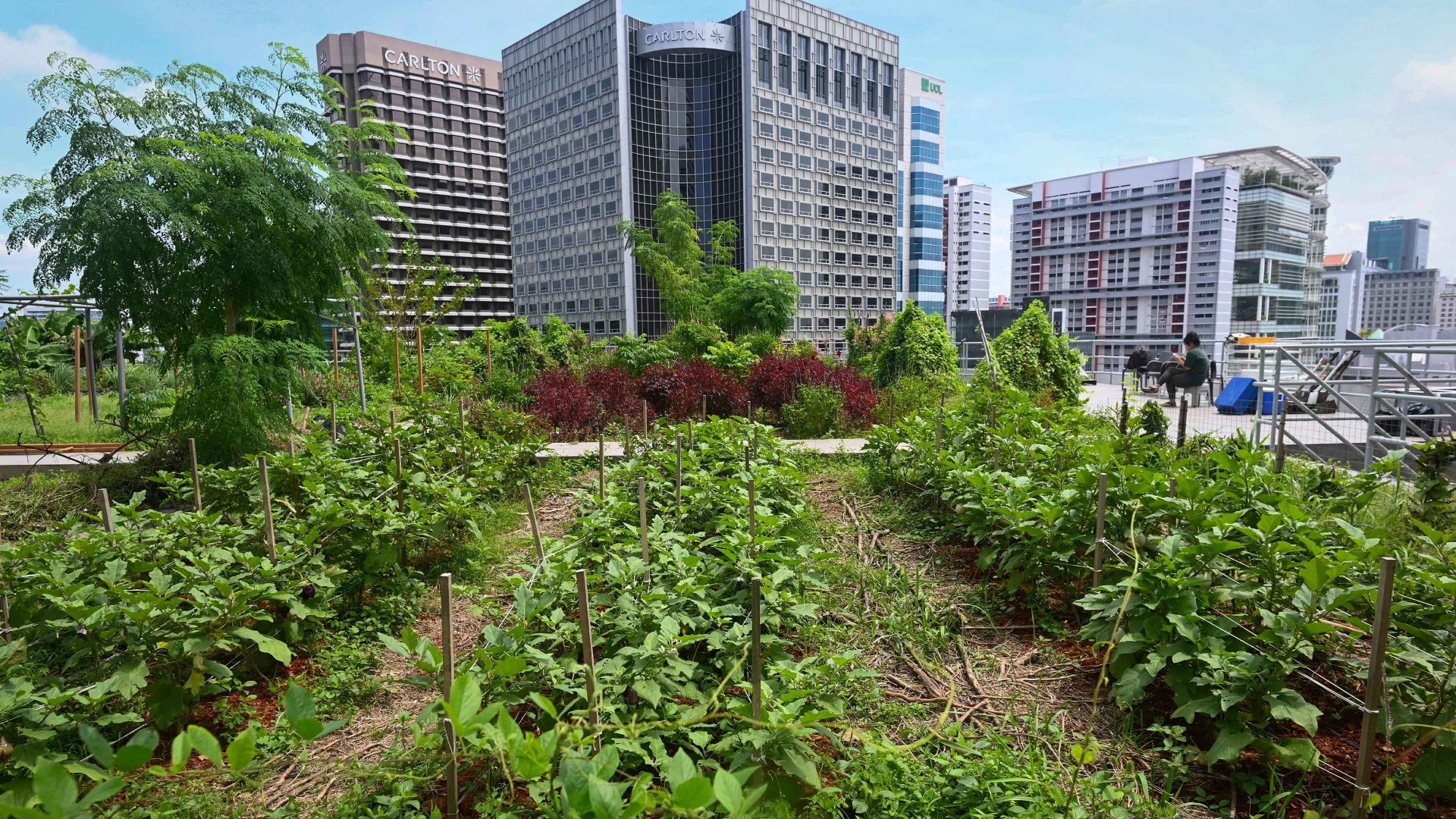
“How’s Singapore’s 30 by 30 plan going?” I asked a financier friend while on a recent visit to the world’s richest city-state.
Fred, an Indian-born Singapore national who has lived in the island country for more than 20 years, chuckled. “It’s been quietly forgotten,” he said. In a country in which huge infrastructure projects are typically delivered on time and to budget, the goal of producing 30% of the nation’s food needs by 2030 was announced by the Singapore government to some fanfare in 2019.
Late last year, to rather less celebration, the idea was quietly dropped, and replaced by more modest ambitions to increase percentages of locally produced “fibre and protein” and to bolster “food resilience” in other ways. These include broadening the range of supplier countries and requiring importers to increase stockpiles so that rice and other staples can be released on to the market at non-exploitative prices in the event of regional shortages.
Critics of the 30 by 30 failure cite a lack of clear targets, milestones or, indeed, methodology. It feels like a mismatch with the economic miracle that is Singapore. It’s a success story built on paradoxes: on the one hand, a hugely successful economy driven by financial services, which account for 70% of wealth, followed by high-tech manufacturing and biomedical science. On the other hand, Singapore has a huge public sector, fuelled by tax revenues (albeit at very low rates), 50% of whose budget goes on social spending, including healthcare and housing.
With the country run paternalistically and largely without corruption by the same political dynasty since independence in 1965, the emphasis is on long-term planning in a way that feels more like Chinese communism than chop-change western capitalism.
“There are no ‘real’ farms at all in Singapore,” said Fred. Another entrepreneur friend told me that the land on which any house is built will inevitably be worth many times more than the house itself.
Such is the value of land that perfectly serviceable buildings may be bulldozed to make way for new: so it is inconceivable that conventional farming could ever generate a purely economic return. Inevitably, nearly all Singapore’s food is imported: eggs, seafood and fresh fruit and vegetables, from Malaysia and Indonesia. Meat and dairy come from Australia and New Zealand; chicken from Brazil; processed foods from China and America.
That’s not to say that all of Singapore’s 285 sq miles are concrete and glass: some 40% of the land area is conserved as rainforest, coastal forest or mangrove wetland, the former including the island’s highest point, Bukit Timah Hill, at nearly 600ft. Colonial-era legacies like the British Club and the Swiss Club sit in extensive parkland, while some of the significant areas of land reclaimed from the sea are devoted to green use, including the new botanic gardens. The island’s Green Plan aims to add 200 hectares of new nature parks, 160km of park connectors, and a million more trees by 2030.
Curiously, Singapore has no real fishing tradition, and fish farming has historically been plagued by viruses and parasites.
The great hope of the 30 by 30 policy was that high-tech production methods would deliver food in sustainable quantities and at competitive prices. For “high-tech” read shelved, vertical farms anything up to 80 metres tall. Lured by attractive startup grants and often backed by venture capitalists, entrepreneurs bought into the idea of producing food in huge hangars, featuring hydroponics, sensor-controlled climate and artificial light.
Suggested Reading


Farmers with their finger on the pulse
But land is not the only expensive commodity in Singapore – energy also comes at a cost, as 95% of electricity is generated from natural gas, imported via pipelines from Indonesia and Malaysia. So too does the highly skilled labour required to operate such high-tech systems. Even “successful” vertical farms are yet to turn a profit, while the list of those that have run out of cash is long, as investors have been increasingly reluctant to throw good money after bad.
All told, the Singapore government ploughed more than 300m Singapore dollars (£175m) into 30 by 30, only to see local production of seafood and vegetables actually decrease by 8% and 15% respectively during 2022-23.
Back in 2019, Lionel Wong, founding director of Upgrown Farming – which designs indoor greenhouses and farms for clients across South East Asia – was advising those excited by the new commercial opportunities in Singapore to focus on niche products and how to bring them to market, so as to mitigate the inevitable high costs.
More recently he is quoted in Channel News Asia as advising “wide-eyed entrepreneurs” with an eye on vertical farming startups: “Don’t do it!”
Stan Abbott is a journalist and author of travel narratives