“My mum showed me how to balance the books at the kitchen table,” Rachel Reeves once said. Fanny Cradock would have approved.
Reeves teetered on the edge of raising income tax in last month’s budget, but when Denis Healey did what no chancellor has done since and dived headfirst off the precipice in his 1975 budget, increasing the basic rate by 2%, Cradock stood ready in pink chiffon and pearls to help the nation’s housewives steer their families through the economic crisis.
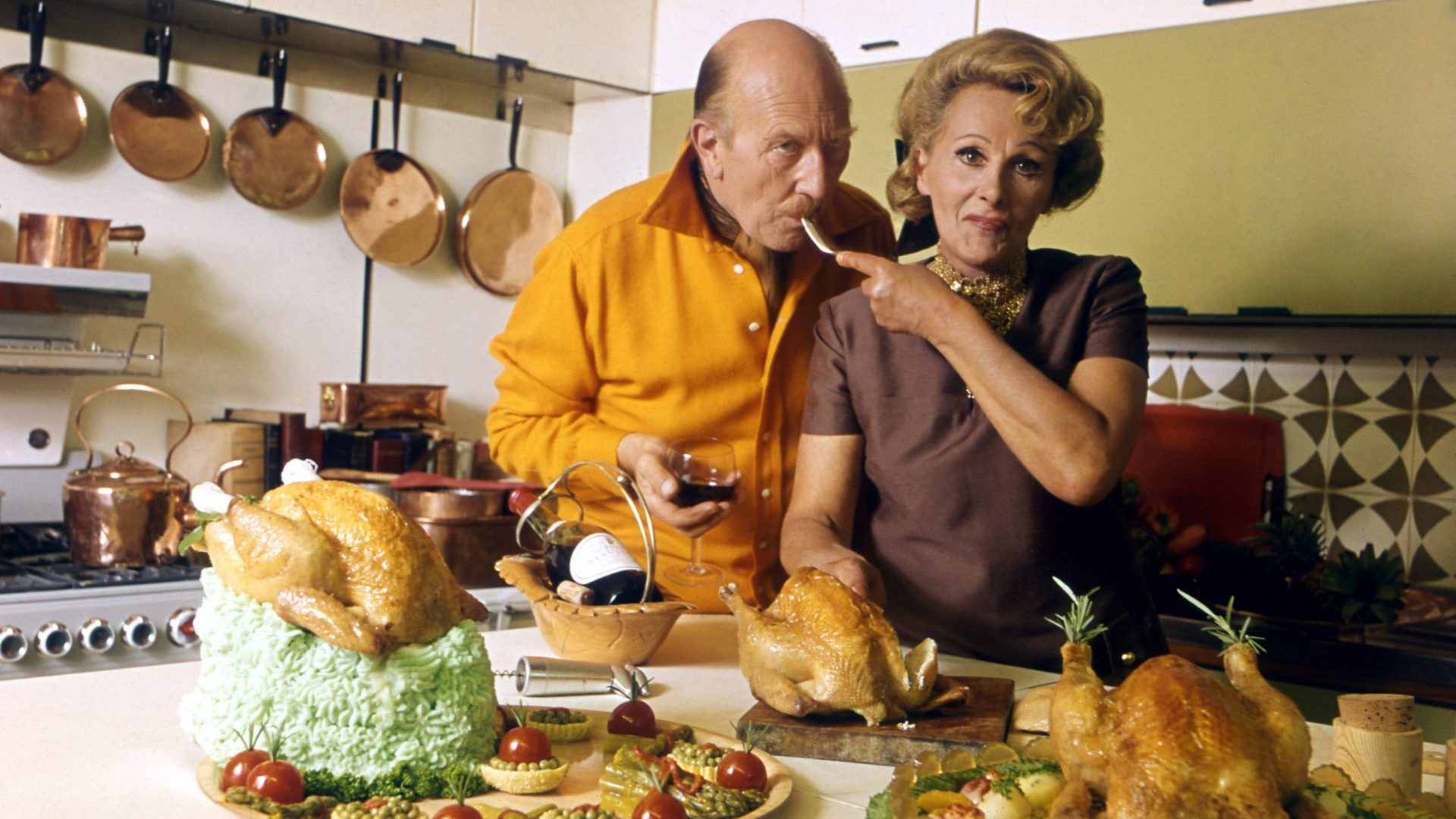
In Fanny Cradock Cooks for Christmas, broadcast at 3.45pm each day in the week beginning December 15, 1975, Britain’s first celebrity chef showed the nation how to cook Christmas classics with a firm eye to economy.
Dripping would replace butter, whipping cream stood in for double cream, and gammon could go on the turkey instead of ham (“My purse won’t run to raw ham these days – whose purse runs to anything?” Cradock exclaimed). Her “tickling things up” on a budget included green food dye and “tiny economical little scraps of angelica” used to make brandy butter look like a lit Christmas tree. There were also chocolate decorations for trifles made using leaves from the garden.
With inflation then at 25%, household finances were indeed horribly squeezed, and Cradock’s oxymoronic blend of thrift and decadence is as relevant to our own turbulent times as it was to those of the mid-1970s. Fanny Cradock Cooks for Christmas – her only series to survive in its entirety – was added to iPlayer in 2017 and its rediscovery coincided with a renewed interest in retro food exploding on social media. Yet Cradock remains a much-misunderstood figure, never given proper credit for her role in British social history.
Fanny Cradock Cooks for Christmas proves that the flamboyant cook’s reputation as a cartoonish grotesque was hardly unwarranted. From barking at her unfortunate young assistant to violently attacking a goose with a fork (“Think of somebody you’ve never really liked, but you’re too well-bred to say what you think of them so you take it out on the goose”), Cradock was undeniably terrifying. Her irascibility has always been said to have been her downfall, her belittling of amateur cook Gwen Troake on a programme the following year causing her to be “sacked” by the BBC.
“It’s a total myth,” says food and media historian and Cradock fanatic Dr Kevin Geddes. “The simple truth is that she never had a contract with the BBC ever in those 20 years that she appeared on screen – she was a freelancer and proud of it,” adding that Cradock had already largely retired by 1976. As the TV cook’s biographer and author of It’s All in the Booklet! Festive Fun with Fanny Cradock, Geddes has trawled the archives to reveal her role as a true broadcasting pioneer.
Geddes says Cradock’s “bulletproof exterior” came from having to survive on her own. First married when she was just 17, partly to escape the poverty of her background as the child of a playwright with a gambling problem and a spendthrift actress, Cradock was pregnant when her RAF pilot husband was killed in a crash just months later. The baby would be raised by paternal relatives, as was another son born from a second marriage two years later. Two bigamous marriages followed, including to her long-suffering TV sidekick, Johnnie.
Suggested Reading

The last good cheap meal in Paris
Cradock’s emphasis on thrift came from having known real want, and she first came to prominence in the late 1940s as a campaigner involved with efforts to secure better food for families. She worked as a lifestyle journalist and a romantic novelist, then appeared in on-stage cooking shows with Johnnie before bursting on to the nation’s screens in Kitchen Magic in February 1955. Screened less than eight months after food rationing ended, the programme found the pair cooking in evening dress, and it was symbolic of how austerity was giving way to aspiration in postwar Britain.
Cradock had a natural genius for broadcasting. “She would look directly down the camera lens, and she always said that she was just speaking to one housewife at home,” Geddes says.
But Cradock also had vision, anticipating almost every concept used in food programming today in her pitches to TV executives, from outside broadcasts and travel-based shows, to cooking in her own home, shows featuring celebrity guests, and even one where she would produce a complete meal in just a quarter of an hour (pipping Jamie’s 15-Minute Meals to the post by more than 40 years). While her ideas were often rejected by BBC suits, she always found ways to work and had a string of sponsorship deals with everyone from the Gas Board to Kenwood.
Geddes is keen to explode the myth that Cradock, who had no formal culinary training, was someone who didn’t really know about food at all – just a snob who would name drop Escoffier while opening a tin. “She was always very clear that she wasn’t a chef, she was a housewife,” Geddes says, adding that when he cooked his way through Cradock’s meals for his blog Keep Calm and Fanny On, “all the recipes were brilliant.”
But what is perhaps most remarkable about Cradock is that she maintained her rapport with her predominantly female audience over decades of sweeping social change, managing to be as successful with 1950s housewives as she was with the apparently emancipated women of 1975. That was International Women’s Year, but it was also a period of stark contrasts.
While 1975 saw new legislation on maternity leave, sex discrimination, equal pay and child benefit, British TV that year suggested women still had a long way to go, from The Benny Hill Show (Hill spoofed Cradock in drag), Helen Mirren being questioned about her breasts by Michael Parkinson, and the first appearances of fictional female grotesque Sybil Fawlty. Press coverage of the Yorkshire Ripper’s early crimes and those of the “Cambridge Rapist” Peter Cook that year had an undercurrent of rampant misogyny.
Cradock declared in the Christmas series that she was “not one for women’s lib – I’m not such a clot,” but she quickly added, “it is my considered opinion that Christmas is just about slave labour for the women,” declaring her main aim was to relieve some of this burden. Her impassioned speech at the end of the penultimate episode – “And may I say how much I admire the housewives of Britain in these appalling present conditions for their courage in trying to give their families another super Christmas” – proves Geddes right: “She was really into empowering other women, whether she realised it or not”.
Fanny Cradock Cooks for Christmas would be her swansong. Still a workaholic as she pushed 70, it took the eyewatering 83% tax rate for high earners under Healey to force her into retirement. She moved to Ireland and returned to writing novels.
But 50 years on, there’s still something very salient about Fanny. So, this Christmas, pour a sherry, don some chiffon, and learn her lesson of Christmas cheer – history always rolls on, but don’t let anything get in the way of good food, good company, and a good time.
Sophia Deboick is a journalist and writer