Damon Albarn has been upsetting people again. As the ex-Blur frontman promoted Gorillaz’s new album, The Mountain, on The Graham Norton Show, he seemed determined to prove his reputation as the most curmudgeonly interviewee in music.
“Damon, welcome back, it’s been a minute,” Norton said with his characteristic levity, only for Albarn to shoot back, “You just haven’t invited me back.” It got awkward and ended up all over the news sites.
There’s long been something off with Albarn. Of course, he made a major mistake when he slagged off the biggest artist in the world four years ago, saying of Taylor Swift: “She doesn’t write her own songs,” and petulantly doubling down when corrected.
This was Albarn’s “All right, grandad” moment. You would have to live under a rock to think Swift was a manufactured pop star, and calling her music “endlessly upbeat” revealed he had not the slightest acquaintance with her back catalogue. This left him open to accusations of the worst of all sins for an artist – incuriosity.
There was more than a whiff of sexism about this 50-something arbiter of “serious” music attacking a younger, female artist. Earlier reports that he had called Adele “insecure” after she had shared her fears with him about returning to music after having a baby didn’t help (the toxic masculinity hidden behind the sharp cheekbones and “irony” of Blur’s Damien Hirst-directed, glamour model-starring Country House video is also hard to forget).
This is all, officially, A Shame. Blur’s almost-novelty songs were pop genius, whether you liked them or not, and Gorillaz were the most original act of the 2000s, recruiting stellar collaborators and redefining the boundaries between mediums by fusing music and visuals. Utterly genre-defying, they had the most killer tunes of the decade – nothing sounded quite like Feel Good Inc, Clint Eastwood, Dare or Dirty Harry.
The Mountain is everything Gorillaz have been consistently good at. Hyper-eclectic without becoming obscure, it is also incredibly sonically beautiful in many places. Albarn and the co-creator of the virtual band, illustrator Jamie Hewlett, both lost their fathers in 2024, and the album explores a central theme of death with genuine affect, featuring the voices of now-deceased Gorillaz collaborators Dennis Hopper, Mark E Smith and Bobby Womack, among others.
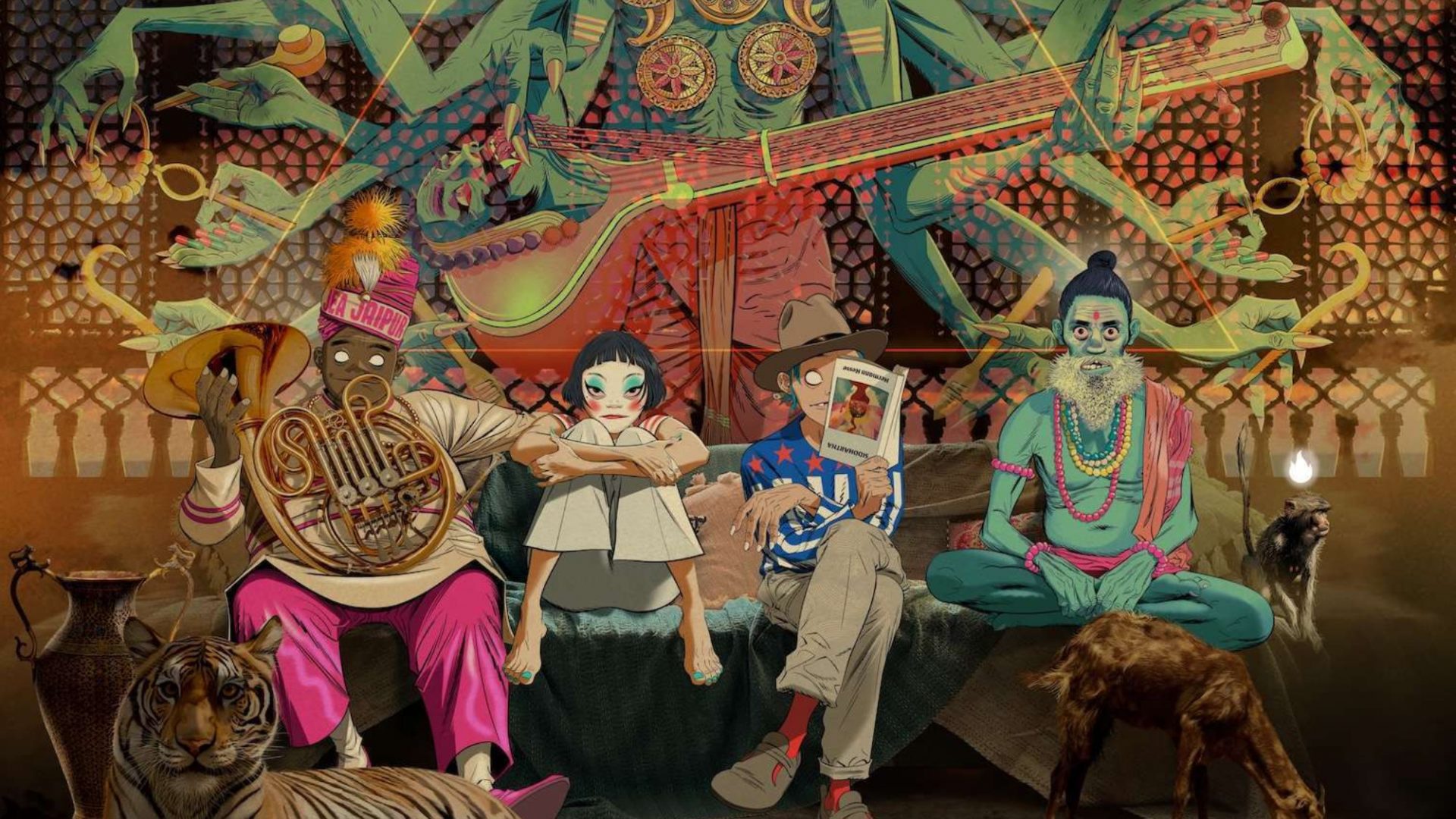
But The Mountain also potentially garners more controversy. Inspired by the time Hewlett and Albarn spent in India, it has gone all-in with the theme, the artwork showing multi-armed gods and recasting the character Murdoc as a blue-skinned Hindu guru. The title is even rendered in Devanagari script, in case we’ve somehow missed that this is all about “The East” (for those who remember 1996, it’s all a bit Kula Shaker).
Suggested Reading

The man who invented the internet too soon
Accusations of cultural appropriation have been put to Albarn ever since 2002’s Mali Music LP, and continuing via Chinese opera Monkey: Journey to the West (2007), Blur’s “Asia-inspired” The Magic Whip (2015) and Gorillaz consistently drawing on “world” music. Albarn has often simply shut down the issue in interviews (“Well, I’ve read Edward Said, and I’m not sure I think that that criticism’s fair. I just think it’s a fucking load of old bollocks” was one choice response), or has otherwise given superficial – and often less than candid – explanations.
“When I was growing up,” Albarn said in a recent radio interview, “I lived in Leytonstone next to an Indian family,” adding, “Ravi Shankar was played in my house from a very early age. So in the back of my mind, I was always going to go to India.”
This seemed tenuous, but it’s an origin story that Albarn has used before (that he moved to a leafy Essex village when he was 10 is often left out). He has mentioned more than once that he has learned to cook Malian food, as if this is proof of his commitment to the culture.
Summing up his process, Albarn said: “What am I reading here in this culture that I can somehow bring into my own culture and kind of, you know, play with it?” This sounds rather unilateral. Certainly, the moment in the 2008 Gorillaz documentary Bananaz, when Albarn tells black parents from Harlem whose kids are singing with him: “In Britain we have kids in schools with guns exactly the same. Really, there is no difference,” as if to claim equivalent knowledge of gun violence, suggesting a poor grasp of the relevance of power imbalance.
Albarn has certainly given back, both via music-making projects with Oxfam and his own Africa Express project, which has given a platform to African and Middle Eastern artists for 20 years. But that cross-cultural collaboration – a rich seam in music from the Beatles to Paul Simon and David Byrne – is at the very heart of his work, which makes it all the more remarkable that he has made little to no thoughtful contribution to this discussion.
Albarn is now an elder statesman of music, however much he may continue to act like a moody teenager (the Gallagher brothers have taken on this mantle with far more humour and self-deprecation, something few would have predicted when Blur were considered the more cerebral, interesting band in the 1990s). That status comes with responsibilities – to those coming up below you, and certainly to those collaborators whose talents you draw on.
Yet this Peter Pan of Britpop seems to have little interest in growing up.
Sophia Deboick is a historian and writer on popular culture