For decades, Cambodia and Thailand have lived in an uneasy state of shared enmity and outbreaks of violence. Just months after a ceasefire — which Donald Trump claimed he had brokered and hailed as a roadmap to peace – the fragile truce has collapsed.
On December 7, Thailand launched airstrikes with F‑16 fighter jets along the Preah Vihear and Oddar Meanchey border. At least nine Cambodian civilians have been killed so far, and hundreds of thousands of civilians have been displaced.
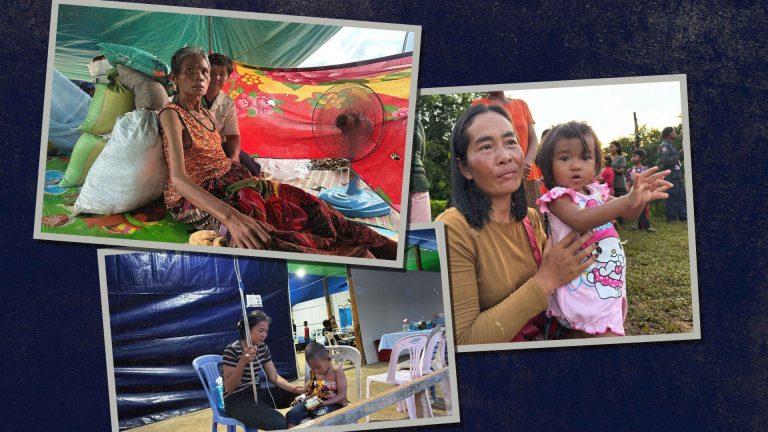
The people who live along the border are scattering into the countryside. Kong Chantha is from the village of Thma Daun. On the morning of December 8, she sent her child to school as usual. Soon after that, the gunfire began. “I went to pick up my son. He was crying with fear and ran out of the school,” she said.
Chantha fled with her three children on a motorbike, eventually reaching a camp at the Phnom Thma Kambor pagoda. For Chantha, this is not her first experience of war. During the previous border fighting, her home was completely destroyed by Thai bombing.
“I have no money to spend,” she said. “Since the conflict, the harvested rice can’t be sold. I left it at home, not knowing if it was damaged by the bombs.”
Khan Yun, 53, is from Sra’aem village, and he managed to get out with his seven family members at night on a tractor. “Around 4 pm, the Thai military used heavy artillery shells on us.” Just an hour after they fled, he said, three bombs struck the village health center. As they were leaving, he heard explosions everywhere.
Back in July, it is alleged that the Thai army used drones and aircraft to release chemicals in disputed areas. A witness, Yun, told me: “Last time, nearly 800 chickens died; they were affected by polluted smoke sprayed by the Thais,” he recalled.
Suggested Reading
Voices of the Cambodian war
Like many others, Yun’s income has now collapsed. Their farm produce remains unsold, the livestock abandoned.
Chert Sreynam, 34, of Sra’aem District, Preah Vihear, fled on December 8 with her three young children – aged three months, two, and seven. They went on foot. She asked a neighbor for help and is now staying with a relative for safety.
Her husband is a frontline soldier stationed at Phnom Kmoch. “I haven’t received his call since the conflict began,” she told me. “Others have heard from their husbands, but mine is silent.”
Sreynam is a vendor, and she fled with nothing more than the clothes on her back. The fighting has now stopped her income, although her husband still receives his soldier’s wage. “I depend on his small salary, but it is not enough to support my children,” she said. Two private buses traveling to pick up evacuees were shot by a Thai drone. The drivers were found dead.
The cultural cost is also high. The temple at Prasat Ta Krabei has been completely destroyed, while heavy gunfire has also damaged the UNESCO‑listed Preah Vihear temple.
This round of violence is unlikely to end soon. On December 8, the former Cambodian prime minister Hun Sen took direct command of the military, warning Thailand that its aggression would not be tolerated. In response, general Chaiphruek Duangprapat of the Thai army threatened to render Cambodia “incapable of military action for a long time”.
In turn, prime minister Anutin Charnvirakul of Thailand branded Cambodia an “adversary” and said that the Joint Declaration between the two nations was finished. That declaration was the peace agreement that Donald Trump was so keen to associate himself with earlier this year. It was in fact brokered by the Malaysian prime minister Anwar Ibrahim during the ASEAN Leaders Summit in October, following the clashes in May.
Meanwhile, the destruction is now spreading fast across an 817km frontier.
 Most popular


Screen scandal: How Ofcom lets GB News get away with it

My late friend’s final message: Never work for the Daily Mail


Now it’s official: Brexit was a disaster. Next, we must join a new EU
GB News Scandal: How Ofcom let GB News corrupt British media