How many angels will pass through your front door this Christmas? A dozen or more, for sure. You might find Botticelli’s lush-winged angel of the Annunciation. You might get a cute angel in the form of a golden-haired little girl in a nightie with a deck quoit floating above her head.
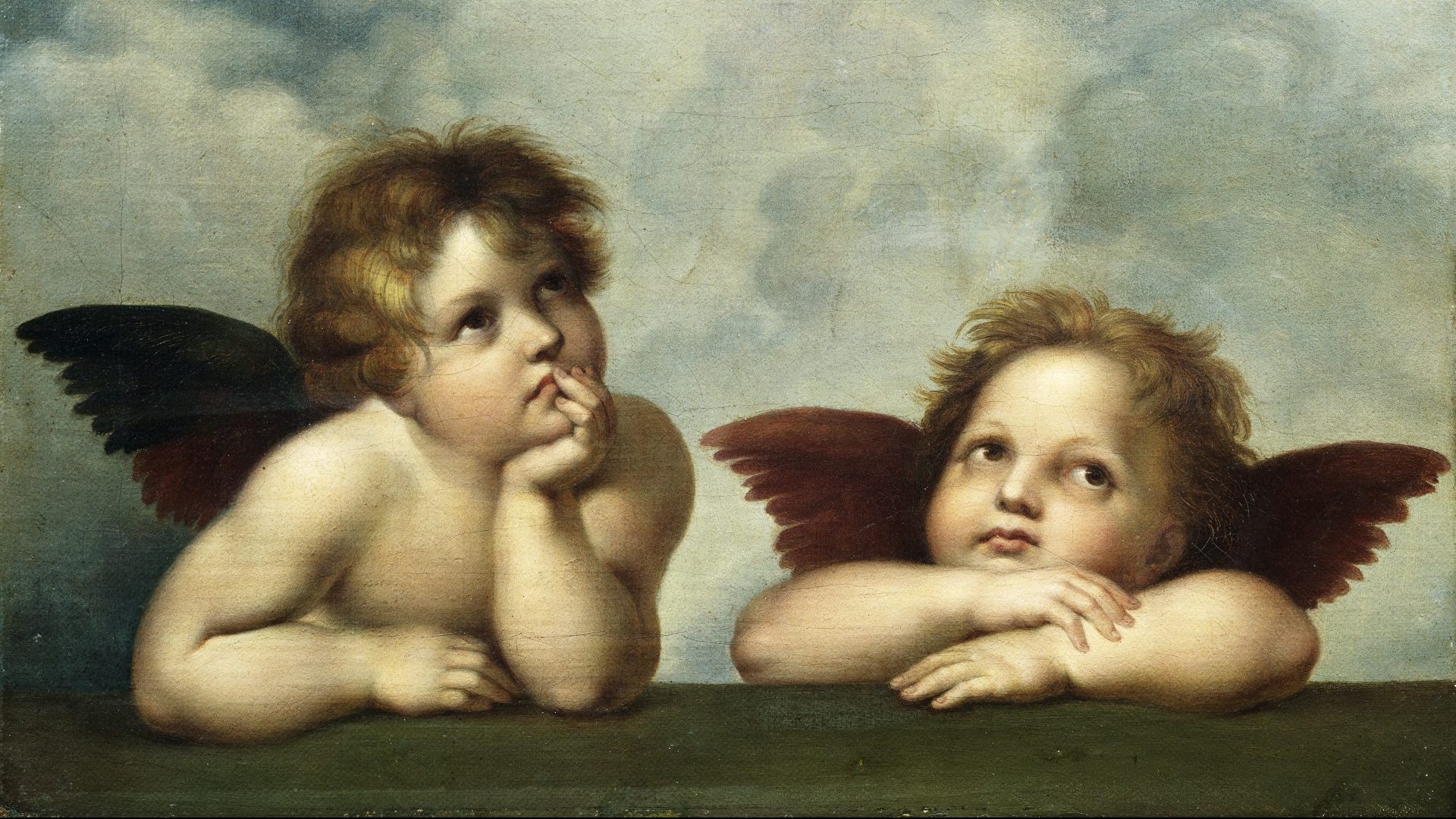
Perhaps the most likely visitation is from the two bored cherubs in Raphael’s The Sistine Madonna – actually in Dresden – staring up at Mary. There’s a story that Raphael got the idea after seeing two children looking wistfully at a baker’s shop.
Angels come flooding to us every year on Christmas cards, and often enough they take the place of honour on top of the tree. As we do our Christmas shopping, songs about angels come bouncing out of the speakers. Then there’s the old joke about the word actually being spelled A, N, G, E – because the angel said: “No L.”
Angels crop up in all the Abrahamic religions: there are Judaic and Islamic angels as well as Christian angels. Angels are messengers: the Hebrew mal’akh was translated with the Greek word angelos: and so angels are messengers of God.
In purely narrative terms, monotheism is dull when compared with the wild excesses of the Greek gods of Olympus or the gorgeous pantheon of Hinduism. Angels take up some of the slack: filling out the cast and fighting against evil, slaying dragons, casting Satan out of heaven, advising fortunate humans and chucking Adam and Eve out of Paradise.
We humans have an enduring belief in the Scala Naturae: the idea that all life operates on a hierarchy, humans on top. Aristotle drew up such a schema. The idea was adapted to Christianity: rocks and stones on the bottom, then plants, then lower animals, then higher animals, and then humans.
But humans have bodies: we see or saw ourselves as half body, half spirit: a kind of amphibian. That puts us below God, who is pure spirit – and between humans and God we have angels. “For thou hast made [humankind] a little lower than angels and has crowned him with glory and honour,” from Psalm 8.
Angels play an important part in the Christmas story in the Gospels: first telling Mary that she will bear the son of God, and later informing the shepherds of the birth of Jesus.
“The angel of the Lord came down and glory shone around” as the Christmas carol has it: and the words are currently echoing across railway stations, often sung by a decent choir accompanied by rattling cash buckets: angels summoning us to dip into our pockets and perform a small good deed.
The angels in the Bible don’t carry wings, or if they do, they’re not mentioned. The first known winged angel appears on the fourth-century Prince’s Sarcophagus, which was found near Istanbul.
I have watched birds all my life and flight fascinates me, whether it’s butterflies, dragonflies, bats, pterosaurs, birds, humans or angels. For us humans, flight represents aspiration: reaching beyond our normal day-to-day lives. So when we seek to depict the most holy beings below God, we give them wings.
Early angels had rather perfunctory wings: very few medieval angels look airworthy. But by the time of the Renaissance angels carried lavish and extravagant wings. Take Botticelli’s Mystical Nativity, now in the National Gallery in London: the angels dancing in the sky above the stable look ready to fly out of the gallery to soar round the Christmas tree in Trafalgar Square.
The church of the Holy Trinity in Blythburgh in Suffolk has a roof decorated with angels, and these angels bear the wings of marsh harriers, raptors you can see from the churchyard over the marshes of the River Blyth. But the classic angel bears the wings of a mute swan, the world’s second heaviest flying bird (after the kori bustard of Africa). My wife, Cindy Lee Wright, who has sculpted angels in both metal and wood, agrees that swans wings are best: “The arc of the wing, and those long primaries,” she said.
The scientist JBS Haldane wrote about angels in a famous essay of 1927, On Being the Right Size. “An angel whose muscles developed no more power for weight than those of an eagle or a pigeon would require a breast projecting for about four feet to house the muscles engaged in working its wings, while to economise in weight its legs would have to be reduced to mere stilts.”
He was being more playful than literal-minded here. Mute swans are very close to the limit of what’s possible with the avian body-plan. Angels need their wings to show their wondrousness: their ineffability: their irrefragable status as second only to God.
Suggested Reading
Inside the church of cat ladies
Strictly speaking, angels have no gender, being creatures of pure spirit. They are traditionally portrayed as androgynous humans: a beautiful beardless young man, or an equally beautiful but stern-featured woman. But there’s no compelling reason to stick to these rules: the Wilton Diptych of 1395 shows a line of delightful angels, all of them unambiguously female. Later angels sometimes had breasts: sexy angels, flying women bringing goodness into the world.
However, St Michael the archangel, conqueror of the fallen angel Lucifer and perpetual fighter against the dragon of evil, is a tough-looking male warrior in Albrecht Dürer’s woodcut of 1498. It seems that artists, like everyone else, are entitled to understand angels in their own way. The conventions that govern other sacred subjects are slightly relaxed when it comes to angels.
Traditionally, angels are above such human things as desire, but John Milton saw it otherwise. In Paradise Lost, Adam is so forward as to ask the angel Raphael if angels have sex. The archangel replies:
Whatever pure thou in the body enjoy’st
(And pure thou wert created) we enjoy
In eminence.
A whole new world of possibilities is opened up by these lines: and with wings as well.
Of course, the scene-stealer in Paradise Lost is Satan, the fallen angel, possibly the most sympathetic demon in literature. The angels in Dante’s The Divine Comedy are rather less personable, though Beatrice goes out of her way to explain the angelic hierarchy to the enraptured Dante.
We have always liked the idea that we go through life with an angel and a devil competing to guide us. Both crop up in Marlowe’s Doctor Faustus. Before the doctor makes his pact with the devil, the angel tells him:
O Faustus, lay that damnèd book aside
And gaze not on it lest it tempt thy soul.
We can ignore the angel’s voice if we choose, though we do so at our peril.
Modern angels tend to lack the soul-shattering power of their predecessors. Cary Grant played the most debonair angel in history in The Bishop’s Wife. There are enigmatic angel-like creatures in The Adjustment Bureau, a 2011 film with Matt Damon and Emily Blunt. The Angel of the North is perhaps the most popular piece of public sculpture in Britain.
Angel has become a term of endearment, much used in song. Merrilee Rush sang Chip Taylor’s song: “Just call me angel of the morning, angel.” Bob Dylan sang in You Angel You: “The way you walk and the way you talk is the way it oughta be”, not his finest lines.
So what is the lowest point that angels have touched in recent years? You can buy little plastic angels bearing such slogans as “Mummy, you are loved” and “I wouldn’t be me if I didn’t have you as a friend”; as Miss Jean Brodie said of the Girl Guides: “For those who like that sort of thing, that is the sort of thing they like.”
Dire Straits sang “Angel of mercy, angel delight,” which may have been above the heads of some of their transatlantic listeners. Angel Delight is a pudding originally manufactured by Bird’s and released to an unsuspecting public in 1967. You mix the powder up with milk and whip it all up together. My mother sometimes served it up: butterscotch was our favourite.
Angels may not be capable of flight according to Haldane, they might exist in forms even more sickly sweet than their eponymous pudding and they might feature in some truly terrible songs – but they refuse to go extinct.
They fill an important void: they represent something that combines the sublime with the good. They tell us about great things that are always out of reach and always worth reaching for. The idea of angels lifts us above the ordinary and tells us about such unmentionable things as righteousness.
It’s hard to believe in angels in any literal sense… but then I hear the final Amen at the end of Messiah in Norwich Cathedral and it seems that heavenly voices have blasted away the lierne vaulting in the roof and sent our poor earthbound souls soaring up to dance with the angels whether we believe in them or not…
We may not believe in angels any more. That doesn’t mean we don’t need them.
Simon Barnes is an author and journalist