
I suspect everyone who ever lived could establish a personal Museum of the New Life: a collection of priceless objects, each one representing an irrevocable decision to live a deeper and a richer life. Some of these might indicate modest success: but too many will show a dismaying tendency to failure. The claims of the old life are too strong.
New year is traditionally the time for resolutions: to snap out of it and become a better person. How deep into January do such resolutions last? Suggested items for the museum: gym membership card. Running shoes, worn twice. Bread-baking machine. Empty bottles of the good stuff as Dry January turns wet.
What else? Language course, and you were so sure you’d be speaking Dante-esque Italian by holiday time. In the library section, recipes from Jamie or the Hairy Bikers for healthier living, one page slightly food-stained. A copy of Ulysses, bookmark stuck forever at the third chapter that begins: “Ineluctable modality of the visible, at least that if no more, thought through my eyes.”
At new year we are forced to examine the ineluctable modality of the aspirational: the soul-deep desire to start the New Year with a New Life. It is a human eternal: the urge to throw a double-six and start again, to have a second chance at life, to make some slight but significant adjustment and be forever after a better and a happier person. Inevitably this has been a theme in great writing across the centuries.
And what could be greater than Mole’s soul-cry: “Hang spring cleaning!”? In the opening chapter of Kenneth Grahame’s The Wind in the Willows, Mole flings his whitewash brush to the floor and scrabbles and scrooges his way up the surface, because spring had filled him with “its spirit of divine discount and longing”.
That universal condition drives Mole to the riverbank, and here his New Life begins. It is so complete that he more or less becomes a different species: leaving his molehood behind to live both with and as a water rat: spending his days by the river simply messing about in boats.
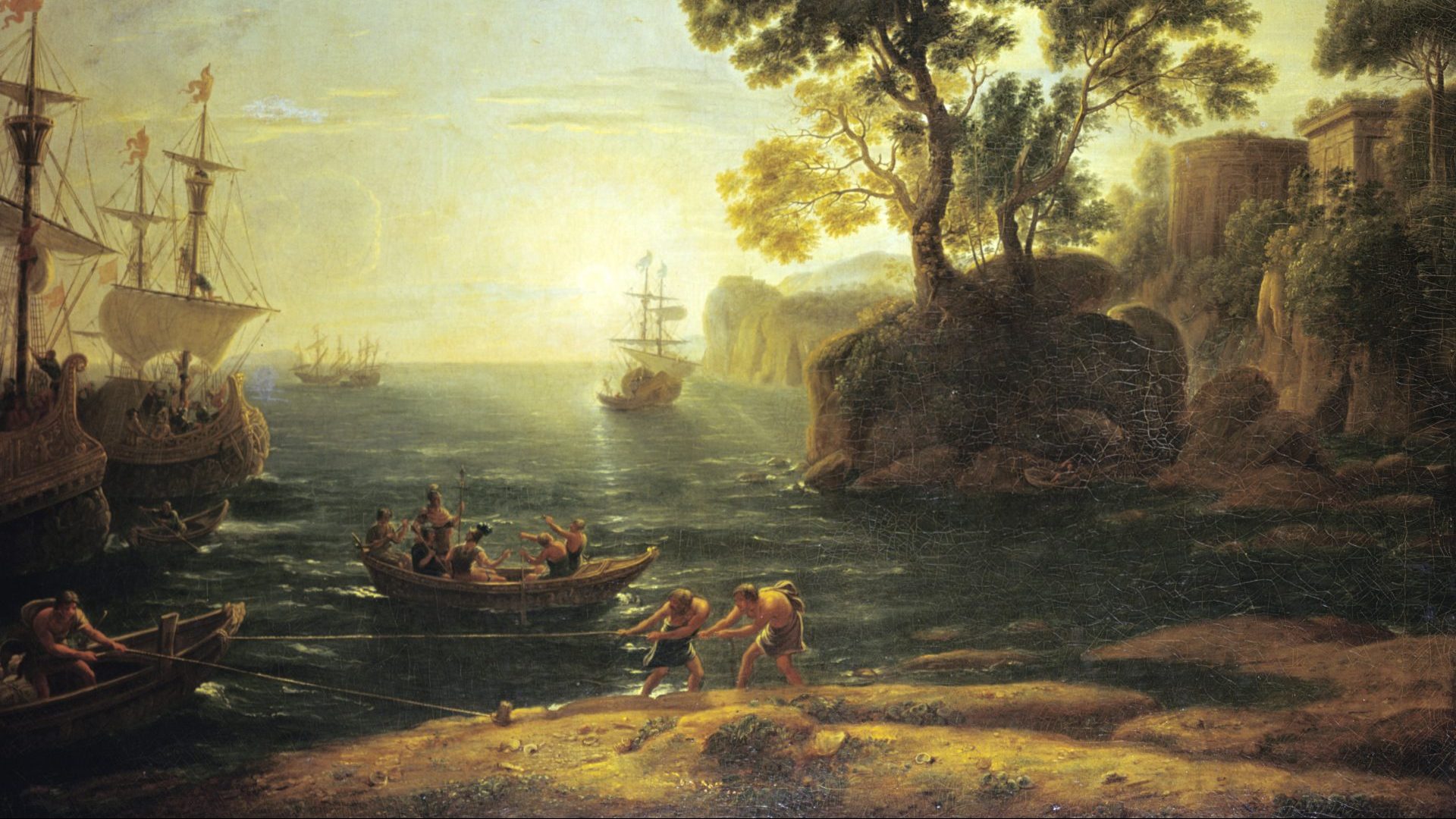
Aeneas feels no such restlessness: he has the New Life thrust upon him: being a Trojan, the fall of Troy forced a drastic alteration to his life. In the Aeneid we hear how Aeneas turns misfortune to good account: making the most of this unasked-for opportunity to redefine his life.
So he founds Rome. He establishes a civilisation that will be greater than the Greeks ever were, despite their victory over Troy. Virgil tells a tale of long, hard and bitter struggles: bitterest of all for poor Dido, Queen of Carthage, jilted as Aeneas sets sail for Italy. She flings herself on the fire and then stabs herself with Aeneas’s sword as his fleet approaches the horizon: but pious, father-like Aeneas travels on and founds the civilisation that will knock the Greeks into a cocked hat.
He becomes tougher and stronger, more pious and fatherly as the epic marches on, but he doesn’t change his essential nature: he just becomes more and more himself. But the idea of changing yourself entirely: going somewhere else to throw away your past and become a completely new person: that too has its attractions.
In Shakespeare’s As You Like It almost all the characters leave the false and pretentious world of the court to live in the forest and to find tongues in trees, books in running brooks, sermons in stones and good in everything.
No one changes more than Rosalind. She decides to be a man and struts about the forest bursting with brilliant wit, secure in her disguise despite being so often addressed as “pretty youth”. She instructs her own lover in the art of love by “pretending” to be his beloved: at this stage she is a boy actor playing the part of a woman who is playing the part of man who is playing the part of woman.
But all will be resolved. Rosalind takes control of the play and of the loves and futures of all the other couples. Only at the very end does she abandon her disguise and speak plain. After that, the forest – the place that has made the New Life possible – is itself abandoned.
The Winter’s Tale is about buggering up your own life on an epic scale and the consequent longing to start again: to set aside all the bad things and become new: to live your life all over again only better. Leontes suspects his wife, the wholly virtuous Hermione, of infidelity. She gives birth to a daughter that Leontes considers a bastard and then dies.
Sixteen years pass: 16 years of misery. But then at last comes the healing of harms. Perdita, the lost daughter, returns and the statue of Hermione comes to life: sadder and wiser and filled with a million regrets, Leontes can start the New Life at last.
The theme of the New Life pervades the days before we make our new year resolutions: Charles Dickens’s A Christmas Carol is an ineluctable part of Christmas whether you’ve read the damn book or not. I once received a Christmas card that was wholly blank but for a real humbug taped to the front.
Scrooge abandons his mean-spirited life and starts anew as a thoroughly decent chap. The book survives in a million forms, perhaps most notably as The Muppet Christmas Carol with Michael Caine as Ebenezer Scrooge.
Anna Karenina is stuck in a bad life, one with plenty of potential for improvement, married to a dickhead husband. I was in my teens when I first read the novel and was convinced that Tolstoy’s heroine would rise above her misfortunes and find eternal happiness with the dashing if unsatisfactory Vronsky.
But her bid to improve a bad life makes everything much worse and, in the end, leads to her death. At the same time the awkward misfit Levin, perhaps Tolstoy’s self-portrait, finds the nerve to make the most awkward proposal in the history of literature and Kitty, dumped by Vronsky, says yes. A new life is, it seems, sometimes attainable.
Suggested Reading

I don’t need New Year’s resolutions, but our politicians do
Dante produced an early work called La Vita Nuova, which all of us who started the language course will understand as The New Life. He has a life-changing and life-defining epiphany: “I say that from that time forward, love quite governed my soul.”
This was nothing less than the famous meeting with Beatrice, who is later cast as the heroine of The Divine Comedy: “She saluted me with so virtuous a bearing that I seemed then and there to behold the very limits of blessedness.” La Vita Nuova is a mixture of prose and verse that takes earthly love and elevates it to the level of divine love.
The Turkish Nobel laureate Orhan Pamuk took this rather further in his Dante-inspired work The New Life, which begins intoxicatingly: “I read a book one day and my whole life was changed for ever.” I was convinced that this was about to become one of my favourite books of all time, but alas, the whole thing fell apart a little after halfway and I had no choice but to throw a double-six and start again with some new book.
But I remember striding along the seashore with Stephen Dedalus in James Joyce’s A Portrait of the Artist as a Young Man as he resolves to become not a priest but a poet. I was the same age as the hero when Joyce told me: “His soul had arisen from the grave of boyhood, spurning her graveclothes. Yes! Yes! Yes! He would create proudly out of the freedom and power of his soul, as the great artificer whose name he bore, a living thing, new and soaring and beautiful, impalpable, imperishable.”
Yes, yes, I too resolved to be a writer, though I have to accept that Joyce did it better.
Joyce’s great friend and protege Samuel Beckett wrote about the New Life and the impossibility of ever finding it in Waiting for Godot. “Sometimes I feel it coming all the same. Then I go all queer.” There’s something of the same thing in TS Eliot’s The Waste Land, but the powerful rhythms of despair are interrupted by vertiginous but wholly elusive shafts of hope: the Hyacinth Girl who has us looking in the heart of light, the silence; the pleasant whining of a mandolin; the inexplicable splendour of the church of St Magnus Martyr and the song of the hermit-thrush.
Eliot is consumed with the idea of new beginnings in the Four Quartets, a series of seductively difficult poems in which the truth – and the New Life itself – seem forever just out of reach. Perhaps he should have the last word, from the last of the quartets, Little Gidding:
What we call the beginning is often the end
And to make an end is to make a beginning.
The end is where we start from.
Simon Barnes is an author and journalist