A haystack and an opera changed the life of Wassily Kandinsky.
In 1896, he was 30 years old and working as an associate professor of law at Moscow University when he saw one of the Haystacks series by the French impressionist Claude Monet. That same year, he heard Richard Wagner’s opera Lohengrin at the Bolshoi Theatre.
Soon, Kandinsky (1866-1944) was giving up his successful career to become an art student. His wealthy family – his father was a tea merchant and the family had links to the aristocratic House of Gantimurov – must have been bemused. But today, Kandinsky is recognised as a pioneer of abstract art, and one of the greatest artists of the 20th century.
The roots of his radical genius can be seen at a remarkable and unprecedented exhibition at Lille Métropole Musée d’art moderne. Reopening the space with a bang after an 18-month renovation, LaM’s Kandinsky face aux images is presented in collaboration with Paris’s Centre Pompidou, itself now closed for a reboot until 2030. The exhibition studies the role that texts, objects and images played in Kandinsky’s career as a painter, as he moved from figurative to abstract art. Around 400 objects are on show. It is a treasure trove of research, exploring his inspirations.
Kandinsky’s intense relationship with colour and sound was formed in his early years. Taught to play the piano and cello, he visualised colours when musical notes were played. Colour and sound were intrinsic, storing memories and experiences. Today, we would say he was experiencing the neurological phenomenon of synaesthesia.
In 1889, in his law student days, he was sent on an ethnographic study of the people of Vologda in north-west Russia. What remained in his memory were the colour-rich dwellings of the indigenous population, which made him feel as if he were entering a painting.
This connected to his knowledge of Russian and German folk tales, read to him as a child. So the first artworks in Kandinsky face aux images lay out the hermeneutic dynamic between text and visuals in Kandinsky’s early paintings based on folklore.
The gallery space, broken into five themes: Memories, Reproduction, Materialisation, Legitimation and Inspiration, connects the research sources that Kandinsky tapped into, including postcards and photographs he collected. A March 1905 photograph of Arab horsemen riding through Tunis was taken by the German artist Gabrielle Münter, Kandinsky’s lover. The picture informed Kandinsky’s Riders (Arab Riders) of that same year.
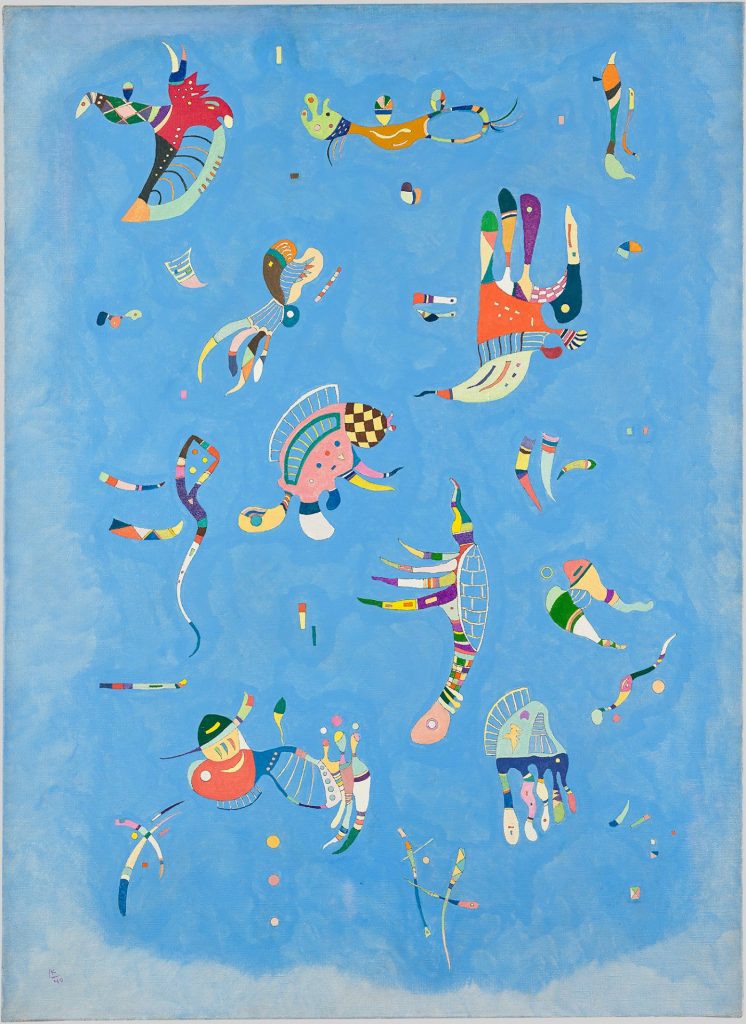
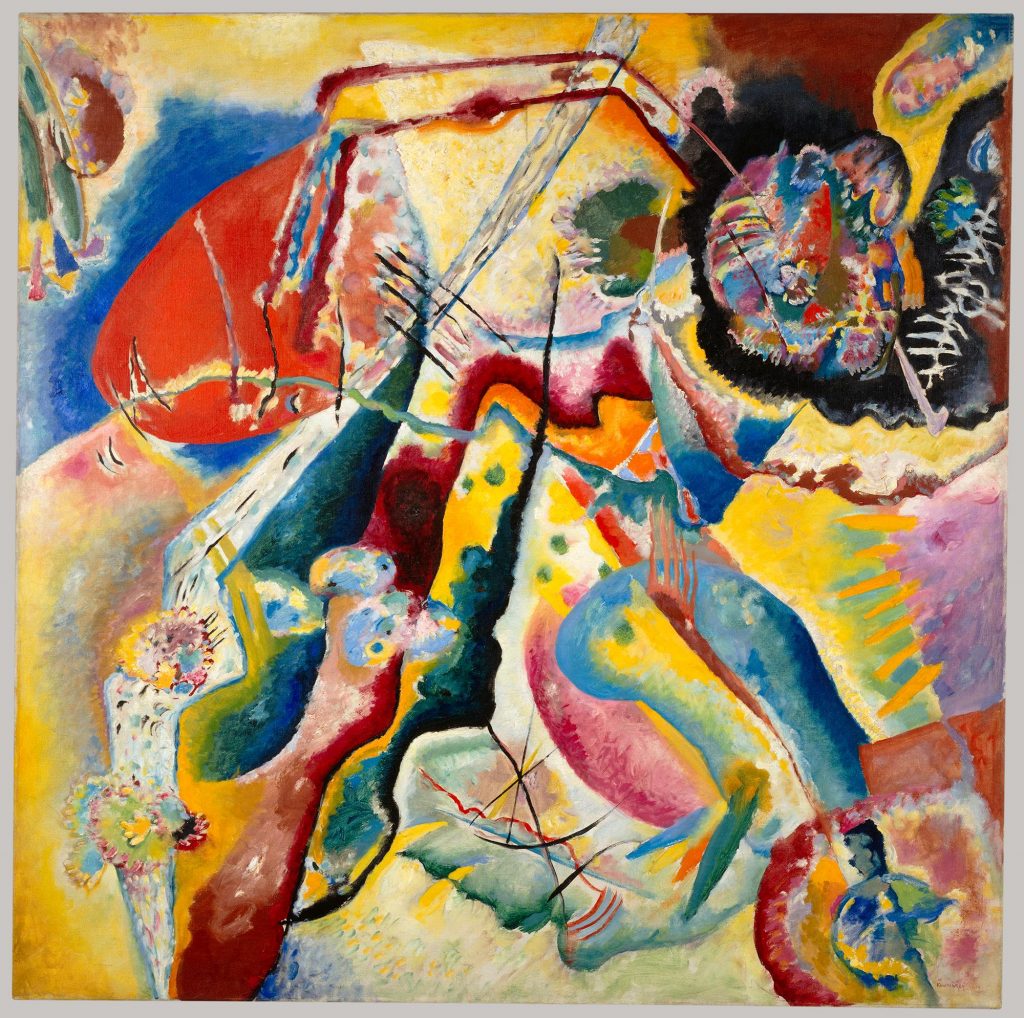
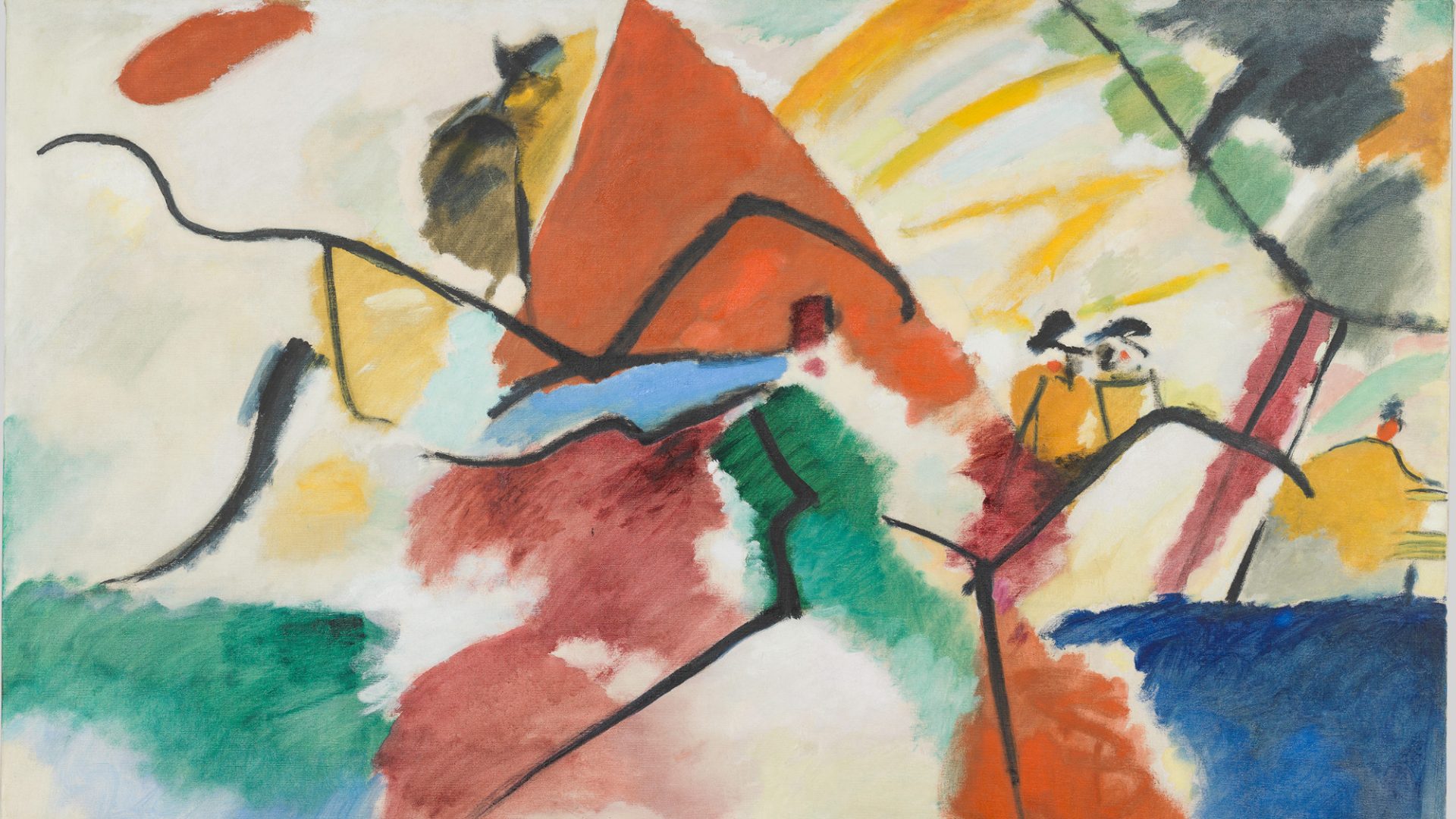
(Painting with Red Spot), 1914
Images often instigated a drawing or painting, but there was more to his work than visual aids. As a follower of spiritualism and theosophy – a then-fashionable esoteric philosophy encompassing a universal divine wisdom with concepts like reincarnation and karma – he pored over treatises by their leading exponents.
His spiritual and theosophic papers and books – displayed at LaM – were transcribed into an essay, Concerning the Spiritual in Art, published in 1912. It was not his first theoretical intervention on art, but the one that caught the wider attention of artists, critics and the public. The essay approached art as a spiritual experience, an inner expression of the artist more than the object, leading towards a non-objective art, an abstraction, or a “concrete art” as Kandinsky called it.
Kandinsky’s vast library – bequeathed to the Pompidou by his Russian second wife Nina Kandinsky (1899-1980) – underlines the breadth of his interests. One is Franz Keibel’s The Developmental History of Vertebrates (1897), revealing Kandinsky’s curiosity in embryology and the formation of germ layers in humans and apes. Knowing this brings an all-new perspective and degree of insight into Kandinsky’s paintings.
Other books in his personal library focused on astronomy and the parascience of astrology. He closely read Astronomie (1921) by Johannes Hartmann, on the physics of the sun and fixed stars. A photograph of a nebula from Hartmann’s book is juxtaposed with a nitrite formation in Kandinsky’s own theoretic book Point and Line to Plane (1926). The artist saw connections everywhere.
Not surprisingly, Kandinsky face aux images explores the expressionist artist group Der Blaue Reiter (The Blue Rider), formed as a breakaway faction after the Neue Künstlervereinigung München (New Munich Artists) to which he had belonged, rejected Kandinsky’s monumental Composition V for an exhibition in 1911.
The Blue Rider, named after the 1903 oil painting that marked his transition from figurative to abstract art, published the one-off Der Blaue Reiter Almanach (Blue Rider Almanac), in Munich in May 1912. It was edited by Kandinsky and the German artist Franz Marc and was less a collection of art by members than an intellectual cultural manifesto.
The origins of the almanac, which aimed to remove the barriers and boundaries of artistic expression, are investigated here through letters, sketches and layouts that helped to form the group’s aesthetic. A chapter titled “Wild Beasts of Germany”, written by Marc and illustrated with ethnic sculptures of people of Borneo, drew disdain at the time for taking the figures in isolation, out of context. These are displayed in the exhibition with accompanying letters, layouts, published texts and media coverage.
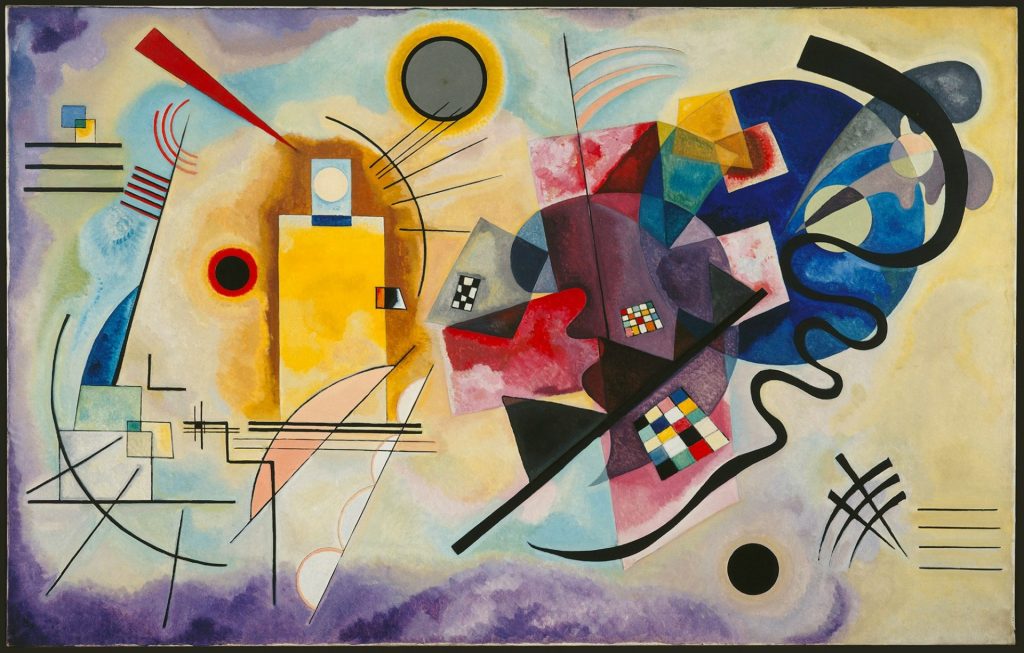
During this period, Kandinsky created his massive Composition VII, 1913, an explosion of dynamic colour that has become recognised as his key work. The Blue Rider group disbanded in 1914 with the onset of the first world war, but the essence of what they wanted to achieve continued, particularly their collective beliefs. Marc described it as “the organ of all truly new, contemporary ideas”.
Suggested Reading
Gerhard Richter, the man who won’t conform
In 1921, Kandinsky was invited to teach at the Bauhaus art school. He joined in 1922 as a master and tutor, teaching in Weimar, Dessau and Berlin, from 1922-1933. The art school motto from 1923 was “Art and technique – a new unity”.
Kandinsky’s rigorous analytical research was the source of his teaching. He said that he was interested in the laws of the universe which united the microcosm and macrocosm, “all human creation, including art, participates in the same cosmic pulse”.
His belief was that every “true artist” was dependent on nature, even if he was “abstract”. Yet despite considerable visual evidence to suggest otherwise, he denied in lectures that his work had been inspired by celestial bodies or the stars.
There is much joy and many revelations in LaM’s exhibition. The biggest revelation of all, however, is that Kandinsky managed to keep his vast archive intact through two world wars in Europe and a revolution in Russia. Its existence today shows how important it was to the artist, and to a personal transition that changed the face of art.
Kandinsky face aux images is at Lille Métropole Musée d’art moderne until June 14.
Rosalind Ormiston’s latest book is Monet: Masters of Art (Prestel)