
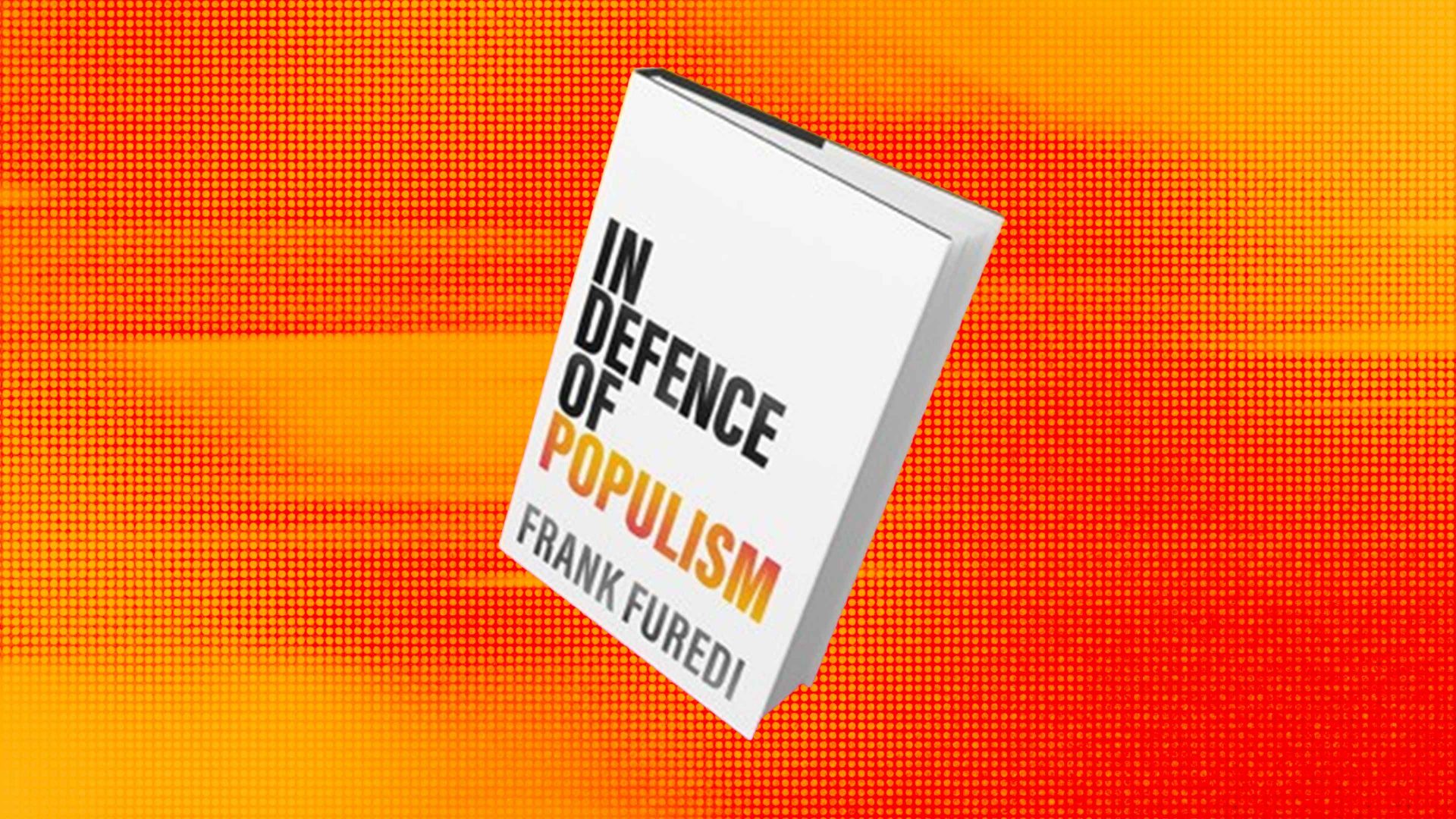
You might think that a book defending populism would be an easy, fluent read, the kind of thing that the masses might recognise as their own. In Defence of Populism is not that book.
Frank Furedi, the Hungarian writer and academic who was formerly professor of sociology at the University of Kent, has evidently decided to play the anti-populist elite at their own game. He marshals everyone from Machiavelli to John Stuart Mill and Hannah Arendt in support of his thesis: that the technocratic elites distrust and even hate ordinary people. Time-honoured sentiments like common sense, nostalgia, the desire for homeland and community – they despise it all.
It makes for a wearying and repetitive read, as Furedi mines the last decade of the culture wars for arrogant slurs against “the populist spirit”. He claims that populists have succeeded despite the hostility of the mainstream media, a hard argument to make in the UK.
It is silly to suggest that European institutions regard patriotism as a “pathology” when sport, for example, is so central to national identity. Individual struggles are grist to his mill: what was in fact a nuanced case of unfair dismissal in the NHS is summed up witheringly in a single sentence.
He occasionally has a point: in recent years, governments have done a poor job of making the case for the policies they espouse, and frequently evaded discussion of things they wanted to take for granted. The left can indeed be illiberal and intolerant.
Unfortunately for Furedi, those failings apply just as much to the populists as their opponents. It would have been better to try to make the case for the European Union before the Nigel Farage era, and in words that ordinary people could understand. But “taking back control” – a slogan Furedi praises as straight from the mouths of the people – turned out to mean little and achieve less when it was implemented.
No one can deny that populism appeals to large numbers of people: it would hardly be populism if it didn’t. What, then, do the people want? For Furedi, who excludes the possibility of left wing populism – Zack Polanski arrived too late for a rewrite – it is cultural continuity, a sense of belonging to a homeland whose values can be traced back through generations, and the freedom for people to speak their minds without fear of retribution.
These tropes are familiar from the rhetoric of Viktor Orbán’s government in Hungary, which lost power earlier this year. In the acknowledgements, Furedi thanks Mathias Corvinus Collegium Brussels, an outpost of the private university which was funded through Hungarian state-friendly entities to promote Orbán’s ideas, and where Furedi is an executive director. “I work alongside a great team of people,” he writes.
Curiously, in an interview with Index on Censorship last year, he claimed he had never met any of his MCC Brussels colleagues. But perhaps the desire for a homeland keeps him in Faversham.
If we accept, then, that the silenced majority are unhappy with cultural and societal change, what kind of politics and policy do they want? Here, Furedi has nothing to say. He urges populist leaders to seize the moment and “develop a coherent alternative… the kind of political sophistication necessary for becoming a party of government”.
Can we look to the arch-populist, Donald Trump? No: “his economic policies never pretended to be truly populist”. What about Giorgia Meloni? No: “she had to pay heed to the demands of market forces” by allowing continued immigration and abandoning a tax on banks. He is remarkably reticent about what Orbán’s long premiership has actually achieved for Hungary.
Suggested Reading


The Four Seasons is a very funny taste of the America we miss
Yet these populists have had years to develop a coherent policy programme. Trump served a full term before he was re-elected in 2024. Either the current set of populist leaders aren’t up to the job, or populism represents an anger that can never be satisfied or resolved by actual policies. One or both must be true.
Furedi pays little heed to the role of social media either, noting that it has enabled populists to muster support but ignoring the effect it is having on social cohesion. It may be, as QAnon supporters believe, that social media is the essential catalyst for the red-pill effect, where people’s eyes are opened to the hidden reality of existence. Or perhaps it just provides a space where frustration and anger can escalate and find a reward. But it is extremely hard to believe it can co-exist with the peaceful cultural continuity that he mourns for – and which, in truth, has been disrupted by war and politics for centuries.
Furedi believes populism can never be fascist because fascism demands conformity and imposes top-down authoritarianism. What can he have made of the laws Orbán passed that made it impossible for independent media to thrive in Hungary?
On one point, we are guilty as charged. Lots of us have been very dismissive of populism. Sometimes we have conflated populist rhetoric with the people it claims to represent. Hillary Clinton should not have referred to Trump supporters as a “basket of deplorables”.
But the reason we are so sceptical is that populism still has no coherent and workable policy agenda and relies on authoritarian “solutions” to wicked problems. Furedi is gracious enough to admit that the movement lacks intellectual substance. He is waiting for the men and women who can channel this extraordinary fury into credibility and policies that improve people’s lives.
He is 79: those of us who live longer will see the result of his delusions.
In Defence of Populism is published by Polity Press.
Ros Taylor hosts the More Jam Tomorrow and Oh God, What Now? podcasts