
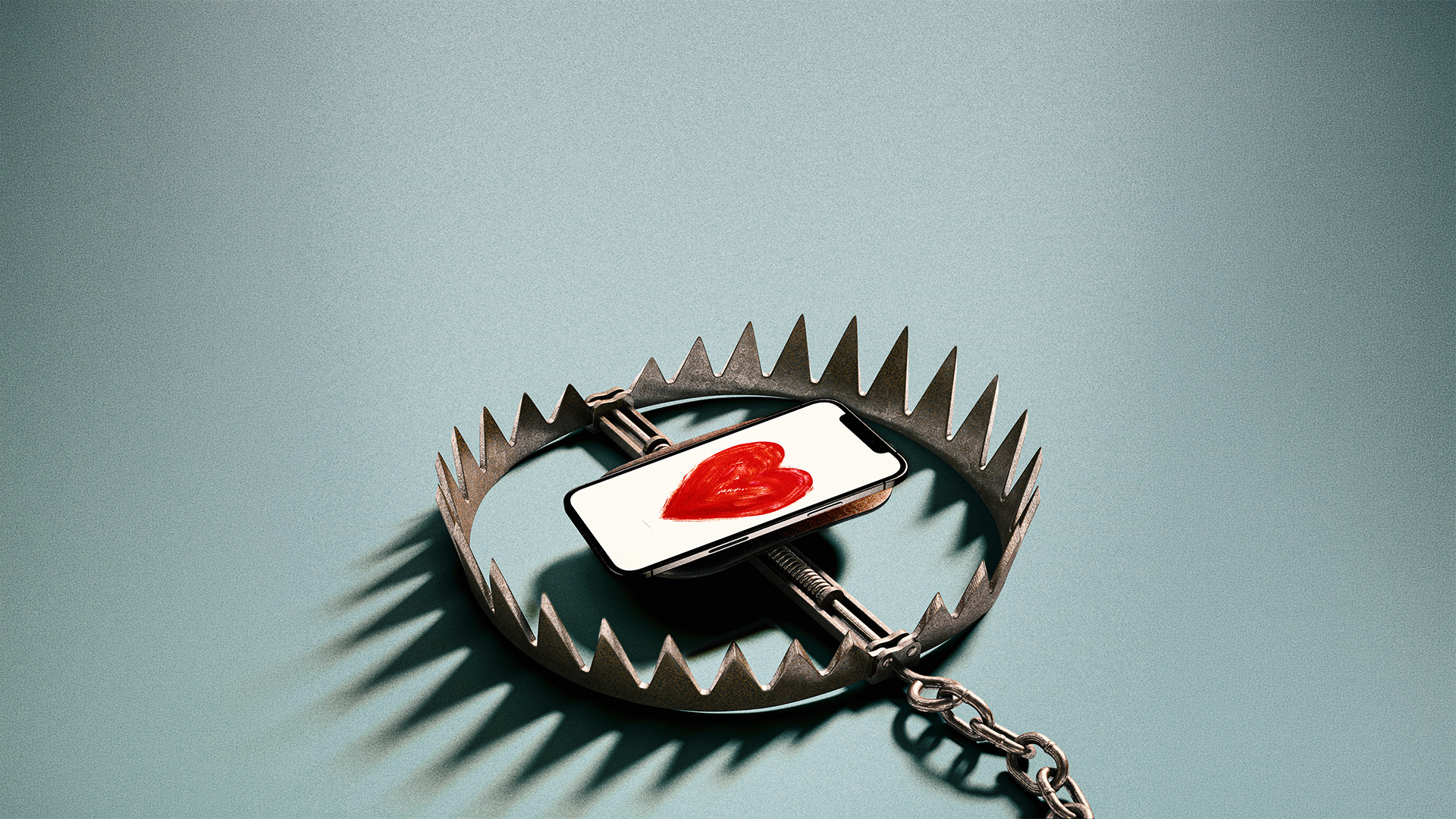
It might start with a match on Tinder, or a flirty message on Snapchat or a gaming app. The sender is fun, eager. They suggest moving the conversation to WhatsApp or Instagram. Things get steamy. Intimate pictures are exchanged.
Then they fall silent. Ten minutes later another message arrives. “I have your nudes and I’m gonna share them with yr Insta followers in 24h. Pay $400 in Steam cards to this email. Or u are ruined.”
This is sextortion. Compromising images have always been a way for blackmailers to threaten to expose an illicit sexual relationship and extract money from their victim. But while the odd private detective is probably still bugging hotel rooms and photographing trysts, fraudsters have far easier prey at their disposal: anyone who is willing to trade a “dick pic” or a shot of their breasts for the prospect of something more.
That’s a lot of people. Every couple of hours a new victim turns up on the Sextortion subreddit. “I was drunk and not thinking clearly… I made the mistake of paying them and now they’re back… HELP.”
No one really knows how many people have been victims of sextortion. We know they are likely to be under 30. Few will admit to having been targeted. Sometimes the victim and the perpetrator know each other in real life. That makes a conviction more likely, but makes reporting it even more personally risky. Many people are unaware that some platforms can block images and videos from being shared. They just want the nightmare to go away.
“This is one of those things that thrive in darkness,” says Josh Thomas of the Internet Watch Foundation (IWF). Sextortion causes intense anguish and distress, particularly to people whose sexuality or online activity is a closely guarded secret, and to the most vulnerable group of victims – children and teenagers.
“It’s a hugely traumatic and life-altering event,” says Jessica Ringrose, a professor of sociology and education at University College London. “Their images are being held against them. There could be cultural issues at play, because of the shame around their sexualised images.”
It might seem pointless for sextortionists to target children, who are unlikely to be able to transfer large sums of money on demand. But while no one knows the true prevalence of the crime, between 2024 and 2025 the number of young people reporting sextortion rose by 72%. The overwhelming majority were boys.
However, Lisa Lazard, a professor of psychology at the Open University, cautions against drawing firm conclusions based on reported crimes or small studies. “There is evidence to suggest young boys are affected by sextortion, but other evidence suggests that girls and LGBTQ communities are victims.”
Children might not be the most lucrative victims, but scammers have learned that they are more likely to pay up and less likely to take any action to protect themselves. This is partly because it is a criminal offence in the UK for under-18s to share intimate pictures of themselves, or of another young person. Many teenagers assume that sharing nudes when they are over the age of consent is legal. It is not. Sextortionists use this knowledge to threaten to report their victims to the police as paedophiles.
“Sexual abuse is usually directed at girls,” says Thomas. “It’s a reversal of that with sextortion. They’re pretending to be a female peer, someone of the same age, and once they’ve got one of the boys to send an image they’ll use it to extort more extreme imagery or the money.” Equally, a boy terrified of being outed as gay is vulnerable to blackmail.
Worse, “sextortion isn’t just about the financial abuse – some of the people who do it have a sexual interest and use the same MO to extract the sexual imagery. It’s a far broader crime.” If the victim has revealed where they go to school, the threats can escalate: “I’ll be at your school tomorrow.” Sometimes children are not deliberately targeted, but are just small fry in the scammers’ net. “They’re doing it in such enormous bulk that it doesn’t matter if they get a child… £5 here, £10 there, and they’re on the hook for years.”
Suggested Reading

OnlyFans and the digital pimp economy
Sextortionists use proven tactics to draw in their victims. The IWF’s team of analysts has found predators sharing tips and online manuals dedicated to ways of coercing children into sending money.
What kind of person makes money from soliciting intimate pictures from young people and blackmailing them? We know very little about who they are.
Some sextortionists are full-time criminals. For others, it’s a side hustle. There have been high-profile cases involving gangs in Nigeria, including one that was successfully pursued by the FBI after a teenager took his own life.
“Clearly it is a money-spinner, but increasingly there are lone wolves and people who are just having a go at this,” says Thomas. Lazard says the evidence around perpetrators is “really small”, but they are not necessarily all male. “It is really likely that girls also do it.”
When the sextortion happens between pupils at school – and nude pictures are often shared around purely for the purposes of shaming, without any attempt to extract money or sexual favours from the victim – the victim is even more vulnerable.
Ringrose has researched the attitudes of teenagers towards “catfishing” for intimate photos. At one inner-city comprehensive, a boy in year 9 (“Amir”) used a fake dick pic to persuade a girl (“Laila”) to send him a nude picture. He then shared it with other pupils. There was little sympathy for Laila among her friends, who accused her of stupidity for not recognising that the photo was fake, as well as hypocrisy because she wore a hijab (though Amir was also a Muslim). He went unpunished.
Young people can receive scant sympathy from parents and teachers, too, who sometimes take the view that anyone stupid enough to share an intimate photo of themselves deserves what they get. (The staff managed to keep the incident a secret from Laila’s father, for fear of his reaction.)
Suggested Reading

Paying for sex could soon be illegal in Scotland
But older people do not always realise just how normalised these images have become. “Some girls in our study, as young as 11, conceptualise receiving dick pics as an indicator of their popularity,” writes Ringrose. Decisions about whether to reciprocate are linked to their self-esteem. “If we do it we get called slags, whores, if we don’t do it we get called frigid,” said one girl in the north-west.
For people who were coerced into sharing nudes with a stranger online, the first advice is not to pay any money and to stop all communication. It is possible to prevent images from being shared on some platforms by informing the StopNCII site. Under-18s can send images and videos to a tool called ReportRemove, run by the IWF and Childline, to stop them from being uploaded.
AI nudification tools, of which Elon Musk’s Grok is the most infamous, might seem to put the sextortionists’ business model at risk. When it is so easy to fake a nude, will genuine pictures lose their power to shame a victim? Thomas says scammers are already discussing how to use AI to fake pictures if a child refuses to send them.
For a teenager, it scarcely helps to know that a nude image that looks like you is actually a fake. Sextortionists will use Instagram pictures to create the images. “I tell [young people] not to put too many images of their faces online,” says Lazard.
“It’s really hard because photo sharing is completely normalised, but there are ways to make it harder for people to take your image – making sure there’s not a range of images of your face, taking it to the side rather than having a full profile – that can undermine the AI that’s used to model it.”
Few of the experts think that a social media ban for under-16s would solve the problem. It might well drive them on to sites with even more inadequate regulation. “For the IWF, banning platforms for under-16s is almost admitting defeat. The answer should be, let’s make our platforms safe for those who want to use them,” says Thomas. Yet Ringrose’s research suggests that the incentives to spend time on popular apps make both girls and boys tolerate abuse and leave them more vulnerable to sextortion.
In many ways, sextortion is the perfect crime. Victims are often too ashamed to report it. Perpetrators are near-impossible to identify. The police are profoundly ill-equipped to deal with it and their priorities lie elsewhere. Most of the scammers demand payment in the form of gift cards, making it impossible to trace or recoup the money.
Even educating people about the danger is quite difficult: attempts to discuss things like dick pics openly on TV and radio fall foul of rules about inappropriate language. Some politicians think the problem of young people sharing nudes would go away if schools kept quiet about it. In 2023, one Conservative MP complained about the nature of Ringrose’s research and its influence on “inappropriate” sex education in schools.
But sextortion only happens because we created the addictive technologies that enabled it. “We talk about safety by design,” Thomas says. “Companies will put out a piece of technology without thinking about how it can be misused by the worst people.
“If you are putting something out there that can be abused, you should be thinking at every stage how you can disrupt the business model of people like this. There will be a moment when they say, ‘this is too much hassle’.”
That moment feels like a very long way off.
 Most popular

This is what happens when Putin loses


Am I still a friend of Peter Mandelson? It's complicated

How Europe stops Gen Z going to war with Putin


A scandal that leads everywhere and infects everything