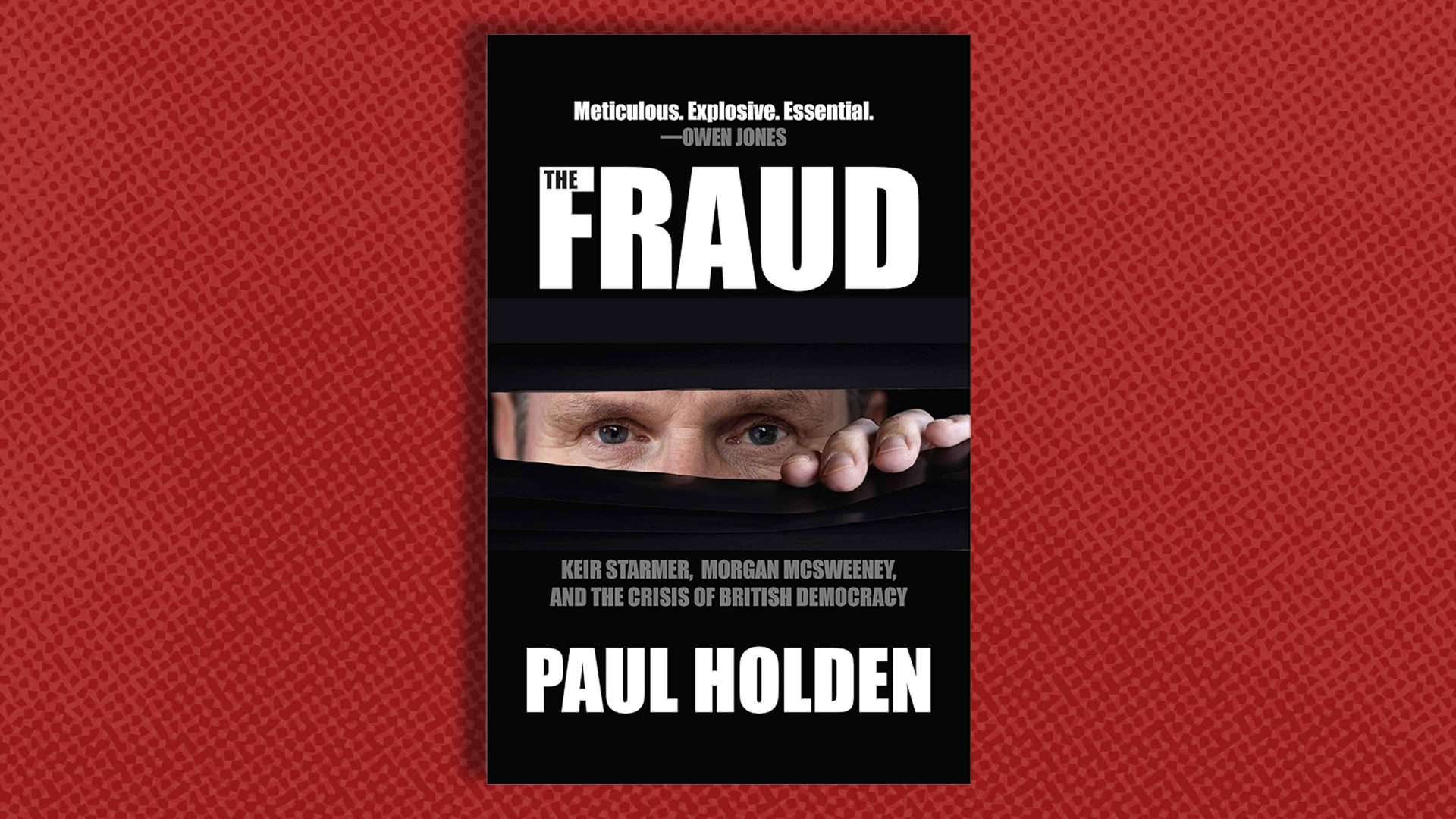
In the perhaps unlikely event that anyone out there is currently pondering whether to join the Labour Party, Paul Holden’s The Fraud is out to change your mind. This book about Keir Starmer’s ascent to power is a straightforward hit job, written by a man who believes Jeremy Corbyn would have eventually won a general election. But in the course of a rummage through the entrails of the far left, we do learn some useful lessons about Labour as a whole – and perhaps a better understanding of why Starmer is so disliked among the public.
The Fraud has nothing original to say about policy – at least, not the kind that can be discussed and debated, rather than functioning as a purity test. This is a story of investigations, dossiers, nominations, de-nominations, suspensions; all the Latinate panoply of party management, alien to anyone who has never been a Labour member. Reports are forever being compiled, published, rejected, sidelined, their findings feeding the endless appetite for rancour and betrayal.
Holden’s key charge against Starmer is that he deceived party members by committing to left wing policies that he later abandoned. He is particularly furious about Labour Together, the think tank set up by Starmer’s current chief of staff, Morgan McSweeney.
One of its less successful initiatives was a podcast, Changing Politics, which was presented by comedian Gráinne Maguire and Marie Le Conte of this parish. You can find a far more entertaining account of McSweeney’s editorial and financial incompetence on Marie’s Substack than the one Holden gives us. Suffice to say that two of the names he mooted for the podcast were Podding The World To Rights and Generation Why Not.
It does help to explain why McSweeney failed to declare Labour Together donations to the Electoral Commission, an omission Holden describes as LT’s “original sin” and for which he was fined. McSweeney just wasn’t very good at running things. Not much change there.
The Fraud is also appalled that the public were not made more fully aware that Labour Together was freelancing to “destroy Corbynism”. But anyone with a pulse who followed British politics knew exactly what it was doing.
This perpetual indignation does Holden no favours. Starmer is, inevitably, “complicit in genocide”, as if Benjamin Netanyahu spares a moment’s thought for what Labour thinks about the killing in Gaza.
Suggested Reading

The Mail’s stunning Starmer scoop doesn’t Czech out
The loathing often veers into petty sniping. When the MP for Holborn and St Pancras sees his vote has fallen at the count in 2024, in part because the independent Corbynite Andrew Feinstein stood against him, Feinstein laughs. Starmer “had a face like thunder… I saw his fury turn into a fixed grin for the cameras.” What exactly is being criticised here? The ability of a politician to conceal his disappointment?
And yet, as Labour’s dire poll ratings show, the book has a point. Starmer was ruthless in his drive to purge the left/make the party electable (delete according to preference). In the process, the people deemed to be in the way were mercilessly removed. Sometimes all it took was to have long ago “liked” a tweet by a non-Labour politician.
The line between antisemitism and disgust with Israel was often unclear, but still deployed with impunity. Members who had campaigned for decades were expelled on the flimsiest of grounds. Corbyn’s own removal was unprecedented, unless you count the very different circumstances of Ramsay MacDonald’s expulsion in 1931.
Starmer made enemies, and in making it clear what Labour was not, he failed to either set out a compelling vision for what it now was, or to endear himself to the rest of the country. Neil Kinnock always understood his own party deeply and did a better job of removing Militant as a result. Starmer, a latecomer to party politics, sees it as an instrument rather than a movement.
It is tempting, for those of us who looked on despairingly as Labour lost elections under Corbyn, to watch the chaos unfolding in Your Party with amusement. However unsatisfactory Starmer may be, he is at least running a government. He has the power to change Britain for the better, even if he hesitates to use it.
Corbyn, on the other hand, finds himself outwitted by Zarah Sultana and unable to bring together the far left factions fighting for influence. But in truth, there is no vindication to be had anywhere in this miserable tale, and that is what makes The Fraud such a dismaying read, no matter what faction of the Labour Party you identify with.
Starmer grasped a losing party, installed ruthless and probably unnecessary discipline, got Labour into power, and is now extremely unpopular. Holden’s book is an elegy to the people who tried to get in his way and the unpleasant tactics that removed them. In the end, a line from WB Yeats comes to mind: great hatred, little room.
The Fraud is published by O/R Books
Ros Taylor hosts the Oh God, What Now?, Jam Tomorrow and Bunker podcasts, and is the author of The Future of Trust