Your favourite song can do many things, but it cannot help to bury the dead. It won’t provide shelter from shells; nor food for your stomach. Six months ago, I’d have told you that there was no place for music amid the atrocities of Russia’s invasion of Ukraine; that it was too innocent. But recently, I have been fortunate enough to meet some remarkable men who believe the opposite – if there is no freedom to listen to records, they say, then there is no freedom at all.
On March 15, 2022, three weeks after the invasion began, there was a break in fighting around the small village of Kamianky, located south of Kharkiv. Vasyl Solianyk and his adult son tried to leave, but their car’s battery was dead; and besides, the Russian tanks up on the hill were shooting at the stream of cars moving along the highway. The two men needed to walk. They made it 40km to the city of Sloviansk before hitchhiking on to Lviv.
The next day, Solianyk’s son signed up for the army. When Solianyk returned home, he found the village in ruins. His house had no windows, no doors, no roof. The Russians had taken to using the second floor of the home as a toilet, and around the garden, they had scattered dozens of so-called petal mines, a type of discreet, scatterable explosive prohibited under international law.
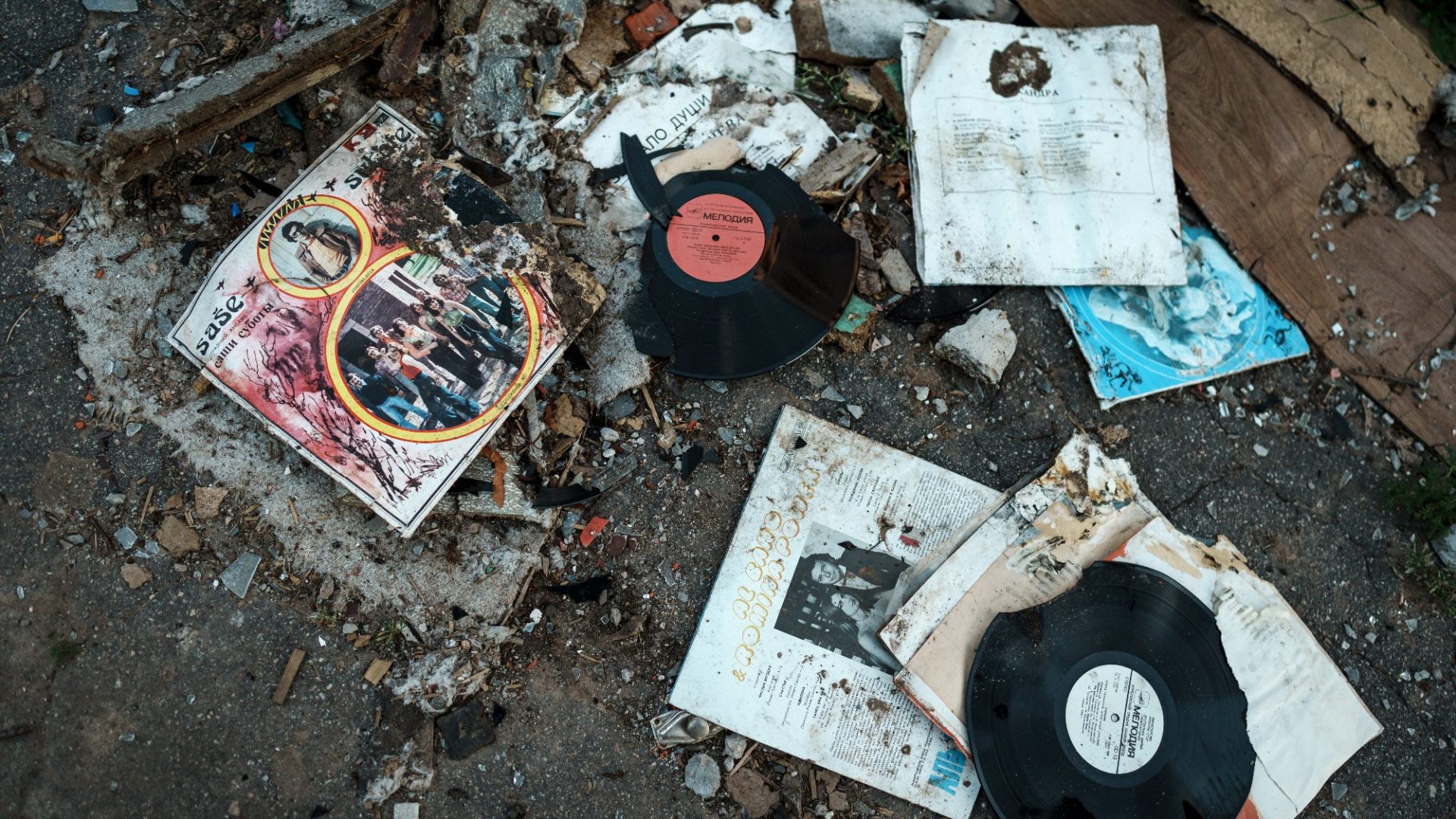
Amid all this carnage, footage of Solianyk searching through the battered remains of his record collection caught the eye of the Ukrainian media. For a week, he became a minor celebrity; a symbol of the dismaying intimacy of a grief that is so often obscured in the larger-scale reporting of war. Statistics become grimly forgettable. But we do not forget the image of an elderly man as he stands forlorn in front of a local news crew and sifts through the debris of a lifetime.
Three weeks earlier, on February 25, a friend who had emigrated to the safety of Spain sent a message back to Kyiv to ask what Hyhrorri Ivantsiv planned to do in the event of a full-scale invasion. Ivantsiv replied that he would be at his record shop, cleaning his records. At 4.30 the next morning, the shelling began.
Within days of the first bombs, he says, “there was anti-tank stuff on the streets everywhere, posts with heavily armoured soldiers, a total curfew. You could only leave for the nearest grocery store. It was like The Walking Dead stuff.”
For more than a month, Ivantsiv was separated not only from his physical passion but from his livelihood, the record store, and the community of like-minded people who congregated there. The first few days after he returned, he says, were the greatest days of his life.
There is a special cruelty here. Both Solianyk and Ivantsiv grew up in a Ukraine with only two TV channels and a handful of radio stations, all censored by the Soviet state. The few western records that passed censorship were often heavily doctored, with much of the information on the albums’ sleeves redacted. When Ivantsiv first saw an LP of A Hard Day’s Night, it was not credited to the Beatles, but to “vocal instrumental ensemble”.
The hobby found a new momentum following the fall of the Soviet Union. Soviet-approved pressings and previously obscure genres such as “Moustache Funk” – a hybrid of pop-tinged funk and soul music directed by the Politburo to satiate young citizens’ desire for the contemporary sounds of the west – were coveted by collectors in the UK and US, while the Ukrainian vinyl market sought to fill its boots with the mass-produced Eurodisco, heavy metal and pop music that had taken on an almost mythical quality while unavailable behind the Iron Curtain.
Given this context, people will go to great lengths in order to save their collections. For those who cannot do so, the ferocity with which they mourn is no surprise.
Andriy Pelyukh began collecting music at 18 years old. It was the physical ritual that first attracted him; the process of cleaning the record and moving the needle, of keeping still around the turntable so the music wouldn’t falter or skip. Over the next 20 years, he would amass a collection of more than 7,000 records, 2,000 cassettes and 500 spools of reel-to-reel tape. After Pelyukh and his family left Luhansk in 2014, the collection was left to gather dust in an empty apartment.
He returned five years later to finalise the sale of the family home, and found that large swathes of the region had been taken by Russian forces. His head told him to get the hell out of there, but his heart had other ideas.
Pelyukh took one look at his collection and started to cry. And at that moment, the purpose of his visit was altered. No longer was this a house sale, but a rescue mission. He hired a local driver with an HGV and filled it with more than 2,000kg of records. Together, the pair headed west.
Suggested Reading

Ten years later, David Bowie is still everywhere
Three hours into their journey, they passed Donetsk, birthplace of their fellow vinyl collector Oleksandr Alekseev. Today, Alekseev is 40 years old. As a child, he remembers that his grandfather had a small stock of Soviet pop music consisting of no more than a dozen records. But Alekseev doesn’t remember these records being played – “I can’t recall a single time when any of the adults listened to music,” he says. Instead, they would listen to the news.
Nonetheless, the physical medium lit a fire under the young boy. His own collection began with fairytales and radio plays such as Chukovsky’s Adventures of Aybolit, Tolstoy’s Pinocchio, and Savelyev’s Treasure of Captain Flint, before growing over the decades to become one of the most comprehensive archives of Soviet rock music, comprised of more than 2,000 records.
After living out of his suitcase for several months, he left Donetsk in late August 2014. Just like Pelyukh in nearby Luhansk, Alekseev was forced to abandon the evidence of his own existence; a collection that dates back to the fairytales and radio plays of his youth. But unlike Pelyukh, he has never had the chance to go back. “As far as I know, my house is still standing,” he says.
Pelyukh and his driver, Yevgeny, moved inch by inch at the back of a 5km queue at the makeshift customs checkpoint at Olenivka. They were surrounded by fleeing families who had stuffed their heaving cars with household furniture and kitchen appliances, condensing entire households and heaving them slowly onwards to the unoccupied west. The men sat in the baking sun for seven hours, until at last, they were waved away by Russian guards and told to come back the following morning.
They parked the lorry in the shadow of a large tree in a bid to be less visible, before enduring a sleepless night in the driver’s cab to the incessant pounding of heavy weaponry nearby. “It wasn’t even automatic gunfire,” remembers Pelyukh, “but artillery.”
Upon reaching the checkpoint the next morning, the guards forced them to open the back of the truck. One by one, Pelyukh and his driver unloaded the collection and the soldiers proceeded to search through the records at random. The men were drunk, aggressive, and sunburnt. They held automatic rifles in their hands. If they pulled out the wrong album – particularly any Ukrainian folk songs – it could easily have meant the end of the journey.
Pelyukh waited for two hours at the side of the road, until – after parting ways with a significant cash bribe – he and his records were eventually waved across the border. Once there, he gifted Yevgeny a bottle of cognac and handed the collection of vinyl over to a courier.
The pair have not seen each other since.
Today, Ivantsiv’s business at the record shop continues. The price of rent has increased all across Kyiv, forcing him to relocate the shop into a smaller unit, and much of last year’s income has been reinvested into an electricity generator in anticipation of another winter of blackouts across the main grid.
Whatever he can spare, he donates to the war effort. “It’s not [a] big [amount] for a big business,” he says. “But for me, it’s pretty significant. I can freely say that I did – and I’m doing – what I have to do.”
Solianyk’s story migrated from the Ukrainian media onto the /r/vinyl community on Reddit, leading people from all over the world to donate records and audio equipment to help him restart his collection. He asks that I pass on his gratitude to all of those who have not forgotten Ukraine.
Pelyukh has joined the army, with whom he is currently stationed in Zaporizhzhia, separated from his family and his record collection by more than 1,000km. These days, he mainly listens to music on his phone. But twice a year, for a total of 30 days, he is permitted to return home to Ivano-Frankivsk, where, upon arrival, he is greeted by a pile of brand new, unopened records that he has ordered online while away.
Once upstairs, in his moment of solitude, he chooses a record and handles the needle, keeps still around the turntable so the music doesn’t falter or skip.
RM Clark is a freelance author and writer on sports, culture and lifestyle. His first book, Winner Stays On: England with the FA Cup for a Compass, is released with Pitch Publishing