
Don’t be depressed by the dark days of winter. Don’t let the self-referential maunderings of politicians get you down. Put Trump on ice.
In short, cheer up. Head to that outpost of bella figura in north London, the Estorick Collection of Modern Italian Art, and spend an hour or so in the company of quirky sculptures, bold, spiky, paintings and exotically decorated furniture, all created by the Italian designer Alessandro Mendini. You will emerge smiling.
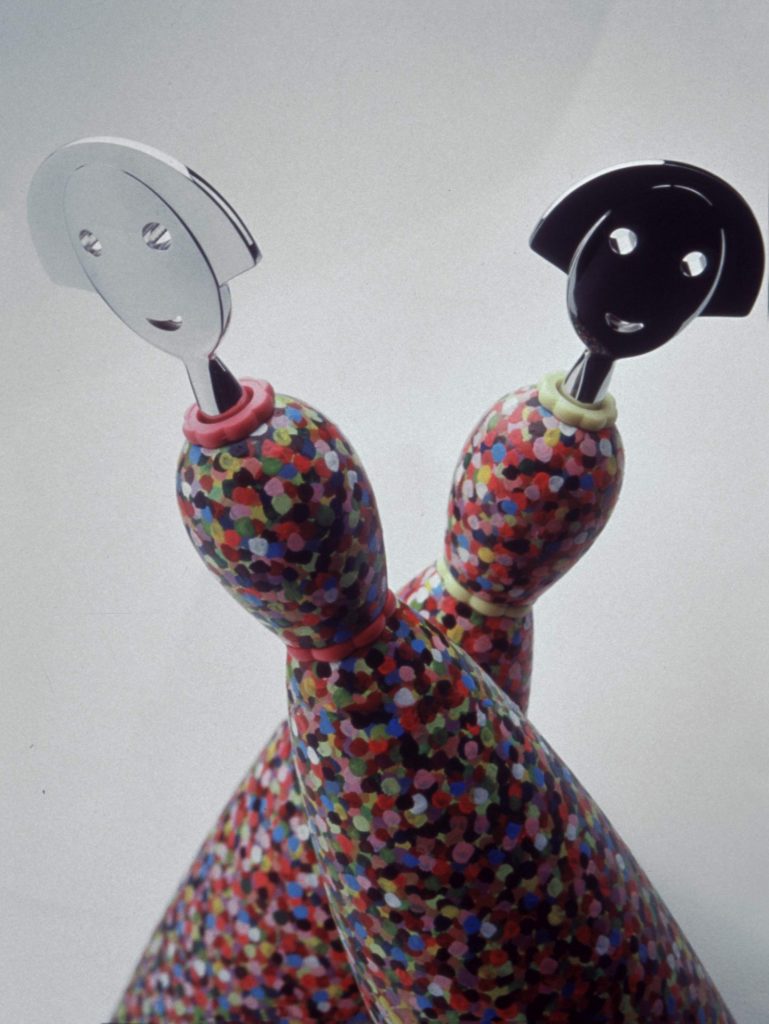
Many will immediately recognise the anthropomorphic corkscrews and bottle openers he conceived with their stylised smiley faces and “arms” ready for cork-drawing duties, which he named Anna G and Alessandro M.
Perhaps they have become something of a cliche, but the apparent frivolity of his creations was born out of a serious intent to radicalise how the everyday could look, summoning the talents of some of the most influential cultural figures of the 20th century for inspiration. Here, Anna and Alessandro are decorated with dabs of colour inspired by the Pointillist painter Paul Signac (1863-1935), proving that objects can be functional but also witty and bright.
Milan-born Mendini (1931-2019) was not just a designer, an artist and a magazine editor, he was a force in Italy’s post-modern movement of the 1970s and 80s. He was also an architect, providing the inspiration for the extraordinary Groninger Museum in the Netherlands, a hotchpotch of asymmetry matched only by Frank Gehry’s Guggenheim Museum in Bilbao, completed three years later in 1997.
The show is divided into four “islands” and highlights the artists who inspired him, such as Kazimir Malevich, an unexpected influence given the inevitable association with the Ukrainian’s minimalist Black Square, which contrasts somewhat with Mendini’s sense of riotous colour. It transpires that the designer was drawn to his earlier, less familiar, figurative works.
In the island labelled Neo-Malevich, the results include a sinister oval face in black Murano glass with white slits for eyes and three “wings” in mottled colours flying out from the head; a steel standard lamp atop a vertical cylinder with a globe at the top half hidden behind a mask with two staring “eyes” which is both austerely functional yet also exotic.
And vases. Comic characters in reds, blues, yellows and black made out of papier maché, glass or ceramic, with almost human faces, narrow eyes and tiny mouths, one with earrings dangling from curvy handles which double as ears.
In another section, Mendini salutes the Futurists, the movement which electrified Italy in the early 20th century, with a tribute to its protagonists such as the poet Filippo Tommaso Marinetti and the artists Gino Severini and Umberto Boccioni. Their likenesses are hard to see.
Marinetti, a moustachioed, fierce-looking fellow, is given improbable green ears, goggle eyes and gaping mouth, while the dashing self-portrait of Boccioni is reconfigured with bulbous cheeks and winsome eyelashes. But Futurism was all about breaking from the past, defying the rules, so no doubt his subjects would have welcomed their theatrical representations.
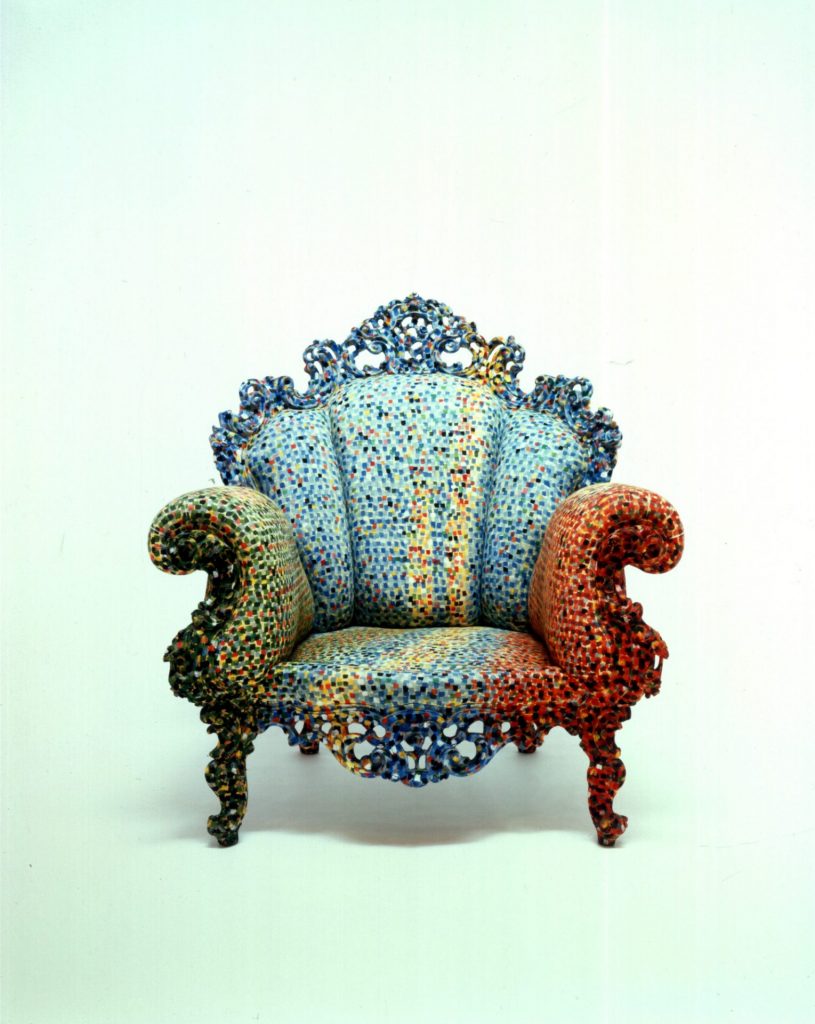
And so to the selection inspired by Marcel Proust. Mendini was fascinated by the writer and his obsession with the past and decided to re-imagine the great writer’s armchair. He took a neo-Baroque piece, projected a slide of a Signac painting on to the surface and added the dots directly on it.
Several smaller versions crouch on shelves and the Pointillist influence is evidenced in other small works, such as a galloping horse, a densely dotted wooden Pinocchio, and a vase in the form of a pert female with ears picked out in blues and reds, and, again, sporting those extravagant earrings.
Mendini had an eye for commercial opportunity as the somewhat garish Swatch watches demonstrate. In fact, he mixed business and art with considerable acumen, collaborating with companies such as Cartier, Hermès, Swarovski, and Louis Vuitton. Anna G and Alessandro M were the biggest sellers for Alessi, the Italian houseware manufacturer.
Suggested Reading


The world’s wildest art gallery
Mendini drew on the revolutionary abstract artist Wassily Kandinsky and his dramatic geometric shapes for an island he preferred to call Kassini, which, as curator Alberto Fiz explains, was to make the work seem more familiar and also, intentionally fake.
A drawing of a fabulously grotesque bug-eyed insect with wings like fluttering banners in a rainbow of colours and what look like kitchen plungers for feet positively leaps off the wall.
He brings Kandinskyesque psychedelic swirls of shapes to a two-seater sofa and redesigns a trio of sideboards into something so rare and wonderful that the original is made well, more original. As he said: “Everything I can think of already exists; what matters is that my way of falsifying it is original.”
The show is like being in a playground of delights. Mendini can have the last word: “By treating objects as if they’re human beings; I make them smile.”
Alessandro Mendini is at the Estorick Collection of Modern Italian Art, London N1, until May 10.